


84 Z Ragtop Help!


Thread Starter
Junior Member
Joined: Apr 2001
Posts: 5
Likes: 0
From: Richmond, Virginia
84 Z Ragtop Help!
Help! I just bought an 84Z that was modified into a convertible by Chevy using a conversion shop. It was titled as a convertible. There is a modification plate on the door jam that states the "International Coach" modified the car and there is a plate on the console that has "ATM Reese" on it. I need a new top and nobldy will touch it...Has anybody heard of these folks;are they still in business?


Joined: Apr 2002
Posts: 1,136
Likes: 1
From: Fayetteville, NC
Car: 84 Z28 Convertible 2 Seater
Engine: Dart Little-M SBC 400
Transmission: Pro-built Automatics 700R4
Axle/Gears: Strange Engineering 3:73
I have the a 84 Z28 Convertible 2 seater, and had to replace the top, all I done was bring it to a Uphosltery Shop and they Custom made it for me. This was when I was station at FT. Bragg, NC. charge me $400.00
There is shops that can custom make the ragtop. Right now im in Augusta Ga. and looking for a Upholstery Shop that can do it without a stiff price or I will bring it back to Ft. Bragg.
David
There is shops that can custom make the ragtop. Right now im in Augusta Ga. and looking for a Upholstery Shop that can do it without a stiff price or I will bring it back to Ft. Bragg.
David


Senior Member
Joined: Oct 2001
Posts: 674
Likes: 2
From: Stevens Point Wisconsin
Car: 1991 Formula
Engine: 350 firebreathing inches of Small Block Chevrolet
Transmission: A 700R4 that has trouble handling the formentioned 350.
DTL504 I would love to see some pic's of the 2 seat Convert. Got any?


Junior Member
Joined: May 2002
Posts: 22
Likes: 0
From: Social Circle, GA
Car: 1991 Trans AM Convertible
Engine: 305
Transmission: manual 5 speed
84 Firebird ragtop
I also have a 84 but is a Firebird ragtop that has International Coach on it. Please if any one has info or knows where to get info I would appreciate it.
Was anyone at the fbodygathering in atlanta this past weekend? If you werent you missed a great show.
Pic of our car attached taken 5/26/02 at the fbody gathering
Was anyone at the fbodygathering in atlanta this past weekend? If you werent you missed a great show.
Pic of our car attached taken 5/26/02 at the fbody gathering
Trending Topics


Junior Member
Joined: Jul 1999
Posts: 6
Likes: 0
From: CENTER MORICHES, N.Y. SUFFOLK

Junior Member
Joined: Apr 2001
Posts: 12
Likes: 0
From: Arlington,Tx

Last edited by Batmobile/SS; May 29, 2002 at 09:10 PM.
Junior Member
Joined: Jul 1999
Posts: 6
Likes: 0
From: CENTER MORICHES, N.Y. SUFFOLK
Junior Member
Joined: May 2002
Posts: 22
Likes: 0
From: Social Circle, GA
Car: 1991 Trans AM Convertible
Engine: 305
Transmission: manual 5 speed
Nice cars!! Ours is a Firebird so is a little different. Still trying to find out about International Coach Conversion. Anybody know about them where they are located are they still in business, ETC? Please let me know ASAP.
Thanks

Thanks
Joined: Apr 2002
Posts: 1,136
Likes: 1
From: Fayetteville, NC
Car: 84 Z28 Convertible 2 Seater
Engine: Dart Little-M SBC 400
Transmission: Pro-built Automatics 700R4
Axle/Gears: Strange Engineering 3:73
This is all the information that I have on Conversion Camaro.
Camaro Convertible Conversions
Half a dozen ragtops made their appearance on the third-generation Camaro base, the most recent and recognized being the dealer RPO version from ASC Inc. (Automotive Specialty Company). Customizers were taking the roofs off these cars, though, as early as March 1982.
The first announcement of a commercial Camaro convertible that I ran across came from Autodyne Corporation of Lincoln Park, Michigan that month. Autodyne offered complete cars or would sell conversion kits to qualified builders. The kits included all necessary floorpan and bulkhead reinforcements to compensate for lost structure in the roof. Most commercial conversions a used handraised top mechanisms and had some sort of fiberglass or metal decklid for access to the trunk.
Coach Builders Limited in High Springs, Florida came next, and their $6,000 conversion included a padded roof with color-coordinated headliner that disappeared under a fiberglass boot. American Custom Coachworks of Beverly Hills began converting Camaros in Sept. 1982 and sold complete cars in the $20,000 price range. Other converters who began advertising around that same time included John Greenwood of Longwood, Fla., best known for his Corvette conversions, and Hi-Line Kustoms, Inc., in Valley City, ND.
An excellent convertible conversion was engineered in 1983 by Duquet-Sawdy Inc., the specialty carbuilder in Warren, Mi. Duquet-Sawdy offered a choice of 10 coordinated top colors, flush-fitting latches, and three-piece heat-sealed rear isenglass. Their idea was to license various converters around the country and then drop-ship the reinforcement hardware and other components to them. Duquet-Sawdy did, in fact, sign up a number of subcontractors and distributors.
In 1984, Auto Form Corp. of Elkhart, In., made a Camaro conversion available as a 2-place ragtop, the rear seats being covered by a large, rear-hinged fiberglass decklid that hid not only the folded top but the entire rear-seat area. Auto-Form Corp. (P.O. Box 2118, Elkhart, IN 46515)
Richard Straman, the Costa Mesa, Ca., coachbuilder, joined the fray in late 1982 and, according to Motor Trend, hoped to interest General Motors in some sort of roofless joint venture for the 1984 model year. Straman’s experience in converting all sorts of cars ranges from Honda CRX’s to Bimmers and Rollses.
It fell to ASC Inc., however, to convince Chevrolet that the division needed a Camaro convertible to compete on a nationwide scale with the Mustang softtop. (Mustang conversions are done by Cars & Concepts.) Before that agreement took effect, though, ASC’s earlier efforts involved signing up individual Chevy dealers and doing conversions to order. In July, 1986, ASC’s price, including return freight, was $4,390 per car on a custom-order basis. Any series of Camaro could be converted, including the Berlinetta and base Sport Coupe, but most 1986 ASC conversions were Z’s and IROC-Z’s.
Then for 1987, Chevrolet decided to make the ASC convertible available through all dealers as a regular production option. The Chevy/ASC conversion retained full rear seating, had a metal top boot and metal decklid, and the non-powered top itself came in either black Cambria cloth of tan vinyl. RPO prices for the 1987 Camaro convertible began at $4,350 above the cost of the car.
Regarding the 1987 convertible, ASC Inc., originally developed this body conversion for the aftermarket as a limited-edition project. It subsequently became a Chevrolet-approved program and, as such, required minor retooling. Tooling changes were mostly to let ASC product the convertible in higher volumes because, according to an ASC spokesman, the program went from a projected 500-1,000 cars per year under the aftermarket plan to more like 10 times that with Chevy’s blessing.
As for modifying the Camaro coupe to become a convertible, there were about 1,000 parts unique to the ragtop. For example, the loss of the steel roof meant structural gussets and braces had to be added to the inner floorpan, the inner rear quarters, and the outer rockers. The engineers likewise added inner floorpan/rocker reinforcements that tied into both the A- and B-pillars.
The ASC Camaro convertible’s top mechanism took its concept from the Corvette roadster. Like the Corvette, you opened the spring-cantilevered rear deck, which hinged from the rear. Once up, you then lifted the top stack out of its well behind the rear seats. You raised the top manually, latched it to the windshield header, raised the rear of the roof, lowered the deck, then pushed the single anchor pin at the trailing edge of the top down into a lock in the deck, and that did it. Very slick and simple.
The convertible top mechanism didn’t interfere with rear-seat or fuel-tank capacity. A fiberglass or SMC (sheet-molded compound) extension wrapped around the outer rear compartment, running along the tops of both rear fenders and into the decklid spoiler, to make a styling transition between the top boot and the metal decklid. Beneath this lid, by the way, stood a usable, fair-sized trunk.
The ASC convertible entered the order books as RPO Z08, available starting in Jan. 1987. It was optional in any Camaro series. Chevrolet stressed that the convertible marked a commemorative 20th Anniversary Camaro as well as a divisional 75th anniversary body style.
Camaro Convertible Conversions
Half a dozen ragtops made their appearance on the third-generation Camaro base, the most recent and recognized being the dealer RPO version from ASC Inc. (Automotive Specialty Company). Customizers were taking the roofs off these cars, though, as early as March 1982.
The first announcement of a commercial Camaro convertible that I ran across came from Autodyne Corporation of Lincoln Park, Michigan that month. Autodyne offered complete cars or would sell conversion kits to qualified builders. The kits included all necessary floorpan and bulkhead reinforcements to compensate for lost structure in the roof. Most commercial conversions a used handraised top mechanisms and had some sort of fiberglass or metal decklid for access to the trunk.
Coach Builders Limited in High Springs, Florida came next, and their $6,000 conversion included a padded roof with color-coordinated headliner that disappeared under a fiberglass boot. American Custom Coachworks of Beverly Hills began converting Camaros in Sept. 1982 and sold complete cars in the $20,000 price range. Other converters who began advertising around that same time included John Greenwood of Longwood, Fla., best known for his Corvette conversions, and Hi-Line Kustoms, Inc., in Valley City, ND.
An excellent convertible conversion was engineered in 1983 by Duquet-Sawdy Inc., the specialty carbuilder in Warren, Mi. Duquet-Sawdy offered a choice of 10 coordinated top colors, flush-fitting latches, and three-piece heat-sealed rear isenglass. Their idea was to license various converters around the country and then drop-ship the reinforcement hardware and other components to them. Duquet-Sawdy did, in fact, sign up a number of subcontractors and distributors.
In 1984, Auto Form Corp. of Elkhart, In., made a Camaro conversion available as a 2-place ragtop, the rear seats being covered by a large, rear-hinged fiberglass decklid that hid not only the folded top but the entire rear-seat area. Auto-Form Corp. (P.O. Box 2118, Elkhart, IN 46515)
Richard Straman, the Costa Mesa, Ca., coachbuilder, joined the fray in late 1982 and, according to Motor Trend, hoped to interest General Motors in some sort of roofless joint venture for the 1984 model year. Straman’s experience in converting all sorts of cars ranges from Honda CRX’s to Bimmers and Rollses.
It fell to ASC Inc., however, to convince Chevrolet that the division needed a Camaro convertible to compete on a nationwide scale with the Mustang softtop. (Mustang conversions are done by Cars & Concepts.) Before that agreement took effect, though, ASC’s earlier efforts involved signing up individual Chevy dealers and doing conversions to order. In July, 1986, ASC’s price, including return freight, was $4,390 per car on a custom-order basis. Any series of Camaro could be converted, including the Berlinetta and base Sport Coupe, but most 1986 ASC conversions were Z’s and IROC-Z’s.
Then for 1987, Chevrolet decided to make the ASC convertible available through all dealers as a regular production option. The Chevy/ASC conversion retained full rear seating, had a metal top boot and metal decklid, and the non-powered top itself came in either black Cambria cloth of tan vinyl. RPO prices for the 1987 Camaro convertible began at $4,350 above the cost of the car.
Regarding the 1987 convertible, ASC Inc., originally developed this body conversion for the aftermarket as a limited-edition project. It subsequently became a Chevrolet-approved program and, as such, required minor retooling. Tooling changes were mostly to let ASC product the convertible in higher volumes because, according to an ASC spokesman, the program went from a projected 500-1,000 cars per year under the aftermarket plan to more like 10 times that with Chevy’s blessing.
As for modifying the Camaro coupe to become a convertible, there were about 1,000 parts unique to the ragtop. For example, the loss of the steel roof meant structural gussets and braces had to be added to the inner floorpan, the inner rear quarters, and the outer rockers. The engineers likewise added inner floorpan/rocker reinforcements that tied into both the A- and B-pillars.
The ASC Camaro convertible’s top mechanism took its concept from the Corvette roadster. Like the Corvette, you opened the spring-cantilevered rear deck, which hinged from the rear. Once up, you then lifted the top stack out of its well behind the rear seats. You raised the top manually, latched it to the windshield header, raised the rear of the roof, lowered the deck, then pushed the single anchor pin at the trailing edge of the top down into a lock in the deck, and that did it. Very slick and simple.
The convertible top mechanism didn’t interfere with rear-seat or fuel-tank capacity. A fiberglass or SMC (sheet-molded compound) extension wrapped around the outer rear compartment, running along the tops of both rear fenders and into the decklid spoiler, to make a styling transition between the top boot and the metal decklid. Beneath this lid, by the way, stood a usable, fair-sized trunk.
The ASC convertible entered the order books as RPO Z08, available starting in Jan. 1987. It was optional in any Camaro series. Chevrolet stressed that the convertible marked a commemorative 20th Anniversary Camaro as well as a divisional 75th anniversary body style.

Junior Member
Joined: Apr 2007
Posts: 25
Likes: 0
From: Lansing, MI
Car: 1984 Pontiac Firebird Convertible
Engine: 2.8L v6 2bbl
Transmission: auto
Re: 84 Z Ragtop Help!
 bump..
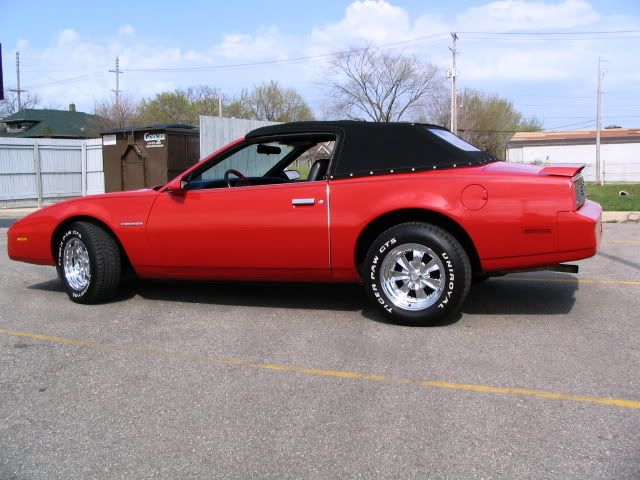
It's been awhile anyone have, seen, or know anything about International Coach Convertible Conversions done on cars such as an 84 Firebird? Thanks!

Last edited by liv2ryde; Jul 2, 2007 at 01:44 PM.

Thread
Thread Starter
Forum
Replies
Last Post
LT1FUN
Canadian Region
8
Apr 30, 2005 10:12 AM
Jims83TA
History / Originality
12
Nov 12, 2001 09:08 PM
