When you click on links to various merchants on this site and make a purchase, this can result in this site earning a commission. Affiliate programs and affiliations include, but are not limited to, the eBay Partner Network.
LTX and LSXPutting LT1s, LS1s, and their variants into Third Gens is becoming more popular. This board is for those who are doing and have done the swaps so they can discuss all of their technical aspects including repairs, swap info, and performance upgrades.
The starting point: 1982 Camaro Z28 with an L98 and T10. The "original" swap to the L98 was done in the late 1980s, and it has been a dedicated autocross car pretty much the whole time since then. A fresh machined L98 long block was installed in 1998, and that is what my friends and I took out yesterday. Yup, took out
When I bought the car in 2008, it had some dinosaur Accel engine management, and I had a Megasquirt built and installed/tuned in 2011 by Peter Florance at PFTuning.
Through my job (Matco distributor), a machine shop I service had an all-aluminum 5.3 long block (243 heads) just laying around doing nothing. They've been doing some massaging and tweaking, and that motor will eventually go in the car. I told them a year-and-a-half ago to "take your time." Don't ever tell a machine shop that.
Here are some things out-of-the-ordinary with this swap:
-- Keep the T10 transmission. It's just an autocross car, so although it is tagged for the street (Maryland historics), it rarely ever sees street time. Autocrossing rarely gets past 2nd gear. Plus if I did a T56 swap, I'd be tempted to take it to Summit Point and wrap it around a tree.
-- A new Megasquirt. Selling the old Megasquirt as a package deal with the old engine. My friend Kirk built a Megasquirt for his 240Z, and he said he'd help me build a new one for my car. What Kirk doesn't know is that I suck at electronics stuff so "help me build" means he will do most of the work. Sorry, buddy!
-- Stock K-member. Thinking of running one of two autocross classes, and one of them is C-Prepared, and it requires retaining the stock K-member. The other class, CAM, can run an aftermarket K-member, but I'd rather keep the stocker to have the option to switch between the two classes.
A few things I have questions about:
1) I'm not going for some insane high HP car. The machine shops estimates it will approach 500hp to the crank. What size intake and throttle body to use? Autocrossing = more low/mid torque.
2) Headers. It has (had) Hedman shorty headers that went into a Y-pipe then into a single muffler that dumped under the passenger seat. Weight savings for not running pipe to the back of the car.
3) Um ... something else? I can't think of anything right now, but this is the reason to start this thread so I can post questions.
Pat
Last edited by slow305; Oct 24, 2017 at 02:21 PM.
Reason: Head castings
Judging by the valley cover, I think you have a Gen IV engine with DOD displacement on demand. I had a 5.3 Gen IV with VVT and DOD. I bought kits and a new cam to delete those functions. What are your plans? I used hedman long tube headers, and had an exhaust shop make a custom y pipe to muffler connection. I don't have a catalytic converter. I exit the garage quickly when I park...
Yeah it's probably Gen IV. It has a 58x crank trigger. I'll have to ask my machine shop guy if it has the DOD stuff anymore (guessing it doesn't).
Exhaust will probably be what I had on it before -- Headers into a single muffler basically under the passenger seat area and dump out there. Historic tags, so I don't need a cat, but they do sound readings at many autocrosses so definitely need a muffler. The old setup with the L98 and Flowmaster muffler, I don't think it ever registered 90db. It was LOUD inside the car, though.
That is a pretty big difference between intake and exhaust at .400 and .500, are you sure you wouldn't be better off with a cam that has a bigger exhaust split?
As far as I know, DOD delete kits include a smooth valley cover. I went down that road as I didn't do enough research before I bought my engine. It wasn't a big mistake. I just had to pay a little more to remove the vvt/dod.
The engine will run with that cover but it won't be good for it. Oil pressure is going to be lower than normal and the engine will wear out very early.
After finally getting my LS-whatever in September from the machine shop, I had almost zero parts for the swap, but since then, I've been acquiring stuff bit by bit. I've seen people saying that they got "everything" together only to find out they still needed all the nickel-and-dime stuff. Well, I'm getting all the nickel-and-dime stuff before all the big stuff.
I got Speed Engineering headers and UMI motor mount brackets. Fuel pump and fuel rails. Mounted pimpy ICT brackets (Christmas present!) with dirty truck coil packs from Crazy Rays (I mean LKQ) -- even though I'll probably end up getting new ones, it's at least something for mockup. Polyurethane motor mount inserts into stock LS1 clamshells are on the motor. I swapped out the truck oil pan with a 4th gen FBody pan (and windage tray and pickup tube), and also swapped out the valley cover with a smooth DOD-delete cover.
I bought a stock 4th gen LS1 throttle body and sent it out to get ported. That with the LS6 intake seems like a good "budget" setup from what I've been reading.
I also sent out the stock front spindles to get machined for "LS1 brakes." Kind of a misnomer since 98-02 V6 cars had the same brakes, which is why my wife was able to score a set from a neglected V6 Firebird at Crazy Ray's about 10 years ago (she has a '96 Z28 ILE that really doesn't have much 1LE stuff anymore). But LS1 calipers will be a nice upgrade over the single-piston stockers. I was always amazed car swapping during autocross fun runs with a friend's 2005 Mustang with OEM dual-piston calipers and nearly going through the windshield when hitting the brakes. And then getting comments like, "It handles great, but the brakes suck!" from people driving my car.
As I mentioned, my car has a T10 transmission, and I'm leaning toward keeping it. It's about 40lbs lighter than a T56, and my car won't be a street/cruiser much, so the extra weight savings is better than two gears?
But my car is a bastard '82 with the mechanical/Z-bar clutch linkage, and I've been mulling over changing to a hydraulic setup. If I kept the mechanical setup, I need to get a mounting plate for the Z-bar since there isn't a spot for it on LS blocks, and it looks like the headers on the drivers side would interfere even if there was. But a hydraulic setup -- from what I've read here -- feels a whole lot better. And I'd probably need to do it if I ever did get a T56. Deci$ions, deci$ions.
You're never done buying parts. Trust me. Its gets painful at times, so get ready for the pain. However, you are off to a good start. A few cents fwiw.
Go T56, the weight is in the center of the car and is negligible. T10 wont last (dont even think you can adapt to make it work).
What is your PCV plan now that you have the valley cover blocked off? You going to run an external PCV to a catch can? Hint hint.
Hydraulic clutch is the way to go, plenty of options and is the only way to go with T56.
Go T56, the weight is in the center of the car and is negligible. T10 wont last (dont even think you can adapt to make it work).
That's something I keep going back to. The T10 will work initially and is lighter but will done blow up at some point. And even though I want a "competitive" autocross car and the weight savings is a plus, I probably won't do anything more than local events and won't do national SCCA stuff unless it's around Maryland (went to the Solo Nationals from 1998-2011, once since then, and probably won't go again).
Originally Posted by ShiftyCapone
What is your PCV plan now that you have the valley cover blocked off? You going to run an external PCV to a catch can? Hint hint.
Don't know yet. Something down the road after figuring out injectors and fuel management and this, that and the other thing.
Don't take too long and get your engine buttoned up before you figure out your PCV. You'll have to go back to the stock valley pan (built in PCV) which can be a pain if the top end is already in place.
Can a T10 be adapted to an LS?
[Edit] the 58x truck valley covers might not have the pcv in them. Might be in the valve covers. You should be ok.
Last edited by ShiftyCapone; Jan 29, 2020 at 07:27 PM.
I took my A-arms off the crossmember a couple weeks ago because I figured it would be easier to access the bolts for the UMI motor mounts and lo and behold after 30 years as an autocross car, the holes on the crossmember had become ovaled. Still on a "budget" (instead of getting a tubular K-member) I opted to have the holes welded so they are back to round.
Anyway, how do people mount the hardened brake line that goes from the master cylinder to the front passenger side? My '82 has brackets screwed into the crossmember to hold the brake line, but two of the holes will be covered up by the UMI mounts. Drill into the mounts for the screws? Zip ties?
Cliff notes: Mated the T10 transmission with a BBC bellhousing to the 5.3 block, put in through the top. But I had the crossmember loose and basically dropped the engine through the engine bay and bolted the crossmember to the engine. Used jacks to finagle the engine to the motor mounts (actually with the transmission mounted, it was good for another leverage point).
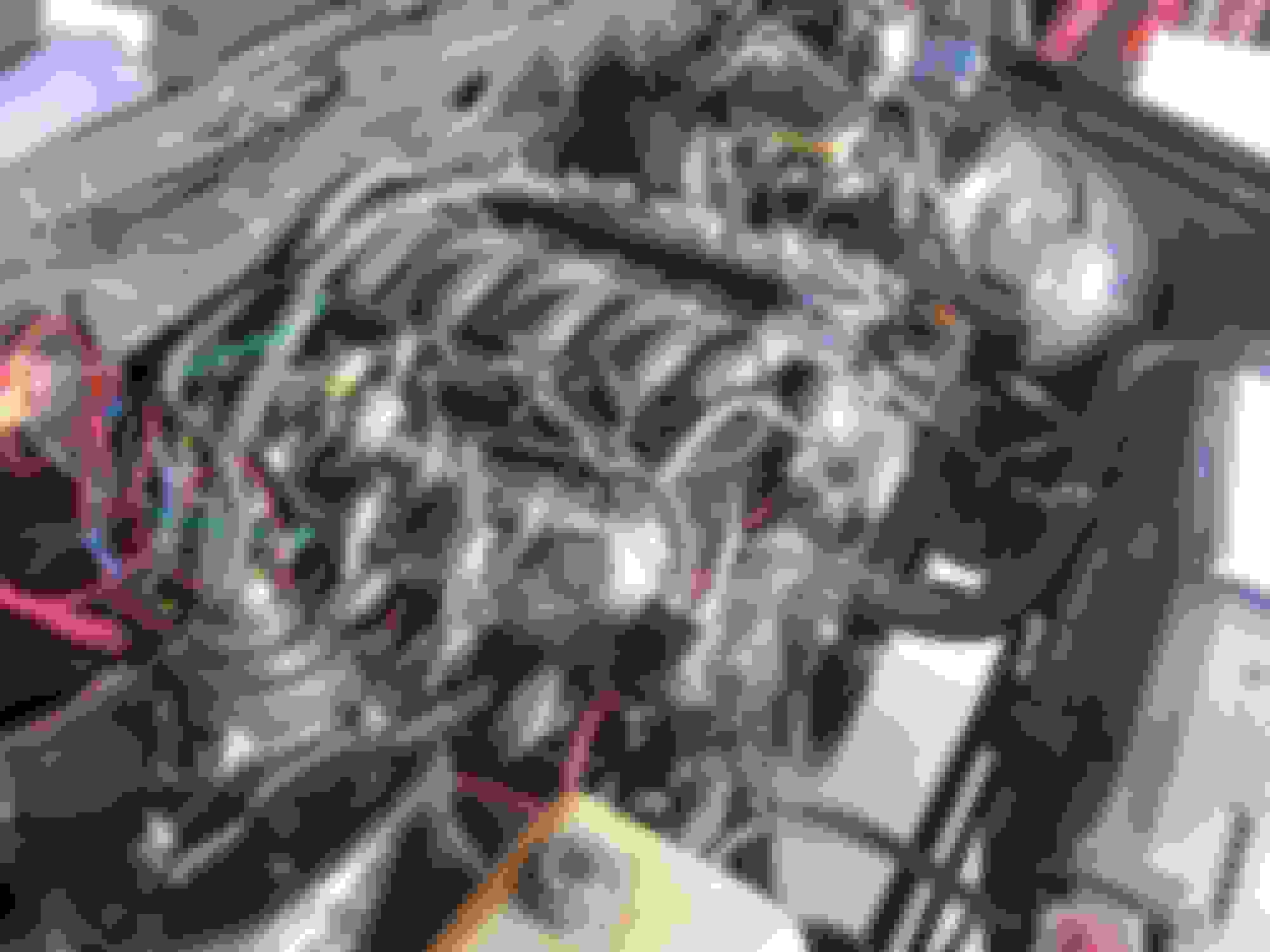
After everything was bolted down, I put the Speed Engineering headers in. They went in with much cuss words and finagling. On the passenger side, I raised the engine (all motor mount bolts loose), removed the coil pack and valve covers, and it somehow went in.
On the driver's side header, I removed the brake lines from the master cylinder, removed the steering shaft, and the header went in with slightly less drama.
Cliff notes: Mated the T10 transmission with a BBC bellhousing to the 5.3 block, put in through the top. But I had the crossmember loose and basically dropped the engine through the engine bay and bolted the crossmember to the engine. Used jacks to finagle the engine to the motor mounts (actually with the transmission mounted, it was good for another leverage point).
After everything was bolted down, I put the Speed Engineering headers in. They went in with much cuss words and finagling. On the passenger side, I raised the engine (all motor mount bolts loose), removed the coil pack and valve covers, and it somehow went in.
On the driver's side header, I removed the brake lines from the master cylinder, removed the steering shaft, and the header went in with slightly less drama.
Pat
Besides the struggles putting them in, how is the build quality/fitment of those Speed Engineering headers?
I'm thinking about buying them for my LS swap into an '86 Camaro that I'm about to do..and they are way more affordable than any others I've seen
Besides the struggles putting them in, how is the build quality/fitment of those Speed Engineering headers?
I'm thinking about buying them for my LS swap into an '86 Camaro that I'm about to do..and they are way more affordable than any others I've seen
They look pretty good, IMO. Very tight on the passenger side frame (might have to dent the furthest tube ... we'll see how it goes when it actually starts). I have UMI adjustable motor mounts set as far forward as possible with Energy Suspension inserts on LS1 clamshells attached to the block.
I thought I'd take the easy way and cut a trap door to access the fuel pump assembly. But my basterized Camaro had the wiring running over the back of the fuel tank, not the front, like 99.9% of the Youtube videos I watched before trying this.
This was three wires -- two went into a hard wire:
And the third was some kind of ... ground? ... welded/soldered to the top of the fuel pump assembly.
So two wires coming off the fuel pump assembly, this third wire that goes directly to the fuse box.
And my new fuel pump assembly has three connections with no "ground" to the top of the fuel pump assembly:
So what kind of "harness" or three-prong connector am I looking for? Something custom? I've googled this for a couple weeks and can't find anything conclusive.
Punted on building my own 58x Megasquirt and sent the computer and DIY harness back for their PnP setup ($1899). Basic harness was easy to install since I was getting rid of the heater box. That left with basic wiring stuff that, well, I suck at basic wiring stuff. A couple buddies showed up yesterday and snipped and stripped and this is where I'm at.
The four-post on the firewall, actually got the idea from someone on Youtube installing an LS in an old GM Chevelle or Nova. Looks much cleaner than all those wires going directly to the battery.
Currently, these connectors should be referred to as: "Aptiv Weather-Pack".
(Aptiv purchased Delphi from GM).
These are old technology now... so they are not popular anymore.
But they are available in tons of places... From pigtails to individual parts and pieces (body, seals, terminals).
Summit Racing to Waytek.
It wasn't just the connector -- it was figuring out which pins did what. I sliced the connectors doing the trap door, and the connections on the new fuel pump assembly have different colored wires than what was on the old assembly. One is power to the pump, one is fuel level and one is a ground, but which one was which? Figured the Google easy button would tell me or posting here, but ... NOPE! Finally last week found something on the Racetronix website:
Ran into the Covid in October, then it just got too cold to get motivated to work in the garage, then ran into an issue getting the MS3 Evo to even connect to the tuner software on the laptop. Sent it back, they said there was nothing wrong with it and sent it back to me. Hooked it up, still had same issue. Worked with Peter Florance at PF Tuning (he built the Megasquirt system for the L98 that was in the car), and he suggested to just start from scratch, and wa-la, it worked!
This is just with the canned tune that comes with the MS3, no O2 sensors or IAT hooked up. Just wanted to hear it run! Even had to jump start it because my "new" battery I got in July or something had lost its charge.
It's running and driving now, got it dyno tuned yesterday. Peter Florance of PF Tuning did the tweaking at Abacus Racing (Dynojet) in Virginia Beach. He built the Megasquirt (MS2) on the ol' L98 that came out of the car. He's pretty well known in the Mid-Atlantic for tuning autocross and roadrace cars, especially with Megasquirt. Several BMWs and Miatas, a few "oddball" cars like a roadrace Triumph TR8 (little Buick V8), turbo 2.5 Duratec RX-8, LS3 "stock car" that turns both right and left.
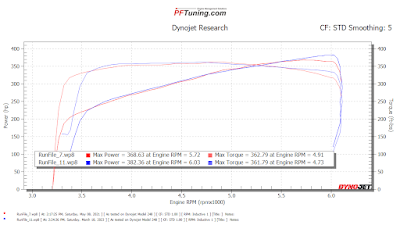
Anyway, I came down a few couple weeks ago and aborted tuning because I thought I had an injector issue. Turned out to be a nothingberder, and I towed down again to try again yesterday. I've been nervous more about the T10 or the 10-bolt not being able to hold up, more so than the "fresh" 5.3 (aluminum block, 58x). Other than a coolant hose coming off, and the throttle cable managing to work itself loose, no issues at all yesterday. First pull was 300/300 and it went better from there. Eventually got to 368/362 (corrected to 360/353).
For fun, check out the dyno comparison to the old L98 on the same dyno with Peter tuning both engines:
Legit 110+ horsepower ... but only 10 more foot-pounds of torque. I took it for a spin around the 'hood this morning, and it is a rev-happy beast!
Probably going to do my first autocross in almost four years in two weeks.
It may "only be" 10lb ft more but it covers the full RPM range. The power under the curve of your new mill murders the curve of the L98. Not even close.
It may "only be" 10lb ft more but it covers the full RPM range. The power under the curve of your new mill murders the curve of the L98. Not even close.
Oh yeah, I know. Kind of an inside joke with my tuner. "What, all I got was 10 more foot-lbs???!!!" For an autocross car that will spend most of its performance life between 2500-5000 rpm in second gear, this is awesome.
My goal of this was an LS swap on the cheap (yeah right) with minimal upgrade$. Keep it somewhat simple, getting it running and driving right and then tweak it along the line. Here are the main modifications from the old L98:
58x aluminum block 5.3 with 243 heads, tweaked and massaged by a local machine shop, custom cam (where most of my budget went)
Speed Engineering long tubes
LS6 intake with ported LS1 throttle body
Bosch 36-lb injectors
MS3 Pro with DIYAutotune harness, tuned by PF Tuning
C5 Corvette filter/regulator
Delphi 150lph fuel pump
4th-gen F-body power steering
4th-gen F-body water pump
Junkyard coil packs
FAST spark plug wires (need heat-protection boots with the headers)
AC Delco 41-962 spark plugs
Ebay knockoff LS1 F-Body oil pan
LSX mini starter (JM7002BK)
Odyssey PC680 battery (doesn’t have to power anything other than the starter and ECU – no HVAC, no radio)
UMI motor mount brackets, LS clam shells, Energy Suspension poly mounts
Ram clutch and flywheel
Bigbrakeupgrade.com LS1 front conversion (real bearings not hubs)
Upgraded S10/Astro steering shaft
Left over from the old setup:
T10 transmission (but with new American Powertrain Hydramax hydraulic setup replacing the Z-bar)
Later 3rd gen 10-bolt disk rear with an Eaton differential
Weight jackers (850/150 springs)
34/21 sway bars
Watts Link
Stock front K-member and LCAs (new poly bushings)
Camber plates of some vintage
Single-adjustable Konis
17X11 CCWs with Hoosier A7s
Stock radiator with single fan
Bought a bunch of parts from that website named after the South American river (great return policy when you have no idea what you’re doing and buy stuff only to realize you need something else), some other upgrades (headers, fuel pump, steering shaft) plus whatever found on the Youtube/Google rabbit hole.
So basically it’s the same suspension as the old E-Street Prepared setup, but it’s much lighter (carpet, rear seats, rear panels plus some other things removed, not to mention the weight difference between the all-aluminum 5.3 and cast-iron L98 block) and has better (lighter) brakes.
My take from this is that there is no “right” way to do an LS swap in these cars. My autocross car may not be the best for your street cruiser or Friday Night Drag Race King. But there’s a lot of information out there to figure out what’s best for your car.
So with my car, it ran into issue after issue. Throwout bearing went out … TWICE. Fuel pump died a slow death. Then a snowball effect early last year of broken rocker arm stud (No. 1 cylinder), to a broken valve spring (No. 6) and then finally removing the driver’s side head to replace a squishy lifter on No. 1 discovering the No. 7 cylinder wall is badly scored.
Since this was a 5.3 that had been bored out, I needed a new block. At the time, I worked at a place that sold rebuilt engines and transmissions (mainly just OEM replacement, very little performance), and we just happened to have an aluminum 5.3/58X core. Plan went into action to machine that, and just replace the piston from the bad cylinder. Except pistons were on back order. This was May of last year, and the piston didn’t get in until October.
Oh by the way, during this May-October timeframe, I quit. But I had known the company owner for 15+ years, so he wasn’t going to hose me over.
When the new piston came in, it came with instructions to measure the ring gap. Rather than doing that and just putting in the new piston, they decided to check the ring gap on all the other pistons. I got a text, “We found Pat’s failure. Evidently his previous builder installed the rings without setting the end gap. All were .001-.003. Required is .020-.023.”
I guess I’m just “lucky” only one piston was bad.
Got the engine back, installed in November, did a few things here and there (namely installing a Tick master cylinder), holidays, etc. It started up with no problems, but it was running rich – all the spark plugs were black. So it needed a new tune.
I wanted to take it to Peter Florance of PF Tuning since he did the original tune (MS3 Pro) from two years ago, and he built the Megasquirt that was on the ol' L98 setup. He said ideally he wants to tune if the temperature is 55 degrees or higher, and wouldn't you know it, southern Virginia was mid- to lower-40s for about eight straight weekends -- it wasn't until this weekend where Mother Nature finally cooperated. Who knew she could be a bitch even away from an autocross site!
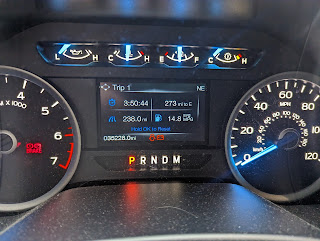
The tow down was thankfully drama free. This was really my first time towing with my new (now in possession for one year) 2017 Ford F-150. Rolling coal on 87 octane and getting almost 15 MPG in sometimes crappy I-95/I-64 traffic.
I unloaded the car, we strapped it on the dyno, I swapped in new spark plugs with Peter's diligent supervision, and we went to work.
Well, mainly I watched as Peter went to work. He did a few easy runs under load around 2,500 RPM on the dyno to break things in.
The car had issues with exhaust smoke and what appeared to be oil burning off the headers. I attributed it to smoke on the driver's side from brake fluid bleeding the clutch eleventy times before installing the Tick master cylinder. The passenger side was from oil leaking from the valve cover. The bolts weren't snug, but even after re-tightening, some oil still seeped out. I didn't address that leak since it wasn't that bad, but when I got back home, it seemed like the gasket wasn't entirely set in the groove of the valve cover.
Anyway, the exhaust smoke, we presumed, was from first engine's residual oil lingering in the exhaust. I first started chasing issues early last year when it smoked badly and a small pool of oil formed under the exhaust exit. After repeated runs on the dyno, it was virtually smoke free.
After break-in, Peter did four or five dyno pulls. With tweaking, the best run was 382 horsepower and 361 foot-pounds of torque. The old setup was 368/362. Peter attributed the increase to slightly cooler weather than the last time, but, hey, more horsepower is still more horsepower! Figuring 12-percent to 15-percent drivetrain loss with a manual transmission (depending on who you want to believe on the internet), that's 427 to 439 horsies.
Also, the new setup seems to just be running better. Go figure with piston rings properly gapped! It runs smoother, and the O2 readings are virtually identical between both sensors right at startup. With the old 5.3, the O2 readout was inconsistent on the digital gauge -- one side would be bouncing around in the 11s while the other was in the 12s -- and wouldn't have similar readings until the engine temps warmed up. And even then, I was chasing my tail bugging Peter about it running mysteriously rich or lean, and he would send me new tunes to try.
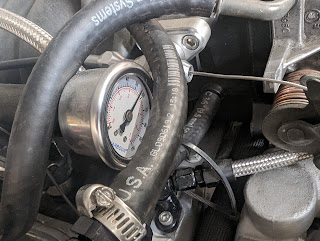
My Cheapo fuel pressure gauge that attaches to an adapter on the fuel rail seems to work fine. Plenty of room!
So things are looking ... good? Hopefully Project Whack-A-Mole doesn't have any major issues ... again.
First "event" on the schedule is a test-and-tune with the Chesapeake PCA at the Bowie Baysox Stadium April 2. It's not a big lot but it's probably the shortest distance I will tow for an autocross -- about 20 miles. If something goes wrong with the car, the drive of shame won't be as brutal!
Finally after six years, completed every run at an autocross, first time since the old L98. Rebuilt 5.3 (again), new trans, fixing a cracked frame, throwout bearing #3, throttle cable No. 2, fuel pump No. 2, etc etc.
Made a short video summary with my fastest autocross run from Saturday:
It drives great, and the flat torque "curve" (see dyno sheet above) is fantastic. The only things now are the little things. Aero (rear spoiler, front splitter) and better $hock$ are on the short list.
I just put a hydramax setup in my 82 like your initial setup, so far so good. What issues did you have w your release bearing?
The guy who installed the second one (after it failed, too) thought maybe there was too much pedal travel, and the throwout bearing over-extended. After the FABbot Aisin AR5 kit was installed, I put a stopper behind the clutch pedal, and since then also installed a Tick adjustable master cylinder. So maybe those "fixes" would have kept the Hydramax throwout bearing from failing?
I'm putting a travel adjuster in because there it definitely too much travel. I only have 30 miles on it but I was worried about over travel because the engagement is super high w the dual disk I have. Once It's fully disengaged and there's still a bunch of travel after that.
Remember my post bragging about the car's reliability? Well a couple weeks ago at an autocross, I noticed the O2 reading from bank 2 was abnormally high. Normally they fluctuate around 12-13 then settle in the 12 range once warmed up, but the bank was reading 14-17. This was as I was idling through the tech line. And it would backfire occasionally. I thought maybe the cooler temperature (mid-50s) was affecting it and didn't think much of it.
Finally got around to getting to grid in the afternoon (would have been earlier but a car hit a tree ... but that's another story), and it was still doing the same thing. I said "F it" and put the car on the trailer and went home.
Trying to diagnose the issue, I swapped coil packs from side to side, fuel injectors, put in new plugs, swapped to an older set of spark plug wires, and still the car ran the same after each change. Thought the wiring for the crank sensor looked a little sketchy, so I spliced in a new pigtail ... and still the same.
The wiring harness (MS3 Pro with a DIYAutotune drop-in harness) has a ground that goes to the front of the passenger-side head, which I ensured was tight 50 times. Then looking through their quick startup guide, remembered there's another ground that goes on the back of the driver-side head. You know, almost zero clearance between it and the firewall so it's easy to forget. That bolt was maybe a half turn loose. Tightened it up, and wa-la, the car runs fine.
I was really mad about not making a run at the autocross because I've basically had zero competition this year in C Prepared, and there was going to be someone in a Mustang who trophied the past couple years at the Solo Nationals. And it was going to be my first autocross with my new spoiler I fabricottled together:
Three piano hinges, a sheet of lexan, cheapo adjustable support rods and about 50 M5 caps screws, nuts and washers.
Also just finished yesterday, installed hood louvers:
Next up is probably my final autocross of the season in a couple weeks. My buddy with a 1981 Camaro setup for CP says he might come out, so maybe I'll finally get a shot at real competition.
Over the winter, I changed the power steering pump to a unit from Turn One. I had an OEM F-body pump before, and it would spew fluid out of the cap, aka cavitation from the fluid boiling over. Something oddly that my old B13 Sentra SE-Rs did, too. The Turn One pump has upgraded internals and is a direct fit for LS1 F bodies (I think they make Corvette pumps, too). I did an autocross last month and made 11 runs with zero issues. Not a drop of power steering fluid coming from the cap.
Also related to steering, I installed a 12:1 steering box from Sweet Manufacturing. Not sure what the old box was and I figured since I was changing the pump might as well change the box, too. I've had the car since 2008 and it has had the same box.
Also scored a set of used UMI camber/caster plates. My car had caster plates of some vintage, but I think the UMI plates allow for more camber, and they have adjustments for caster, too. My wife also got me a camber/caster gauge for Christmas to go along with toe plates I've had for awhile.
Also, I found out last week I got accepted to compete at UMI's King of the Mountain autocross in August. It might be the most premier autocross event outside of the SCCA Solo Nationals. Sam Strano won it last year in our friend John Vitamvas' Mazda Mazda RX-8 (non-rotary turbo 2.5 duratec) and took home $15,000. I'm not going with any delusions of grandeur about winning the whole thing -- hoping to just be somewhat competitive in the "Mid-Model" Class for 1973-1987 cars. The finals are live streamed on Youtube, and even for autocrossing it's fun to watch.
The UMI events require "real" street tires -- 200+ treadwear -- so no Hoosiers. I have 17X11 CCWs, and there is nothing good in 200-treadwear tires in 17" sizes, so I'll have to find new rimz as well as tires. Sam has a set of 18X11 Corvette rimz with 315 Yokohama A502s, so hopefully they fit with the old 2" Skulte spacers.
The car has [knock on wood] been amazingly reliable since the issues with the old short block (pistons weren't gapped correctly, if you're keeping track at home). Even kicking around the idea of taking it to Capitol Raceway for a Friday night test-and-tune.
The "new" engine is running like a top. Knock on wood.
I did have a couple minor issues last year. The first one being that the car started to idle high, and then water temps climbed too high for my liking. It turned out that the ported LS1 F-Body throttle body that I had been using developed a leak where the plate wouldn't seal. Apparently a common problem on ported throttle bodies. So I bought a Fitech 92mm throttle body, and that fixed that issue.
On to the cooling issue. This crept up at the SCCA Pro Solo in June. Pro Solo is basically three sessions over the weekend where you do four runs in each session. Temps were climbing above 220 as my third runs started, and I bailed on the fourth runs in every session. Fan works fine, Champion three-row radiator. Some friends who are much smarter than me suggested I need a fan shroud. My car has some kind of "OEM" 16" fan with no shroud. So I fabricodled one with some plastic sheet then sealed it with thermal tape.
That seemed to fix everything.
Then the rear main seal blew. I had a sealed catch can (as you can see in the pic above), and more of those same friends suggested a vented catch can to relieve pressure.
With all that fixed, the last two autocrosses of the year went flawlessly for the most part.
Last offseason, I tried selling the car and didn't get anyone to commit to, you know, actually buying it. I ****ing hate trying to sell stuff nowadays. Talked to a guy on the phone for almost an hour, said he was going to come look at it that weekend, then he ghosted me. Well, he messaged me a few months later like nothing had happened, and I told him to pound sand.
This offseason with intent on keeping the car, I've already made a couple upgrades. The first one was ditching the exhaust that I had band-aided on there when I first did the swap. The muffler was really low and scraped over everything. And with it dumping under the car, it was LOUD inside. Also was pretty close to breaking maximum sound requirements (most SCCA autocrosses take sound readings and enforce if you go over -- fix the car then or DQ your runs).
As you can see, the exhaust was really, really low. It would even scrape over the little hump in front of my garage.
A local autocrosser has a small shop where he does welding and other minor fab stuff, so I took it to him.
MUCH quieter. Now I can hear EVERY creaking noise and suspension groan! It's three-inch diameter, 409 stainless steel with an 18-inch Cherry Bomb Salute muffler.
His shop is Pipe Dreams Fabrication on Facebook, and he's about 20 miles north of the Baltimore beltway. Funny that he autocrosses a 1996 Tercel that is actually kind of fast. But one of his other projects is a 1982 Malibu with a 1ZZFE -- 4.0L Toyota V8.
I also splurged for new Penske 7500 double-adjustable shocks for the rear. They were actually not too terrible -- about $1,700 for the pair. When "fancy shocks" started becoming a thing 10-15 years ago, it was standard to fork over $5,000 for a set of four.
Near the beginning of last season, I also decided to switch from C Prepared with sticky R-compound Hoosiers to CAMT with a minimum treadwear of 200. I settled on Yokohama A052s after using a used set for the UMI events in 2024. They are really close to Hoosiers but not quite there. I guess about 1-2 seconds on a 45-second autocross course. After autocrossing on nothing but R-compounds for most of the past 25+ years, they definitely took getting used to. Actually they are probably really close to R-compounds from the early 2000s. Like a Hoosier A6 or the "best" Kumho Victoracer from that era.





















 I took it for a spin around the 'hood this morning, and it is a rev-happy beast!