When you click on links to various merchants on this site and make a purchase, this can result in this site earning a commission. Affiliate programs and affiliations include, but are not limited to, the eBay Partner Network.
LTX and LSXPutting LT1s, LS1s, and their variants into Third Gens is becoming more popular. This board is for those who are doing and have done the swaps so they can discuss all of their technical aspects including repairs, swap info, and performance upgrades.
I am utterly worn out trying to figure out what products and crimp tools I should use when building my engine harness. I'd like to start a discussion about this to get some help.
1. What splices are you guys using for 3 x 20 AWG wires? I've been using Amplivar open barrel splices with Delphi Metri-Pack crimpers. Cheap and easy.
2. What splices are you guys using for larger quantities of wires like 4, 5, 6, 7, 8 wires? And what crimp tool? I'm looking at Molex uninsulated parallel splices, and step-down butt connectors. https://www.prowireusa.com/splices.html
From what I've seen, a hexagonal crimp would be excellent for a larger crimp, but I have been told it will split any barrel that has a seam. The recommendation from ProwireUSA is to use a W-shape crimp like Sargent 4235-CT. I think the Molex tool for these splices is 640030100 but it is spendy.
I also found a Rennsteig die 624 1071 3 0 (since I already have those handles). Would this work as well or better than the Sargent?
I don't use splice hardware at all except when it gets to heavy gauge wire. Solder and heat shrink is easy, cheeeeeeeeep (quoting sofa there) and compact which is important in a loom application in addition to staggering them so i don't have a big bundle of splices all in one spot. On heavy gauge I will use a bare butt splice but I will solder and shrink that as well. I don't think this is something that needs to be overthought and I haven't had any issues thus far.
Right now I have so much solder in my existing harness that it probably throws off the weight distribution of my car. Solder is considered a no-no in most circles, but I didn't know any better back then. I'm definitely looking for a mechanical crimp of some kind with this next harness build.
Solder makes the wire strands much more susceptible to breaking near where it was soldered. Also can result in more voltage drop because it's not a tight pack. Mechanical crimp done right will literally make all the wires one, and not strain the wire as it exits the crimp. This is why I'm being so particular about finding the right crimp tool.
Properly made battery cables aren't soldered either, the lead is literally formed around the cable when the part is cast. Cables ends are now crimped since RoHS has put restrictions on use of lead.
Soldering is preferred in a situation where Everything in the direct environment remains static.
In an Aircraft or Automobile where the Vehicle is normally moving, shaking, vibrating, Etc...
The Soldered-Joint is strong but Brittle and may fracture.
Thus a Crimped-Joint is the preferred method for dynamic environments.
Proper Crimp techniques yield a malleable enough Joint to survive all the moving, shaking, vibrating, Etc...
And not be brittle where a fracture could occur.
I think I actually have that tool, but mine is unbranded. And it makes me sick thinking how much I paid for it. I swear that iCrimp HX-50B is the same tool as the Grote Cub and Toolaid 18840 selling for close to $150.
Turns out the Molex Versakrimp butt splices are seamless so I went with my first plan to use a hex crimper. Bought a Rennsteig PEW-9 for half the cost of a new set of dies for my PEW-12 system. Hoping this will up my game big time.
Turns out the Molex Versakrimp butt splices are seamless
Well, after finding more info about them (the Molex site kind of sucks) it seems they are not seamless, but rather a brazed seam that they swear will not split. Hmmm... maybe should have gotten the D or W crimp.
Honestly, I've even thought of using Size 12 and 16 Deutsch terminals for pigtail splicing and laying heat shrink over it. It's a solid machined tube and the crimper dimples four sides. But I'm not sure if the Deutsch style crimp is really good enough for reliably keeping 5 to 7 small wires together.
The HEX crimp will definitely pack everything together real tight.
Got the Rennsteig 619 031 3 Hex crimper. It does not like the Molex Versakrimp barrels. The OD of the barrels are too large for the dies in the tool and a bunch of material smooshes out when trying to make a crimp. It's either over crimped or under crimped. Increments of sizing just don't jive with the Versakrimp sizes. But apparently it is good at coax cable.... yay, just what I didn't need. I'm going to call Rennsteig though because they say it can be used with splices so I want to know exactly what product line they are talking about.
But here's the laughable part: Turns out I had the perfect tool the whole time and didn't even know it! Apparently my old hex battery cable crimper does much smaller sizes than I remembered. It makes nice hex crimps on the Versakrimp splices. I have no idea what is this tool, it came with no branding or ID anywhere. Bought it from CE Auto Electric a decade ago. It looks like a Toolaid 18840, or a Grote Cub, or maybe they're all the HX-50B rebadged. Whatever it is, it just became my go-to for splices!
Rennsteig tool on top with green handles
The wonderful mystery tool on bottom with red handles
Glad you found something that meets your needs. You're not getting that "mystery tool" up under the dash or into other tight spaces thought, are you. For harness building on a bench that's not an issue.
Seems we have a user malfunction happening here. I think what I need to do with these VersaKrimp splices is fill the barrel with dummy wires to get the proper compression when crimped. At that point the Rennsteig tool also can work beautifully.
My battery cable crimper may have been over crimping (final size too small) but I didn't realize it because the die kept everything contained so well without any material bleeding out the sides. I think I see now what is a proper final size after crimp. It's all a bit of a guess because there are no technical specs that I can reference for this.
I think what I need to do with these VersaKrimp splices is fill the barrel with dummy wires to get the proper compression when crimped. At that point the Rennsteig tool also can work beautifully.
I played with these barrel splices today (Molex VersaKrimp), did a bunch of different crimps with different wire sizes.
One thing that stands out is the barrel has to be somewhat overstuffed with wires (total CMA) in order to use the hex crimper. I suspect the D and W crimpers that these splices are really made for displace a lot more volume to make the crimp tighter with less wire.
I tried using eight 20-AWG wires in the 12-10 splice like seen on that RB Racing website. Total no-go. The wires pull out by hand, in fact it's so loose that I can push the wire back in too. So I increased to 10 wires and it is tighter; but I find it hard to believe that many wires will have a good fill when I cut it open. I will cut through the spices with my band saw after the weather warms up some. It's just too dang cold to be doing that outside right now.
In the meantime, I'm considering ordering another crimper. I think I need a D or W to get these right.
make sure to put the shrink wrap on first, loop the wires as shown, solder, let cool, move heat shrink overtop, and heat gun it for a nice solid connection.
I am not repairing a broken wire. I am building a new, modern engine harness from scratch and making breakouts for all the commons (grounds, +5V, +12V). One wire breaking out into many.
I considered using splice connectors (a connector with internal buss bars) but I would need several and it would take up a lot of real estate and be awkward to find a place to tie down. I might have a small splice connector hidden somewhere to allow for future expansion, but it is not a basic need for building this harness.
I'm going to call Rennsteig though because they say it can be used with splices so I want to know exactly what product line they are talking about.
Got an answer back from Rennsteig engineering. The 619 031 3 Hex crimper was developed with Klauke butt splices, standard copper. Commonly found in Europe but not so much here in the USA. For multi-stranded, round conductors to DIN EN 60228 CI. 2
I have been reading up and getting into splicing as well. One thing I cant get a clear answer on is when to us open vs close barrel splices. Is it simply preference or are there certain situations where one is used over another?


 Solder is considered a no-no in most circles, but I didn't know any better back then. I'm definitely looking for a mechanical crimp of some kind with this next harness build.


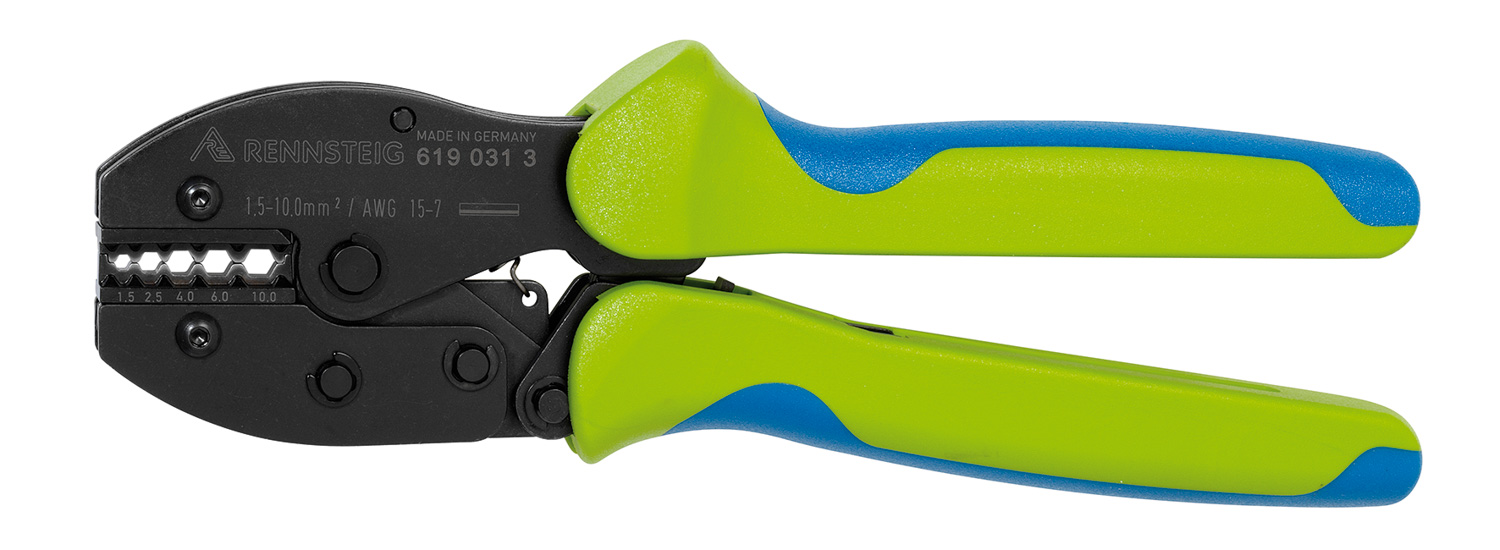

 The OD of the barrels are too large for the dies in the tool and a bunch of material smooshes out when trying to make a crimp. It's either over crimped or under crimped. Increments of sizing just don't jive with the Versakrimp sizes. But apparently it is good at coax cable.... yay, just what I didn't need. I'm going to call Rennsteig though because they say it can be used with splices so I want to know exactly what product line they are talking about.
 Apparently my old hex battery cable crimper does much smaller sizes than I remembered. It makes nice hex crimps on the Versakrimp splices. I have no idea what is this tool, it came with no branding or ID anywhere. Bought it from CE Auto Electric a decade ago. It looks like a Toolaid 18840, or a Grote Cub, or maybe they're all the HX-50B rebadged. Whatever it is, it just became my go-to for splices!


