


What turbo this is?


Thread Starter
Junior Member
Joined: Feb 2006
Posts: 11
Likes: 0
Originally posted by Steven89Iroc
On that engine, not much. Two of them would work great though.
On that engine, not much. Two of them would work great though.

Senior Member
Joined: Jul 1999
Posts: 701
Likes: 0
From: College Park, MD
They made 210hp at 9 psi.
You want to worry about airflow capacity before worrying about boost level. They can't flow all that much air.
Read through this (then turbo tech 103, or start with 101 and read all three if you need to)...
http://www.turbobygarrett.com/turbob...o_tech102.html
FYI, my Talon stock made 210hp at 11 psi, with an itty bitty T25 on a 2.0 liter.
You want to worry about airflow capacity before worrying about boost level. They can't flow all that much air.
Read through this (then turbo tech 103, or start with 101 and read all three if you need to)...
http://www.turbobygarrett.com/turbob...o_tech102.html
FYI, my Talon stock made 210hp at 11 psi, with an itty bitty T25 on a 2.0 liter.
Thread Starter
Junior Member
Joined: Feb 2006
Posts: 11
Likes: 0
Originally posted by Steven89Iroc
They made 210hp at 9 psi.
You want to worry about airflow capacity before worrying about boost level. They can't flow all that much air.
Read through this (then turbo tech 103, or start with 101 and read all three if you need to)...
http://www.turbobygarrett.com/turbob...o_tech102.html
FYI, my Talon stock made 210hp at 11 psi, with an itty bitty T25 on a 2.0 liter.
They made 210hp at 9 psi.
You want to worry about airflow capacity before worrying about boost level. They can't flow all that much air.
Read through this (then turbo tech 103, or start with 101 and read all three if you need to)...
http://www.turbobygarrett.com/turbob...o_tech102.html
FYI, my Talon stock made 210hp at 11 psi, with an itty bitty T25 on a 2.0 liter.
Trending Topics

Supreme Member

Joined: Jul 2005
Posts: 1,210
Likes: 17
Logicly speaking assuming a certain air flow for a certain boost level is like assuming that you'll make the same HP just because the engine has the same displacement. The 301 you're getting the turbo off of makes ~150hp in N/A form, compared to your 200 hp N/A engine with only one more cubic inch.
While there are plenty of guides out there on how to turbocharge, I'll give a short explanation.
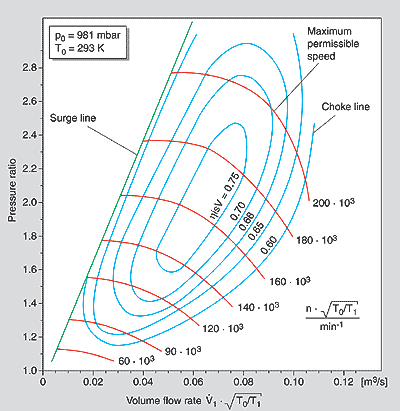
This is a turbocharger compressor map. If you look there are concentric areas on this map, these denote a certain efficiency of this turbocharger. To the left side is the pressure ratio, this is how much "boost" you're running. Most of these are in atmospheres, so if it's 2.0 that means 2.0X14.7 or 29.4 PSI absolute pressure, or 29.4-14.7=14.7 PSI of pressure above atmosphereic pressure. The bottom is in cubic meters per second, most maps I've seen are in CFM or lbs/minute of air. You can interchange between these units, you just have to get the conversion factor from the internet. If I was you I'd get some books and start reading, you've got a long way to go.
While there are plenty of guides out there on how to turbocharge, I'll give a short explanation.
This is a turbocharger compressor map. If you look there are concentric areas on this map, these denote a certain efficiency of this turbocharger. To the left side is the pressure ratio, this is how much "boost" you're running. Most of these are in atmospheres, so if it's 2.0 that means 2.0X14.7 or 29.4 PSI absolute pressure, or 29.4-14.7=14.7 PSI of pressure above atmosphereic pressure. The bottom is in cubic meters per second, most maps I've seen are in CFM or lbs/minute of air. You can interchange between these units, you just have to get the conversion factor from the internet. If I was you I'd get some books and start reading, you've got a long way to go.
Last edited by Drac0nic; Feb 26, 2006 at 03:28 PM.
Thread Starter
Junior Member
Joined: Feb 2006
Posts: 11
Likes: 0
Originally posted by Drac0nic
Logicly speaking assuming a certain air flow for a certain boost level is like assuming that you'll make the same HP just because the engine has the same displacement. The 301 you're getting the turbo off of makes ~150hp in N/A form, compared to your 200 hp N/A engine with only one more cubic inch.
While there are plenty of guides out there on how to turbocharge, I'll give a short explanation.
This is a turbocharger compressor map. If you look there are concentric areas on this map, these denote a certain efficiency of this turbocharger. To the left side is the pressure ratio, this is how much "boost" you're running. Most of these are in atmospheres, so if it's 2.0 that means 2.0X14.7 or 29.4 PSI absolute pressure, or 29.4-14.7=14.7 PSI of pressure above atmosphereic pressure. The bottom is in cubic meters per second, most maps I've seen are in CFM or lbs/minute of air. You can interchange between these units, you just have to get the conversion factor from the internet. If I was you I'd get some books and start reading, you've got a long way to go.
Logicly speaking assuming a certain air flow for a certain boost level is like assuming that you'll make the same HP just because the engine has the same displacement. The 301 you're getting the turbo off of makes ~150hp in N/A form, compared to your 200 hp N/A engine with only one more cubic inch.
While there are plenty of guides out there on how to turbocharge, I'll give a short explanation.
This is a turbocharger compressor map. If you look there are concentric areas on this map, these denote a certain efficiency of this turbocharger. To the left side is the pressure ratio, this is how much "boost" you're running. Most of these are in atmospheres, so if it's 2.0 that means 2.0X14.7 or 29.4 PSI absolute pressure, or 29.4-14.7=14.7 PSI of pressure above atmosphereic pressure. The bottom is in cubic meters per second, most maps I've seen are in CFM or lbs/minute of air. You can interchange between these units, you just have to get the conversion factor from the internet. If I was you I'd get some books and start reading, you've got a long way to go.

Senior Member
Joined: Oct 2004
Posts: 539
Likes: 0
From: Chico, CA
Car: 89 Firebird, 92 RS
Engine: 2.8L MPFI, 355 TPI
Transmission: t-5, t-5
Axle/Gears: open 3.42, posi 3.42
that 301 stock flowed about as much as the 3.4l from a 93-95 camaro, hence the 60 trim t3. your engine(i sure hope) will be flowing a lot more than that, so you will need a bigger turbo.
flow is how much air the turbo can pump out. pressure ratio is the resistance the turbo compressor has to work against to push out more air. not only do different sized turbos push out different amounts of air, but they are also tuned to push out that much air against a certain resistance. so a huge turbo can put out the same amount of air as a small one, but if you put it on a lower breathing engine it would underperform becaue the pressure ratio would be off the chart. a lot of people dont realize how complicated turbo sizing can be.
that turbo on the stock 301 pushes ~330 cfm of air at 9 psi(note: stock 3.4's flow ~250 cfm at 0 psi, and ~400+ cfm at 9 psi, with almost 100 less cubes!). if you opened up the heads/intake/exhaust of that 301, the turbo flowing the same amout of air would be making less boost. Boost is just the leftover air that has nowhere to go. a better flowing(higher volumetric efficiency) naturally aspirated engine will make more power at lower boost than a worse flowing one.
never pick a turbo based on what different engines are running, especially factory engines. turbo sizing is crucial and as i said before, somewhat complicated to the untrained/unaware. i suggest picking up a book. Maximum Boost by Corky Bell is good, as is Forced Induction Performance Tuning by A. Graham Bell. There is a wealth of information on the internet, but as is typical with the internet a lot of it is misinformed and/or incomplete.
flow is how much air the turbo can pump out. pressure ratio is the resistance the turbo compressor has to work against to push out more air. not only do different sized turbos push out different amounts of air, but they are also tuned to push out that much air against a certain resistance. so a huge turbo can put out the same amount of air as a small one, but if you put it on a lower breathing engine it would underperform becaue the pressure ratio would be off the chart. a lot of people dont realize how complicated turbo sizing can be.
that turbo on the stock 301 pushes ~330 cfm of air at 9 psi(note: stock 3.4's flow ~250 cfm at 0 psi, and ~400+ cfm at 9 psi, with almost 100 less cubes!). if you opened up the heads/intake/exhaust of that 301, the turbo flowing the same amout of air would be making less boost. Boost is just the leftover air that has nowhere to go. a better flowing(higher volumetric efficiency) naturally aspirated engine will make more power at lower boost than a worse flowing one.
never pick a turbo based on what different engines are running, especially factory engines. turbo sizing is crucial and as i said before, somewhat complicated to the untrained/unaware. i suggest picking up a book. Maximum Boost by Corky Bell is good, as is Forced Induction Performance Tuning by A. Graham Bell. There is a wealth of information on the internet, but as is typical with the internet a lot of it is misinformed and/or incomplete.
Thread Starter
Junior Member
Joined: Feb 2006
Posts: 11
Likes: 0
Originally posted by Naft
that 301 stock flowed about as much as the 3.4l from a 93-95 camaro, hence the 60 trim t3. your engine(i sure hope) will be flowing a lot more than that, so you will need a bigger turbo.
flow is how much air the turbo can pump out. pressure ratio is the resistance the turbo compressor has to work against to push out more air. not only do different sized turbos push out different amounts of air, but they are also tuned to push out that much air against a certain resistance. so a huge turbo can put out the same amount of air as a small one, but if you put it on a lower breathing engine it would underperform becaue the pressure ratio would be off the chart. a lot of people dont realize how complicated turbo sizing can be.
that turbo on the stock 301 pushes ~330 cfm of air at 9 psi(note: stock 3.4's flow ~250 cfm at 0 psi, and ~400+ cfm at 9 psi, with almost 100 less cubes!). if you opened up the heads/intake/exhaust of that 301, the turbo flowing the same amout of air would be making less boost. Boost is just the leftover air that has nowhere to go. a better flowing(higher volumetric efficiency) naturally aspirated engine will make more power at lower boost than a worse flowing one.
never pick a turbo based on what different engines are running, especially factory engines. turbo sizing is crucial and as i said before, somewhat complicated to the untrained/unaware. i suggest picking up a book. Maximum Boost by Corky Bell is good, as is Forced Induction Performance Tuning by A. Graham Bell. There is a wealth of information on the internet, but as is typical with the internet a lot of it is misinformed and/or incomplete.
that 301 stock flowed about as much as the 3.4l from a 93-95 camaro, hence the 60 trim t3. your engine(i sure hope) will be flowing a lot more than that, so you will need a bigger turbo.
flow is how much air the turbo can pump out. pressure ratio is the resistance the turbo compressor has to work against to push out more air. not only do different sized turbos push out different amounts of air, but they are also tuned to push out that much air against a certain resistance. so a huge turbo can put out the same amount of air as a small one, but if you put it on a lower breathing engine it would underperform becaue the pressure ratio would be off the chart. a lot of people dont realize how complicated turbo sizing can be.
that turbo on the stock 301 pushes ~330 cfm of air at 9 psi(note: stock 3.4's flow ~250 cfm at 0 psi, and ~400+ cfm at 9 psi, with almost 100 less cubes!). if you opened up the heads/intake/exhaust of that 301, the turbo flowing the same amout of air would be making less boost. Boost is just the leftover air that has nowhere to go. a better flowing(higher volumetric efficiency) naturally aspirated engine will make more power at lower boost than a worse flowing one.
never pick a turbo based on what different engines are running, especially factory engines. turbo sizing is crucial and as i said before, somewhat complicated to the untrained/unaware. i suggest picking up a book. Maximum Boost by Corky Bell is good, as is Forced Induction Performance Tuning by A. Graham Bell. There is a wealth of information on the internet, but as is typical with the internet a lot of it is misinformed and/or incomplete.
Senior Member
Joined: Jul 1999
Posts: 701
Likes: 0
From: College Park, MD
Originally posted by mr_malina
My car is making 200hp n/a but that is besides the point. I read through the info, very good by the way, but it did not answer all of my questions. What is the difference between airflow capacity and boost, its seems like they should be the same thing to me. The more air you flow the more boost you will have.
My car is making 200hp n/a but that is besides the point. I read through the info, very good by the way, but it did not answer all of my questions. What is the difference between airflow capacity and boost, its seems like they should be the same thing to me. The more air you flow the more boost you will have.
That link I gave you correctly and throroughly explains compressor maps if you read all three of the sections, If you don't understand what it says, then ask more questions about them. To grasp that though, first read my explaination on boost vs. airflow:
Think of it this way. Go get a fat straw (drink straw) and a skinny straw (coffee stirrer). Put the fat straw in your mouth and blow. Feel the air come out the other end. Now put the skinny straw in your mouth and blow with the same amount of force and feel the air come out the other end.
Notice how the fat straw flows a lot more air than the skinny straw at the same lung pressure? Bingo.
You're fine if you only want to make 200hp at 9 psi through that little straw (301 with tiny intake/exhaust passages), but if you want to make 400hp at 9 psi through that big straw (302 with much bigger intake/exhaust passages) because it will flow more air at the same pressure, you need bigger lungs (bigger turbo, or two) because yours aren't quite up to the task (not insulting, just using examples, heh).
Get it?
Now if you grasp that, go read the articles in full, and what others here have explained.
The charts you want for turbo sizes are the compressor maps. The place I use for most Garrett compressor maps is here...
http://64.225.76.178/catalog/compmaps/fig1.html
Now, that's all only about the compressor side. You also need to match up the turbine side to your engine, and the compressor side. Too small of a turbine housing/wheel will spool fast but choke off top end power and possily overspin the turbo, too large of a turbine housing/wheel will take a long time to build boost which will take away low end power you could have. The trick is to get a combination with the best of both worlds. Get the compressor side stuff first, then go on to worry about which turbine side will match up and what not. I gotta go for now.
Hope this helps.

Thread
Thread Starter
Forum
Replies
Last Post
New2Chevy
Engine/Drivetrain/Suspension Parts for Sale
2
Sep 28, 2015 12:35 AM
