


Destroked engine revving up faster..?


Thread Starter
Member
Joined: Jul 1999
Posts: 134
Likes: 0
From: Aruba
Destroked engine revving up faster..?
I've heard a lot about destroked engines revving up faster and how stroked engines have more low-end torque.... but can someone try and explain WHY the destroked rev's better (quicker) is it just the lesser stroke?? making the pistons and rods have to travel less ? or is there a more interesting theory ??

Supreme Member

Joined: Jan 2001
Posts: 7,164
Likes: 1
From: Someone owes me 10,000 posts
Car: 99 Formula
Engine: LS1
Transmission: T56
Axle/Gears: 342
I know you rev a destroked engine higher, but I never heard of it reving faster, just wondering if that part is true.
------------------
"Rice burners are like tampons...Every pu$$y has to have one"
'86 IROC
T-TOPS, TINTED WINDOWS, BRAKE LIGHT BLACKOUTS
GM GOODWRENCH 350
EDELBROCK TES HEADERS
3" Hooker CatBack w/Aero Chamber muffler
EDELBROCK 600CFM CARB.
KN AIRFILTER
ACCEL HEI DISTRIBUTOR
160* Stat, just switched to 180* b/c of winter coming and going to college in the mts.
3:73 Posi
Rebuilt 700R4
B&M Megashifter, 5" Autometer Tach w/shift lite
------------------
"Rice burners are like tampons...Every pu$$y has to have one"
'86 IROC
T-TOPS, TINTED WINDOWS, BRAKE LIGHT BLACKOUTS
GM GOODWRENCH 350
EDELBROCK TES HEADERS
3" Hooker CatBack w/Aero Chamber muffler
EDELBROCK 600CFM CARB.
KN AIRFILTER
ACCEL HEI DISTRIBUTOR
160* Stat, just switched to 180* b/c of winter coming and going to college in the mts.
3:73 Posi
Rebuilt 700R4
B&M Megashifter, 5" Autometer Tach w/shift lite

Supreme Member
Joined: Aug 1999
Posts: 1,443
Likes: 0
From: College Station, Tex USA
Car: 89rs
Engine: 400Sb
Transmission: Tremec 3550
The main reason for reving faster is less mass. Most 283 cranks weigh several pounds ligher than a 350. If you are carefull you can get some pretty light (and strong) parts for just about any stroke now. My 400 crank is only a couple of lbs heavier than a 350.

Supreme Member
Joined: Jul 1999
Posts: 18,457
Likes: 16
From: Loveland, OH, US
Car: 4
Engine: 6
Transmission: 5
It isn't the rotating mass, it's the reciprocating mass. At least with rotating mass, once you get it spinning, it doesn't cost any power to keep it spinning; but with the reciprocating mass of the rod and piston, on each stroke you have to accelerate it upwards (consumes power); stop it at the top (consumes power); accelerate it downwards (consumes power); and stop it at the bottom (consumes power). So every single stroke, i.e. 4 times per crank revolution or 8 times per cylinder firing, the engine throws away all that energy involved in the up-down motion of the rod, pin, and piston.
There are 2 ways to reduce this parasitic loss: use lighter parts, or move the parts a shorter distance. You can only go so far with lighter parts before you get into reliability problems. You accomplish the other thing by shortening the stroke. That is why a 302 or a 327 revs faster than a 350, and they continue to produce useful power at a higher RPM; it's less power since they're smaller, but it peaks at a higher RPM. Stroking a motor typically increases the power output but lowers the RPM at which it occurs, because of the parasistic losses that increase with RPM.
------------------
"So many Mustangs, so little time..."
ICON Motorsports
There are 2 ways to reduce this parasitic loss: use lighter parts, or move the parts a shorter distance. You can only go so far with lighter parts before you get into reliability problems. You accomplish the other thing by shortening the stroke. That is why a 302 or a 327 revs faster than a 350, and they continue to produce useful power at a higher RPM; it's less power since they're smaller, but it peaks at a higher RPM. Stroking a motor typically increases the power output but lowers the RPM at which it occurs, because of the parasistic losses that increase with RPM.
------------------
"So many Mustangs, so little time..."
ICON Motorsports


its like this basically, the longer the stroke, the longer the piston has to travel, to say stick you arm out and move it side to side real fast for mabey 3 inches, then do it at about 6 inches, you'll noticed you can move your arm as fast the longer the distance, and this is the same way the pistons works, also the longer the stoke the more power you can put into each movement back and forth (IE more torque) also a lighter mass (forged pistions) will make the stokes faster, a big myth is that the more R's the more power, thats just not true in most cases unless its a constant high r' engine like in circle track, other wise allways for for the extra torque over the HP, HP looks nice on papers, but low end torque wins races.


Joined: Mar 2000
Posts: 43,187
Likes: 45
From: Littleton, CO USA
Car: 82 Berlinetta/57 Bel Air
Engine: L92/LQ4 (both w/4" stroke)
Transmission: 4L80E/4L80E
Axle/Gears: 12B-3.73/9"-3.89
<font face="Verdana, Arial" size="2">Originally posted by Hulk0202:
"At least with rotating mass, once you get it spinning, it doesn't cost any power to keep it spinning."
Thats obviously not true. </font>
"At least with rotating mass, once you get it spinning, it doesn't cost any power to keep it spinning."
Thats obviously not true. </font>
The pistons having to be stopped and started twice per revolution would be an outside force on the crank rotation. So, basically, it isn't really true (although the longer stroke would produce slightly more rotational momentum).
I'd have to agree that it is the piston having to go a longer distance, and therefore having to be accelerated at a greater rate for a single revolution that makes a longer stroke engine less capable of higher RPM's. Since acceleration is force divided by mass (remember, F=MA), it will take more force and therefore more power (P=work x time = force x distance x time) to move a longer stroke rotating assembly to the same RPM's, even if the reciprocating mass is the same. Therefore, there is more parasitic loss in a long stroke as RPMs increase, so the net effect is: keep the RPMs up on a short stroke to produce more power, and down on a long stroke engine to maximize torque (HP=torque x RPMs / 5252).
Does "There's no replacement for displacement" still apply? Probably. The mag articles on 383 stroker 350 vs. 377 destroked 400 tend to prove that out.
Oh, never addressed the part about longer stroke engines producing more torque. Torque is force times length of the lever arm; the force in this case is the pressure in the cylinder times the area of the piston, and the lever arm is the distance from the centerline of the crank main bearings to the centerline of the crank throw (i.e., 1/2 the stroke). A longer stroke engine will have a longer lever arm, so at the same cylinder pressure and piston area, will produce more torque than a shorter stroke engine.
------------------
82 Berlinetta, orig V-6 car, now w/86 LG4/TH700R4. 2.93 limited slip. 2-1/2" cat-back, ZZ4 intake, Accel HEI SuperCoil. AMSOIL syn lubes bumper-to-bumper. Daily driver, work-in-progress (ported World 305 heads, Crane PowerMax cam, Hooker 2055 headers, 3" Catco cat & 3" catback w/dual-opposite Flowmaster, restalled TC, Spohn SFCs).
57 Bel Air, my 1st car. '66 396, 9.7 CR forged TRWs, Weiand Action+, Holley 750VS w/4150 conversion, GK 270 cam, Magnum rockers, Jacobs Omnipack, 1-3/4" Hedders & 3" Warlocks, TH400 w/TCI Sat Night Special conv & Trans-Scat shift kit, MegaShifter, 3.08 8.2" 10-bolt w/Powertrax, AMSOIL syn lubes bumper-to-bumper. Idles smooth @ 600 RPM in D. Best 15.02/95.06 @ 5800' Bandimere (corrected 13.93/102.4 @ sea level).
Trending Topics

Supreme Member
Joined: Aug 1999
Posts: 1,443
Likes: 0
From: College Station, Tex USA
Car: 89rs
Engine: 400Sb
Transmission: Tremec 3550
Sounds like if the stopping and starting were the biggest factors that an engine with a very long stroke would be less prone to that problem (it would be spending a larger precentage of it's time with the piston traveling at a average speed.) Maybe I slept through that lesson.
I guess i better do some of the work they pay me for.
[This message has been edited by jcb999 (edited October 30, 2001).]
I guess i better do some of the work they pay me for.
[This message has been edited by jcb999 (edited October 30, 2001).]

Supreme Member
Joined: Jan 2001
Posts: 2,463
Likes: 0
From: Annandale,NJ
ahhh but you see, that law of motion takes place in where there is no frition any where...do this, if you take off the con rods and piston and anything eles connected to the crankshaft so it is just sitting in the block and spin it what happens, well it will spin the stop, all the kinetic energy it had was used up. but once it is spinning it takes alot less force to keep it going b/c that extra force is the force required to overcome the frition of the cranks in its mounts. So don't be so quick to respond that someone is incorrrect unless you are sure what you are saying, and have the whole story correct...this was not a flame. and spelling does not count 
------------------
1987 Black 305 TPI 5spd IROC, G92, 9-bolt 3.45, Lowered, Cat-back, Air Foil, Sub Frames, Huge sways.
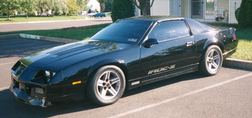
AIM: IROC 5spd
http://www.geocities.com/chevy5spdiroc/87Roc.htm
------------------
1987 Black 305 TPI 5spd IROC, G92, 9-bolt 3.45, Lowered, Cat-back, Air Foil, Sub Frames, Huge sways.
AIM: IROC 5spd
http://www.geocities.com/chevy5spdiroc/87Roc.htm

Supreme Member
Joined: Apr 2000
Posts: 1,338
Likes: 0
From: Chander, Arizona USA
Car: 2006 Silverado 1500
Engine: 5.3L
Transmission: 4L60E
short stroke engines only rev up faster with no load on it. under load a longer stroke engine built the same will rev quicker just not as high. i most cases, short stroke engines are smaller and are given deeper gear ratio's from the factory so they also feel to rev quicker, when in fact they are mearly taking advantage of less load. piston speed is much lower on a short stroke engine which helps for higher rev's and as well as better breathing from a larger bore. this is about as simple as i can explain it. going into the whole physics of it is obviously worthless or you'd have thought of it yourself.

Supreme Member
Joined: Jan 2001
Posts: 1,116
Likes: 0
From: Rio Rico, AZ 85648
Car: 1989 IROC-1
Engine: L98
Transmission: 700r4
The other day I asked why there aren't any counter weight cranks for SBC's.
Some engines use them and that helps with the starting and stopping of motion.
Clearance isn't an issue I don't think......
But they are effective.
------------------
http://www.gruveb.com/z28
Some engines use them and that helps with the starting and stopping of motion.
Clearance isn't an issue I don't think......
But they are effective.
------------------
http://www.gruveb.com/z28

Thread
Thread Starter
Forum
Replies
Last Post
