


Need valve spring recommendation


Thread Starter
Member
Joined: Sep 2002
Posts: 159
Likes: 0
From: Raleigh, NC
Car: 1991 Corvette
Engine: Bottle fed L98
Transmission: ZF 6 speed
Axle/Gears: D44 IRS/3.92
Need valve spring recommendation
I have some AFR 195 competition port heads with the upgraded springs from AFR (I think the spring upgrade is P/N 9018). I was assured by AFR that these springs would handle anything my mild street combo could throw at them. However, I chose to use a comp cams 280 XFI cam. I have been told this cam sets the valves down very hard/quickly. Even when I first put the heads on the car, it would float the valves at about 6500. Now, after 18 months or so, I can't rev the engine past about 6000 without floating the valves.
I am happy with the cam, but not married to it or anything. I'd rather just swap out to some stronger valve springs (something that won't crush a stock replacement hydraulic lifter) but if there isn't a suitable spring option that will get me to 7000 reliably, I'm not opposed to swapping the cam to something that sets the valves down a bit slower and makes the springs job easier.
Thoughts and recommendations are greatly appreciated, thanks guys!
I am happy with the cam, but not married to it or anything. I'd rather just swap out to some stronger valve springs (something that won't crush a stock replacement hydraulic lifter) but if there isn't a suitable spring option that will get me to 7000 reliably, I'm not opposed to swapping the cam to something that sets the valves down a bit slower and makes the springs job easier.
Thoughts and recommendations are greatly appreciated, thanks guys!

Supreme Member
iTrader: (3)
Joined: Nov 2001
Posts: 2,428
Likes: 2
From: Fairview Heights Illinois
Car: 1986 Irocz
Engine: 305 TPI
Transmission: 700R4
Axle/Gears: 3.25:1
Re: Need valve spring recommendation
You might want to re-evaluate your optimum shift points for your engine as far as matching your camshaft.
Those extreme cams like you have are to get the maximum amount of power out of a relatively narrow range of RPM. A more radical ramp on the cam-lobe does not mean higher RPM. In fact it is the opposite.
If you do need to rev your engine to 6500 or higher, then it will be in your best interest to use a camshaft with much milder valve closing ramps.
Cams with lazy ramps give you a valvetrain that's much more comfortable at very high RPM.
Combining a high duration with a lazy ramp will of course cost you a little power at the lower RPM, and that should be part of your re-evaluation to determine how to get the best vehicle performance.
Also, when pushing the limits with hydraulic lifters it is often to your advantage to run as close to zero pre-load as possible. The further you go into the lifter plunger the less valvespring pressure is applied at the valve-seat, and the sooner you will get into valve-float if there is any pump-up in the lifter at high RPM.
Those extreme cams like you have are to get the maximum amount of power out of a relatively narrow range of RPM. A more radical ramp on the cam-lobe does not mean higher RPM. In fact it is the opposite.
If you do need to rev your engine to 6500 or higher, then it will be in your best interest to use a camshaft with much milder valve closing ramps.
Cams with lazy ramps give you a valvetrain that's much more comfortable at very high RPM.
Combining a high duration with a lazy ramp will of course cost you a little power at the lower RPM, and that should be part of your re-evaluation to determine how to get the best vehicle performance.
Also, when pushing the limits with hydraulic lifters it is often to your advantage to run as close to zero pre-load as possible. The further you go into the lifter plunger the less valvespring pressure is applied at the valve-seat, and the sooner you will get into valve-float if there is any pump-up in the lifter at high RPM.

Supreme Member
iTrader: (2)
Joined: Jan 2002
Posts: 9,962
Likes: 5
From: Moorestown, NJ
Car: 88 Camaro SC
Engine: SFI'd 350
Transmission: TKO 500
Axle/Gears: 9-bolt w/ 3.23's
Re: Need valve spring recommendation
Have you considered a rev-kit? That will help control the lifters, and allow you to run something more conventional, like a dual-coil or beehive, as the valvespring will only control the valve and pushrod.
The only downside is that it loads the roller lifters. Too much load can cause pitting on the cam lobes and lifter rollers. If you do run a rev-kit, you'll probably want to run a somewhat lighter spring to equalize the load on the lifters and prevent pitting. I dont think the XFI cams are full billet steel, but I could be wrong.
For those RPM ranges, you might want to consider going with light weight solid lifters (and mechanical roller cam). If you use roller rockers, they should seldom need re-adjustment.
As for the lash, you should check with the manufacturer. Unlike GM lifters, many aftermarket ones cannot be run with almost zero lash. Some have very specific requirements if they are anti-pump up style.
The only downside is that it loads the roller lifters. Too much load can cause pitting on the cam lobes and lifter rollers. If you do run a rev-kit, you'll probably want to run a somewhat lighter spring to equalize the load on the lifters and prevent pitting. I dont think the XFI cams are full billet steel, but I could be wrong.
For those RPM ranges, you might want to consider going with light weight solid lifters (and mechanical roller cam). If you use roller rockers, they should seldom need re-adjustment.
As for the lash, you should check with the manufacturer. Unlike GM lifters, many aftermarket ones cannot be run with almost zero lash. Some have very specific requirements if they are anti-pump up style.
Supreme Member
iTrader: (2)
Joined: Jan 2002
Posts: 9,962
Likes: 5
From: Moorestown, NJ
Car: 88 Camaro SC
Engine: SFI'd 350
Transmission: TKO 500
Axle/Gears: 9-bolt w/ 3.23's
Re: Need valve spring recommendation
Also, have you done any dyno pulls with the engine to see where the peak power is? Wouldnt make sense to rev the snot out of it if it tops out at 6200 RPM or something.
Thread Starter
Member
Joined: Sep 2002
Posts: 159
Likes: 0
From: Raleigh, NC
Car: 1991 Corvette
Engine: Bottle fed L98
Transmission: ZF 6 speed
Axle/Gears: D44 IRS/3.92
Re: Need valve spring recommendation
It has only been pulled to about 6500 on the dyno, then it kinda starts to float the valves. It's making peak power right there in the 6500 area, so without the valve float I think a 7K shift would be the hot ticket.
The car has 3.92 rear gears and a 1:1 4th gear. It's trying to trap North of 135 when I spray it, so being able to turn it to 7K would be help me get to the stripe without a 4-5 shift.
I'm not going to convert to any kind of solid roller, I'd rather slow the car down 25 HP or so and stick with a hydraulic lifter set up. Does anyone have a suggestion for a cam with similar duration (230/236) that uses a less agressive lobe?
The car has 3.92 rear gears and a 1:1 4th gear. It's trying to trap North of 135 when I spray it, so being able to turn it to 7K would be help me get to the stripe without a 4-5 shift.
I'm not going to convert to any kind of solid roller, I'd rather slow the car down 25 HP or so and stick with a hydraulic lifter set up. Does anyone have a suggestion for a cam with similar duration (230/236) that uses a less agressive lobe?
Last edited by neat; Nov 21, 2011 at 05:44 PM.

Supreme Member
Joined: Sep 1999
Posts: 7,072
Likes: 13
From: Philly, PA
Re: Need valve spring recommendation
I can believe it. Aggressive hydro-roller cams can be a real tough nut to keep the valves under control. You're right in the RPM range where most street/strip combos commonly "hit the wall." And a steadily declining valve float RPM over time almost always means tired springs.
The aggressive lobe profiles mean high valve acceleration rates. And high acceleration rates mean you either need big spring pressures to control them (which has it's limits on what the lifter can handle) or, a more popular solution these days- reduce the mass of the valvetrain and then you don't need such strong springs to control it.
Without going to crazy-expensive parts like titanium valves and retainers, the increasingly popular way of addressing that problem these days is using beehive-style springs. They drop a TON out of the valvetrain mass PLUS their shape with smaller coils at the top and larger ones at the bottom makes them less prone to hitting a "harmonic" at certain RPMs and instantly going into float.
I'd check with Comp about what beehive springs would work well with that cam. They're not dirt cheap but they're not much different than buying a new cam, plus you don't have to tear way into the motor to change them.
The aggressive lobe profiles mean high valve acceleration rates. And high acceleration rates mean you either need big spring pressures to control them (which has it's limits on what the lifter can handle) or, a more popular solution these days- reduce the mass of the valvetrain and then you don't need such strong springs to control it.
Without going to crazy-expensive parts like titanium valves and retainers, the increasingly popular way of addressing that problem these days is using beehive-style springs. They drop a TON out of the valvetrain mass PLUS their shape with smaller coils at the top and larger ones at the bottom makes them less prone to hitting a "harmonic" at certain RPMs and instantly going into float.
I'd check with Comp about what beehive springs would work well with that cam. They're not dirt cheap but they're not much different than buying a new cam, plus you don't have to tear way into the motor to change them.


Joined: Apr 2005
Posts: 7,736
Likes: 14
From: Not in Kansas anymore
Car: 82 Z28
Engine: 383 SP EFI/ 4150 TB
Transmission: T400
Axle/Gears: QP 9" 3.73
Re: Need valve spring recommendation
Trending Topics
Thread Starter
Member
Joined: Sep 2002
Posts: 159
Likes: 0
From: Raleigh, NC
Car: 1991 Corvette
Engine: Bottle fed L98
Transmission: ZF 6 speed
Axle/Gears: D44 IRS/3.92
Re: Need valve spring recommendation
It's got really nice bee-hives on it now. The upgraded ones from AFR (I can't remember the specifics off the top of my head, I'll google and report back later) so I was hoping I'd be good to 7K without issue. Regardless, I am having issues so I need to address it via a spring swap or cam and spring swap.
Do you mean the TFS heads I ran with the PAC springs? I didn't rev that combo as high since it only ever trapped 119 or so. The AFR heads trap 123 or so NA, and 137-ish is where it's trying to land on spray. Unfortunately, I can't seem to get the RPM out of it to support the trap speeds it's trying to achieve.
At this point, I'm leaning towards a new set of springs and a cam swap.
Do you mean the TFS heads I ran with the PAC springs? I didn't rev that combo as high since it only ever trapped 119 or so. The AFR heads trap 123 or so NA, and 137-ish is where it's trying to land on spray. Unfortunately, I can't seem to get the RPM out of it to support the trap speeds it's trying to achieve.
At this point, I'm leaning towards a new set of springs and a cam swap.
Supreme Member
iTrader: (3)
Joined: Nov 2001
Posts: 2,428
Likes: 2
From: Fairview Heights Illinois
Car: 1986 Irocz
Engine: 305 TPI
Transmission: 700R4
Axle/Gears: 3.25:1
Re: Need valve spring recommendation
It has only been pulled to about 6500 on the dyno, then it kinda starts to float the valves. It's making peak power right there in the 6500 area, so without the valve float I think a 7K shift would be the hot ticket.
The car has 3.92 rear gears and a 1:1 4th gear. It's trying to trap North of 135 when I spray it, so being able to turn it to 7K would be help me get to the stripe without a 4-5 shift.
I'm not going to convert to any kind of solid roller, I'd rather slow the car down 25 HP or so and stick with a hydraulic lifter set up. Does anyone have a suggestion for a cam with similar duration (230/236) that uses a less agressive lobe?
The car has 3.92 rear gears and a 1:1 4th gear. It's trying to trap North of 135 when I spray it, so being able to turn it to 7K would be help me get to the stripe without a 4-5 shift.
I'm not going to convert to any kind of solid roller, I'd rather slow the car down 25 HP or so and stick with a hydraulic lifter set up. Does anyone have a suggestion for a cam with similar duration (230/236) that uses a less agressive lobe?
I forgot to ask this, but what ratio rocker arms are you using?
If it's more then 1.5:1 then you might get where you want to be by dropping the ratio down, maybe even just on the intakes. It could be that you have a "fat" set of intake valves that are just too much weight to control. I don't think you'll give up much by backing off of the intake side a bit, especially on the bottle.
BTW I do love the beehive springs, but I usually use the thinner and lighter 8mm valves (info in signature) and that combination drops over 25% of the mass when compared to other common parts combinations. I've just gotten away from using heavy valves being that it's so easy and cheap to get LSX style valves. I don't know what you're looking at as far as valve weight and total lift, but the Comp 918 springs and Ti-retainers might cover you.
FYI, on the bottle your optimum shift point is usually at least 500 RPM less that what it would be running NA. The greater amount you spray ( % of engine power ) the lower the optimum shift-point is shifted.
If you are all about getting the power from the bottle, then you might want to consider dropping your rear gear a bit to match a lower RPM range. You might very well find out that your car picks up both ET and trap using less gear. I have seen this happen many times.
Supreme Member
Joined: Sep 1999
Posts: 7,072
Likes: 13
From: Philly, PA
Re: Need valve spring recommendation
My experience with AFR heads is that their stated spring pressure specs are out to lunch. I love everything about AFR heads (have bought multipls sets for both small and big blocks I own) but in that one area they seem to be off in the weeds many times.
I know this only because I actually tear them down and basically "blueprint" them before installing. That includes checking valve spring installed height (usually right on spec) and measuring actual spring pressure against spec. And that's where I find problems A LOT. Sometimes they are higher than spec on rate, or seat pressure or both. Rarely are they lower, but anything that ain't right can cause weird valvetrain problems.
Call Comp- they know what works with their cams and install a set that is properly matched by the manufacturer. AFR has to build to suit a wide variety of possible applications- they can't supply springs that will work perfectly in every single application. And spinning up to 7000 with a hydro-roller you are definitely not "most applications".
In the end, you may need to get a rev kit to spin that high (significant bucks). But 6500-6700 with just the right springs should be entirely possible. Remember you used to get 6500 out of it. Now you're down 500 from that. Just getting back up to a reliable 6500+ should make a world of difference. And if you can do it with better valvetrain stability and reliability you may just find that everything from ~5500 on up improves to the point that it's better than ever.
I know this only because I actually tear them down and basically "blueprint" them before installing. That includes checking valve spring installed height (usually right on spec) and measuring actual spring pressure against spec. And that's where I find problems A LOT. Sometimes they are higher than spec on rate, or seat pressure or both. Rarely are they lower, but anything that ain't right can cause weird valvetrain problems.
Call Comp- they know what works with their cams and install a set that is properly matched by the manufacturer. AFR has to build to suit a wide variety of possible applications- they can't supply springs that will work perfectly in every single application. And spinning up to 7000 with a hydro-roller you are definitely not "most applications".
In the end, you may need to get a rev kit to spin that high (significant bucks). But 6500-6700 with just the right springs should be entirely possible. Remember you used to get 6500 out of it. Now you're down 500 from that. Just getting back up to a reliable 6500+ should make a world of difference. And if you can do it with better valvetrain stability and reliability you may just find that everything from ~5500 on up improves to the point that it's better than ever.
Last edited by Damon; Nov 21, 2011 at 07:07 PM.
Thread Starter
Member
Joined: Sep 2002
Posts: 159
Likes: 0
From: Raleigh, NC
Car: 1991 Corvette
Engine: Bottle fed L98
Transmission: ZF 6 speed
Axle/Gears: D44 IRS/3.92
Re: Need valve spring recommendation
1.6's. If I was stuck with a 6500 float, I would probably try stepping the rocker ratio down, but since I'm progressively losing the ability to rev the engine out, I definitely need some new springs.
Lower RPM = more time with the intake valve open = more time for cylinder fill = more oxygen/fuel
The point at which you are achieving maximum cylinder fill is usually where you make peak TQ. Peak HP is usually beyond peak TQ, but you are doing more work per unit of time so the unit of time is making up for the loss in TQ per cylinder cycle. Eventually, the loss in power per cylinder cycle can not be over come with more cylinder cycles because the enthalpy associated with cylinder fill doesn't allow it. The point at which you start to lose the battle of cylinder fill/work performed per cycle, etc... is normally when you are past the HP peak and sliding down the other side of the curve.
This is exacerbated with nitrous. You are able to do more work per cylinder cycle because of nitrous/fuel being added, but the losses accrued as RPM increases and cylinder fill times decrease are typically greater than you would see in an NA engine. However, compared to the NA version of itself, the nitrous engine is much more powerful at any RPM. The difference in power production is not as pronounced at 7000 as it is at 4000, but compared to it's NA counterpart - 7000 on the juice is a riot compared to 7000 NA.
My point is that I agree with you on optimum shift points being reduced while spraying. However, in my situation, reducing the shift points only results in my being in 4th gear longer in an attempt to reach ~135 MPH at the stripe. While I'm sure there are differences to be had in ET by varying the shift RPM my counterpoints would be 1)Given my situation, the difference are subtle, and nearly offset by the longer travel time in 4th gear. 2)I'm not nearly a good or consistent enough driver to realize gains of less than about .05 of a second. 3)Given that I can't rev the engine out to where I'd like to, I have no real idea what a high RPM shift would gain me. Not having that information, makes lowering the shift RPM and determing if I am going in the right direction almost impossible.
The car is a street car first, drag car second, and nitrous car third. It runs NA 99% of it's life so I didn't choose the cam or heads based on my intention to spray. I guess I just decided I'd just let the N20 numbers fall where they may.
I stepped down from a 4.09 to a 3.92 in anticipation of 135+ trap speeds with the new motor combo. I could go back to a stock-ish gear of 3.45 or so, but I'll probably stick with the 3.9X gear for now. It might MPH better on the gas with the stock gear, but with the manual trans launching the car is tough enough on the 3.9X gear, stepping back to the 3.45 makes it that much harder to keep from breaking the IRS in the event that the tires hook. I also think that a more stock-ish gear would be less fun and slower when running NA. I might end up with a 27 or 28 inch tall tire on it if I get the RPM problem straightened out and am still running out of steam in 4th before the end of the 1/4. I think I'd still rather do that than mess with yet another gear change in the IRS. Either way, I have to get the RPM thing sorted before worrying about gear/tire issues.
Thanks for all the help and insight, I'll post back once I get the issue solved.

FYI, on the bottle your optimum shift point is usually at least 500 RPM less that what it would be running NA. The greater amount you spray ( % of engine power ) the lower the optimum shift-point is shifted.
The point at which you are achieving maximum cylinder fill is usually where you make peak TQ. Peak HP is usually beyond peak TQ, but you are doing more work per unit of time so the unit of time is making up for the loss in TQ per cylinder cycle. Eventually, the loss in power per cylinder cycle can not be over come with more cylinder cycles because the enthalpy associated with cylinder fill doesn't allow it. The point at which you start to lose the battle of cylinder fill/work performed per cycle, etc... is normally when you are past the HP peak and sliding down the other side of the curve.
This is exacerbated with nitrous. You are able to do more work per cylinder cycle because of nitrous/fuel being added, but the losses accrued as RPM increases and cylinder fill times decrease are typically greater than you would see in an NA engine. However, compared to the NA version of itself, the nitrous engine is much more powerful at any RPM. The difference in power production is not as pronounced at 7000 as it is at 4000, but compared to it's NA counterpart - 7000 on the juice is a riot compared to 7000 NA.
My point is that I agree with you on optimum shift points being reduced while spraying. However, in my situation, reducing the shift points only results in my being in 4th gear longer in an attempt to reach ~135 MPH at the stripe. While I'm sure there are differences to be had in ET by varying the shift RPM my counterpoints would be 1)Given my situation, the difference are subtle, and nearly offset by the longer travel time in 4th gear. 2)I'm not nearly a good or consistent enough driver to realize gains of less than about .05 of a second. 3)Given that I can't rev the engine out to where I'd like to, I have no real idea what a high RPM shift would gain me. Not having that information, makes lowering the shift RPM and determing if I am going in the right direction almost impossible.
If you are all about getting the power from the bottle, then you might want to consider dropping your rear gear a bit to match a lower RPM range. You might very well find out that your car picks up both ET and trap using less gear. I have seen this happen many times.
I stepped down from a 4.09 to a 3.92 in anticipation of 135+ trap speeds with the new motor combo. I could go back to a stock-ish gear of 3.45 or so, but I'll probably stick with the 3.9X gear for now. It might MPH better on the gas with the stock gear, but with the manual trans launching the car is tough enough on the 3.9X gear, stepping back to the 3.45 makes it that much harder to keep from breaking the IRS in the event that the tires hook. I also think that a more stock-ish gear would be less fun and slower when running NA. I might end up with a 27 or 28 inch tall tire on it if I get the RPM problem straightened out and am still running out of steam in 4th before the end of the 1/4. I think I'd still rather do that than mess with yet another gear change in the IRS. Either way, I have to get the RPM thing sorted before worrying about gear/tire issues.
Thanks for all the help and insight, I'll post back once I get the issue solved.
Last edited by neat; Nov 27, 2011 at 01:04 AM.
Thread Starter
Member
Joined: Sep 2002
Posts: 159
Likes: 0
From: Raleigh, NC
Car: 1991 Corvette
Engine: Bottle fed L98
Transmission: ZF 6 speed
Axle/Gears: D44 IRS/3.92
Re: Need valve spring recommendation
My experience with AFR heads is that their stated spring pressure specs are out to lunch. I love everything about AFR heads (have bought multipls sets for both small and big blocks I own) but in that one area they seem to be off in the weeds many times.
I know this only because I actually tear them down and basically "blueprint" them before installing. That includes checking valve spring installed height (usually right on spec) and measuring actual spring pressure against spec. And that's where I find problems A LOT. Sometimes they are higher than spec on rate, or seat pressure or both. Rarely are they lower, but anything that ain't right can cause weird valvetrain problems.
Call Comp- they know what works with their cams and install a set that is properly matched by the manufacturer. AFR has to build to suit a wide variety of possible applications- they can't supply springs that will work perfectly in every single application. And spinning up to 7000 with a hydro-roller you are definitely not "most applications".
In the end, you may need to get a rev kit to spin that high (significant bucks). But 6500-6700 with just the right springs should be entirely possible. Remember you used to get 6500 out of it. Now you're down 500 from that. Just getting back up to a reliable 6500+ should make a world of difference. And if you can do it with better valvetrain stability and reliability you may just find that everything from ~5500 on up improves to the point that it's better than ever.
I know this only because I actually tear them down and basically "blueprint" them before installing. That includes checking valve spring installed height (usually right on spec) and measuring actual spring pressure against spec. And that's where I find problems A LOT. Sometimes they are higher than spec on rate, or seat pressure or both. Rarely are they lower, but anything that ain't right can cause weird valvetrain problems.
Call Comp- they know what works with their cams and install a set that is properly matched by the manufacturer. AFR has to build to suit a wide variety of possible applications- they can't supply springs that will work perfectly in every single application. And spinning up to 7000 with a hydro-roller you are definitely not "most applications".
In the end, you may need to get a rev kit to spin that high (significant bucks). But 6500-6700 with just the right springs should be entirely possible. Remember you used to get 6500 out of it. Now you're down 500 from that. Just getting back up to a reliable 6500+ should make a world of difference. And if you can do it with better valvetrain stability and reliability you may just find that everything from ~5500 on up improves to the point that it's better than ever.
Anyway, thanks for the tips.
Supreme Member
Joined: Sep 1999
Posts: 7,072
Likes: 13
From: Philly, PA
Re: Need valve spring recommendation
I know, but you're not running an LS motor. I think their valvetrains are inherently more stable by their design (although I cuoldn't point to an exact reason why I could make a few guesses). Anyway, there's no denying you've lost 500 RPMs up top. And the gradual erosion of that number over time just screams "tired valvesprings.". I'd definitely try a fresh set of properly spec'ed springs before dropping bucks on a rev kit.

Senior Member
Joined: May 2002
Posts: 564
Likes: 0
From: loxahatchee fla
Re: Need valve spring recommendation
you have two basic problems, the first ones that HYDRAULIC tappet cams are not designed to nor will they reliably operate at 6500rpm-7000rpm NO MATTER WHAT the cam manufacturer may tell you, any time your looking to spin 6500rpm plus with a f hydraulic cam your really in SOLID LIFTER TERRITORY and should use a solid lifter cam and a rocker stud girdle or shaft rockers
next many COMP cams cams have lobe designs that have acceleration rates and result in lofting the valves or loss of valve train control ,that are at the limits of valve control, Id suggest talking to several manufactures about a solid lifter cam (preferably a roller solid lifter design)
what most guys over look is that by the time you add enough valve spring load rate to control a hydraulic lifter at 6500rpm your really in solid lifter rpm ranges
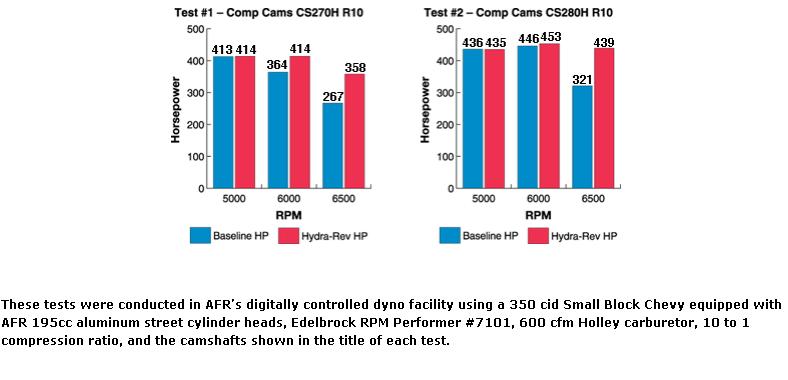
heres a similar engine, notice that without a rev kit power falls drastically above 6000rpm, and even with a rev kit they don,t push a hydraulic roller to 7000rpm
next
the second ones that your current cam and heads both max out below 6500rpm
http://www.rbracing-rsr.com/runnertorquecalc.html
http://forum.grumpysperformance.com/...php?f=52&t=333
your cams designed to max out at well under 6500rpm
http://www.compcams.com/Company/CC/c...csid=1111&sb=0
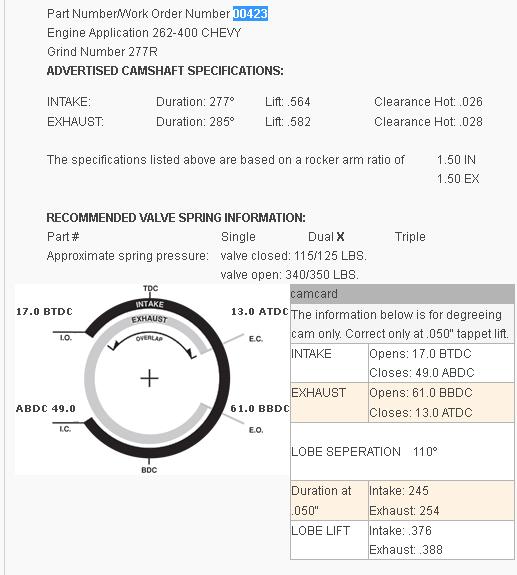
CHECK WITH SEVERAL CAM COMPANYS but your more likely to find something like this cam below works at 6500rpm
next many COMP cams cams have lobe designs that have acceleration rates and result in lofting the valves or loss of valve train control ,that are at the limits of valve control, Id suggest talking to several manufactures about a solid lifter cam (preferably a roller solid lifter design)
what most guys over look is that by the time you add enough valve spring load rate to control a hydraulic lifter at 6500rpm your really in solid lifter rpm ranges
heres a similar engine, notice that without a rev kit power falls drastically above 6000rpm, and even with a rev kit they don,t push a hydraulic roller to 7000rpm
next
the second ones that your current cam and heads both max out below 6500rpm
http://www.rbracing-rsr.com/runnertorquecalc.html
http://forum.grumpysperformance.com/...php?f=52&t=333
your cams designed to max out at well under 6500rpm
http://www.compcams.com/Company/CC/c...csid=1111&sb=0
CHECK WITH SEVERAL CAM COMPANYS but your more likely to find something like this cam below works at 6500rpm
Last edited by grumpyvette; Nov 27, 2011 at 01:09 PM.

Thread
Thread Starter
Forum
Replies
Last Post
