When you click on links to various merchants on this site and make a purchase, this can result in this site earning a commission. Affiliate programs and affiliations include, but are not limited to, the eBay Partner Network.
Tech / General EngineIs your car making a strange sound or won't start? Thinking of adding power with a new combination? Need other technical information or engine specific advice? Don't see another board for your problem? Post it here!
Need the electrical brain trust on this one. Am not a total electrical idiot, but probably 60% incompetent. Have a current issue that is causing car not to start. This began the day after running and starting OK with no intervention whatsoever. Just tried to crank the next day and car would not start. Get one click at solenoid and then no battery voltage to entire car. I realize this is the classic condition of a weak battery (except for no voltage to car), but battery's not the issue. See below:
Battery voltage not running = 12.7v
I watched battery tested by battery shop on 2 different testers holding 10.2v under load for 15 seconds -- better than one of their off the shelf batteries for sale, so battery OK
I watched solenoid/starter pass 4 tests. Starter/solenoid appear to be OK
There are 3 wires from 12v solenoid post that feed the entire car with 12v (the red wires in the pic below). Each have a fusable link attached to the solenoid battery post. All tested OK with 100% continuity from above where the link attaches to the wire to the connector. All butt connectors where the fusable links attach to the wires are tight. So fusable kinks are OK.
But here's what's happening whether alarm is active or is unplugged and disabled (see diagram below):
Try to crank and get one click at the solenoid/starter and obviously no start
Voltage across battery does not change when this occurs
Afterwards, no voltage to entire car
Test voltages at fuel pump relay wire connected directly to starter solenoid 3 feet away, and test fuse panel. All are to ground causing nothing to work. Plus no headlights, etc.
Disconnect/reconnect battery ground and immediately have 12v back to fuel pump relay, fuse pane and headlights
Can rinse and repeat
This makes absolutely no sense to me. What can be the issue? How can 3 wires from the starter solenoid battery post to the fuel pump relay, the fuse panel and headlights all be to ground (no voltage) using a +/- tested -- while at the same time there is 12v from the battery to the solenoid battery post where the 3 wires attach. The only thing between those 3 grounded points and the starter solenoid battery post are 3 fusable links that all proved to be good.
Way beyond my pay grade. Help please! Any and all insights appreciated!
Last edited by 84Elky; Aug 11, 2019 at 07:19 PM.
Reason: Forgot to add pic
You ARE loosing the ground , and describing the classic symptoms of it .
You need to check the big negative wire from the battery to the block , the smaller negative wire from the battery to the radiator frame , and the ground strap wires from the back of the head(s) to the firewall . If you still have the original type sideposts , check especially well for corrosion at the terminal that connects to the battery .
Need the electrical brain trust on this one. Am not a total electrical idiot, but probably 60% incompetent. Have a current issue that is causing car not to start. This began the day after running and starting OK with no intervention whatsoever. Just tried to crank the next day and car would not start. Get one click at solenoid and then no battery voltage to entire car. I realize this is the classic condition of a weak battery (except for no voltage to car), but battery's not the issue. See below:
Battery voltage not running = 12.7v
I watched battery tested by battery shop on 2 different testers holding 10.2v under load for 15 seconds -- better than one of their off the shelf batteries for sale, so battery OK
I watched solenoid/starter pass 4 tests. Starter/solenoid appear to be OK
There are 3 wires from 12v solenoid post that feed the entire car with 12v (the red wires in the pic below). Each have a fusable link attached to the solenoid battery post. All tested OK with 100% continuity from above where the link attaches to the wire to the connector. All butt connectors where the fusable links attach to the wires are tight. So fusable kinks are OK.
But here's what's happening whether alarm is active or is unplugged and disabled (see diagram below):
Try to crank and get one click at the solenoid/starter and obviously no start
Voltage across battery does not change when this occurs
Afterwards, no voltage to entire car
Test voltages at fuel pump relay wire connected directly to starter solenoid 3 feet away, and test fuse panel. All are to ground causing nothing to work. Plus no headlights, etc.
Disconnect/reconnect battery ground and immediately have 12v back to fuel pump relay, fuse pane and headlights
Can rinse and repeat
When you say you test voltage at the fuel pump relay and the result is "all are to ground causing nothing to work".... what do you mean by this? What are you testing here exactly and what tool are you using?
Do this - use an incandescent test light (NOT an LED one), and connect one side to the battery positive post. Check how bright the light *should* be by touching the battery negative terminal. Then check the test light on the chassis and on the engine block. Do this both before and after you get the one single click from the solenoid (don't reset things by touching the battery post). I think you may find that you have a really dim (or no) light at the engine block, etc - at least after the one click occurs and you heat up that bad ground.
You can do the reverse of this also and hook the test light to battery ground and touch the positive terminal on the starter solenoid with the test light - before and after. I suspect you have a bad connection either on one of the ground leads from the battery, or on the positive lead to the solenoid.
And as OrangeBird suggests - check those side posts carefully. They can hide corrosion - seems to be a significant problem with the design.
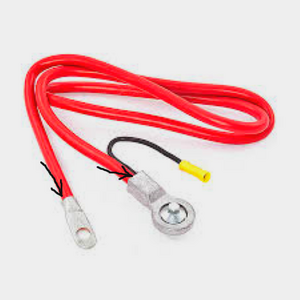
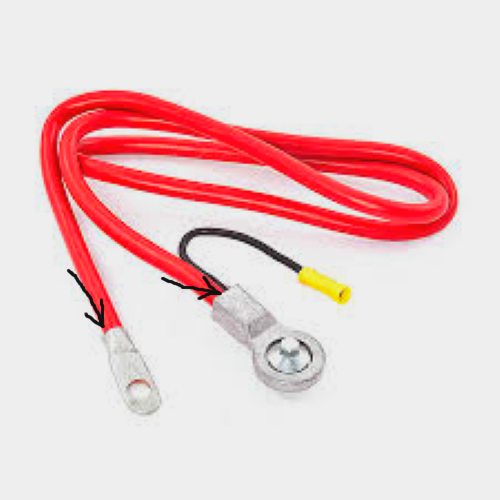
Pull back the insulation a bit at the arrows and check for green/blue corrosion; this is fairly common with poor-quality, parts-store cables:
As GD has mentioned---and something not well-understood by many when chasing electrical issues---don't rely on voltage measurements alone to verify the quality of a circuit; instead, use a test lamp that draws a few amps. "Voltage" can be measured across a drop of salty water, but it sure won't run a fuel pump---or anything else.
Yeah, a circuit may pass a measurable voltage with just a meter, but, put a load on it, and it disappears. If you have the side post terminals like pictured above, pull both, clean 'em with a wire brush, battery side also.... reinstall, and happy driving.
This sounds like one of two things (already suggested) corrosion or weak ground to me.
More than likely you have conductivity at low amperage but as soon as you increase the amp draw you are loosing conductivity.
Also even a test light will still not have enough amp draw to show this. I always suggest making a high amp test light with a old headlight or fog light or two. Use this to generate a load on the circuit in addition to a good multimeter to watch for the voltage across the same circuit.
If you turn on your headlights and then do the multi-meter or test light test you will be pulling quite a lot of amperage through the battery cable to the starter lug, so if the corrosion is there it should show up.
You can also do a cheater test and use a good heavy set of jumper cables to add an additional ground to the block from the battery.
A ground issue will often lead to electrical potential difference between two points you think is a ground. Take a good meter and test between battery negative and the block, this should be 0, test between battery negative and car frame, this should be 0, test between block and frame, this should be 0. Often time if you have a weak ground one of these will be greater than .5 volts. Do this with a heavy (turn on your headlights) and no load test that will often in my experience expose where the problem is. You can also do this test between two ground points. But do not do this test between a chassis ground and a isolated computer sensor ground, as you can spike the computer.
When you say you test voltage at the fuel pump relay and the result is "all are to ground causing nothing to work".... what do you mean by this? What are you testing here exactly and what tool are you using? GD
Thanks for all the good and prompt replies. Am digesting them, but am replying to this now because it may lead to finding the problem. But before that, this is not a daily driver and is somewhat a toy and show car. I should have said that initially. Everything is virtually new. Battery side posts are factory new - clean and solid. I will test the grounds as suggested but believe they are solid as well, but double check never hurts.
Regarding the testing of the fuel pump relay wire:
Circuit probe is hooked to +/- battery posts. Internal circuitry reports red if circuit probed is hot (+) and green if ground (-). Pic below.
I have the connector to the fuel pump relay disconnected so I can test (and matters not whether connected or not for test failure)
Before the starter test, have voltage to every test point in car which inculdes the 12v wire from the solenoid which at the relay connector reports red (+). As it should.
After the start attempt, it reports green as do all other previously red-reported test spots in car. And no headlights. Said another way, no voltage to entire car. Everything's gone to ground. And it will remain this way indefinitely.
Dis/re connect battery and all test spots back to 12v. What the . . . . . ?
Because of my admitted lack of understanding electrical, I can't grasp why after the start failure the solenoid battery post reports positive (where the fuel pump relay wire is attached) ,and 3' away at the fuel pump relay connector, the other end of the wire reports ground. And what could be resetting when the battery is dis/re connected?
Hope that guides to a solution. Please keep suggestions coming. Will report on other recommendations as time permits.
I give you credit for trying to diagnose the problem before spending money on battery and starter. That is what many people do without zero thought the battery cables and wiring between the two.
Something as simple as loose battery cables at the battery can cause this. And, like others have said, corrosion between battery cables and battery terminals. Also, look at your battery cables. That would be my first purchase before anything else. 30 year old battery cables can corrode inside the wire coating. Heat also prevents good electrical flow. Battery cables getting cooked by engine heat will eventually kill their efficiency. If your cables have gotten burned in the past, just replace them. I won't use anything less than 2 guage on my cars.
To check if you have a wiring problem losing electrical flow from starter to interior fuse box. Put a voltage meter on the fuses before and after the car is running. If you have 12.5+ volts at the starter side and not the interior side, there may be a short somewhere. The ignition switch and fuse block losing power due to a short will mimick a dead battery as well. Finding that short will completely stinks and time consuming, but it is not really hard to do. The ignition switch and fuse block losing power due to a short will mimick a dead battery as well.
Scott Liggett BluePrint Engines Product Specialist 800-483-4263 info@blueprintengines.com www.blueprintengines.com
Thanks for all the good and prompt replies. Am digesting them, but am replying to this now because it may lead to finding the problem. But before that, this is not a daily driver and is somewhat a toy and show car. I should have said that initially. Everything is virtually new. Battery side posts are factory new - clean and solid. I will test the grounds as suggested but believe they are solid as well, but double check never hurts.
Regarding the testing of the fuel pump relay wire:
Circuit probe is hooked to +/- battery posts. Internal circuitry reports red if circuit probed is hot (+) and green if ground (-). Pic below.
I have the connector to the fuel pump relay disconnected so I can test (and matters not whether connected or not for test failure)
Before the starter test, have voltage to every test point in car which inculdes the 12v wire from the solenoid which at the relay connector reports red (+). As it should.
After the start attempt, it reports green as do all other previously red-reported test spots in car. And no headlights. Said another way, no voltage to entire car. Everything's gone to ground. And it will remain this way indefinitely.
Dis/re connect battery and all test spots back to 12v. What the . . . . . ?
Because of my admitted lack of understanding electrical, I can't grasp why after the start failure the solenoid battery post reports positive (where the fuel pump relay wire is attached) ,and 3' away at the fuel pump relay connector, the other end of the wire reports ground. And what could be resetting when the battery is dis/re connected?
Hope that guides to a solution. Please keep suggestions coming. Will report on other recommendations as time permits.
When you test at the starter lug and the relay socket are you moving the ground clip on the test light? Like others said get a simple incandescent test light and try. The probe type that shows open, hot, ground can be confused by voltage potential. Especially since its a simple red/green probe its probably using the fact that LED's don't light up if hooked up in reverse. A + will light the red led and a ground will light the green because of the polarity of the LED's. But a LED can also light across two positive DC points if the voltage is different. That is if you are getting say 7vdc at the relay then the green may light as the electrical potential from 7dc to 12 dc is 5vdc. (I'm trying to simplify this). This light is going to have some sort of internal switching so you don't burn out the LEDs or go direct short to ground.
Also when testing at the starter probe are you doing so on the bolt, or one of the ring terminals?
The fact that it shows ground concerns me... Its like internally your starter is still engaged which will provide a path to ground and draw the rest of the system to a lower voltage.
When you attempt to start it does the starter in fact turn?
Got a link to the probe you are using? I would like to look at its specs.
Ok - step ONE - throw that "circuit tester" off the nearest bridge/boat dock/cliff, etc. That's a useless tool and it will only confuse the tests you need to perform. That's essentially a battery powered DVOM without the features of a real DVOM. It can't load a circuit so it tells you NOTHING useful about what you are testing. Might as well jab at it with your finger. Seriously that's a horrible tool made for people that don't understand automotive electrical.
Go buy a (quality) incandescent test light or just make one from an old bulb.... Hella makes a nice one that's like $10 and there are plenty of others out there....
You can make your own if you test how many amps they draw and label them accordingly.
The idea with a test light is that you are comparing the brightness of the bulb to a direct battery connection. A dim bulb means you have a voltage drop in the circuit. Which WILL NOT show up on a DVOM as they don't load the circuit. You can have a glob of green puss (completely corroded copper wire) and if you use a DVOM you are likely to show about the same voltage as the battery. But that voltage will disappear under a load. Think of the voltage as pressure - for example your have about 35 psi in your tires. If I want to use that air pressure to run say an air tool I need to hookup a hose to it of sufficient size to run the tool. If I just want to check the pressure in the tire I can use a tire checker at the shrader - that's like the DVOM or this tool you have shown. The test light is like a little tiny air tool. It actually uses electrical *volume* (amperage) and will be able to show a lack thereof.
That "tool" you have there is NOT for diagnostics. It's for (maybe) finding power to run accessories or wire some lights or a towing harness, etc. It's for finding power and ground on otherwise working electrical systems...... I guess. It honestly is pretty much useless in my opinion. It does not give enough information to draw any useful diagnostic conclusions.
GD
Last edited by GeneralDisorder; Aug 12, 2019 at 04:14 PM.
A silver star and a "like: for all. But not a gold star yet (more later).
The issue was truly a ground -- battery to block. But a most unusual one. The test that brought it out was disconnecting battery ground cable, Neg DVM lead to neg batt and pos lead to disconnected cable. Bingo, 0.2v. All grounds good except at the block. It was more than tight and not corroded. But, after disconnecting and inspecting the cable end, it was not truly flat where attached to block. Not bent, just not truly flat, apparently preventing solid contact. But know that this cable has been this way for over 6 years and has never been touched. Filed connector flat, reattached and it cranked. Yes! Then cranked 5 more times in a row just to make sure I wasn't dreaming. Having an extra good bottle of wine tonight.
But the reason for a silver rather than gold start is because it's troubling that dis/re connecting the batt ground cable, with no other intervention and not disturbing the poor block connection, caused voltage to return to the car. That defies logic even to an electrical incompetent. There has to be something in the car being reset. Wiring is factory El Camino but for the TPI harness. Go figure. I do have 200W of stereo powered by a separate 0 gauge cable and maybe there's something there. Time will tell.
So stay tuned. And thanks again for all the prompt and accurate responses!
I'll stick to the mechanical and programming the computers for our cars and rely upon you for this type of help.
A silver star and a "like: for all. But not a gold star yet (more later).
The issue was truly a ground -- battery to block. But a most unusual one. The test that brought it out was disconnecting battery ground cable, Neg DVM lead to neg batt and pos lead to disconnected cable. Bingo, 0.2v. All grounds good except at the block. It was more than tight and not corroded. But, after disconnecting and inspecting the cable end, it was not truly flat where attached to block. Not bent, just not truly flat, apparently preventing solid contact. But know that this cable has been this way for over 6 years and has never been touched. Filed connector flat, reattached and it cranked. Yes! Then cranked 5 more times in a row just to make sure I wasn't dreaming. Having an extra good bottle of wine tonight.
But the reason for a silver rather than gold start is because it's troubling that dis/re connecting the batt ground cable, with no other intervention and not disturbing the poor block connection, caused voltage to return to the car. That defies logic even to an electrical incompetent. There has to be something in the car being reset. Wiring is factory El Camino but for the TPI harness. Go figure. I do have 200W of stereo powered by a separate 0 gauge cable and maybe there's something there. Time will tell.
So stay tuned. And thanks again for all the prompt and accurate responses!
I'll stick to the mechanical and programming the computers for our cars and rely upon you for this type of help.
The reasons are hard to explain but what was happening was you were getting grounding through other components. You should have a small ground wire off the battery terminal to the frame rail. So you starter was engaging maxing out the current it could pull through the weak grounds. And probably the starter was hanging up in a current draw mode (or some other component, or even corrosion was working as a hot resistor to ground). So the starter was exceeding the electrical potential of the ground. You can almost think of it as the block became 12vdc. More than likely if you had a infrared camera you would of seen some wire or connection getting hot.
When you disconnected the battery this component (or corrosion) reset, allowing again a low amperage ground path to the battery. (this is why we were pushing for a higher amperage test light)
As for the ground cable if it wasn't flat you probably had light corrosion mixed with paint/corrosion. You might even have had corrosion inside the terminal that you filled and by working it got enough contact inside the connector (if this is the case it will show up again the next few times it gets wet)
Now to blow your mind... most people are taught electricity flows from hot to ground right .... well actually think about that. Electricity is electrons flowing between two potentials, and electrons are negatively charged. So in reality the electrons flow from the negative to the positive But for our purposes it is basically water pipes. Have you ever seen vapor lock in fuel lines? Its where heated gas turns to vapor, witch causes the liquid fuel to experience cavitation, which effectively stops up the line preventing additional liquid fuel from flowing past that point. The obvious way to return that flow is to reduce the pressure for a moment.
Spend some time to learn the electrical side, it will save you a lot of time and effort. I highly recommend a youtube channel called South Main Auto, he shows you how to properly diagnose problems. And I would say 90% of the cars he gets because others couldn't fix it turn out to be electrical issues, and since he is in NY a lot of that is corrosion. It really isn't that hard and you know more now than you did yesterday.
Spend some time to learn the electrical side, it will save you a lot of time and effort. I highly recommend a youtube channel called South Main Auto, he shows you how to properly diagnose problems. And I would say 90% of the cars he gets because others couldn't fix it turn out to be electrical issues, and since he is in NY a lot of that is corrosion. It really isn't that hard and you know more now than you did yesterday.
South Main Auto (Eric) is great. Also Scanner Danner (Paul) and Pine Hollow Auto Diagnostics (Ivan).
After you have subscribed to these guys for a couple years you will have a really good understanding of your electrical system. Also you will probably own a Picoscope, and at least a Snap-On scanner with a scope in it. I think I have about $20,000 invested in scopes, scan tools, and laptops.
Seriously - there's some really good content on YouTube if you listen to the right people. Paul Danner actually teaches automotive diagnostics at a trade school and has a for-profit online course you can sign up for. This is more for professional techs or shop owners like myself. He posts a lot of free content on his channel though also.
The reasons are hard to explain but what was happening was you were getting grounding through other components. You should have a small ground wire off the battery terminal to the frame rail. .
Thanks to all. That's what TGO is all about.
I do plan to visit the recommended sites and will install a ground wire to the frame because I have a small voltage drop there (0.15v). Have #0 wires to engine and body, but the frame has been ignored.




 You ARE loosing the ground , and describing the classic symptoms of it .




 But for our purposes it is basically water pipes. Have you ever seen vapor lock in fuel lines? Its where heated gas turns to vapor, witch causes the liquid fuel to experience cavitation, which effectively stops up the line preventing additional liquid fuel from flowing past that point. The obvious way to return that flow is to reduce the pressure for a moment.

