


Tuning with the EBL


Supreme Member

Joined: Dec 2001
Posts: 1,997
Likes: 12
From: Bartlett, IL
Car: 92 ZR-1
Engine: LT-5
Transmission: ZF-6
Axle/Gears: SuperDana 44 4.10
southernspeed,
I have been working on te PGs myself. Don't make big changes. Its easy to simply adjust way past the sweet spot. I try to bring it down by 2-3% at a time.
I have been working on te PGs myself. Don't make big changes. Its easy to simply adjust way past the sweet spot. I try to bring it down by 2-3% at a time.
Supreme Member
Joined: Dec 2001
Posts: 1,997
Likes: 12
From: Bartlett, IL
Car: 92 ZR-1
Engine: LT-5
Transmission: ZF-6
Axle/Gears: SuperDana 44 4.10
As I drive, I'll take motor up through rpm range in each gear. And I'll mark EBL log at points where I feel motor is surging a bit. Then I go back and drop the PG at the corresponding gms/sec in the Gain Multiplier v Airflow table. Most of my changes have been between 30-60gms/sec. I may reduce the adjacent areas just to keep everything relative. For fine tuning it I have been playing with the Gain Duration Offset. I make small changes, sometimes as I drive using the Ostrich. Its helped quite a bit. I'm just about there.

Junior Member
Joined: Jan 2006
Posts: 72
Likes: 0
From: Surrey, England
Car: '91 K5 Blazer, '05 Ram Daytona QC
As I drive, I'll take motor up through rpm range in each gear. And I'll mark EBL log at points where I feel motor is surging a bit. Then I go back and drop the PG at the corresponding gms/sec in the Gain Multiplier v Airflow table. Most of my changes have been between 30-60gms/sec. I may reduce the adjacent areas just to keep everything relative. For fine tuning it I have been playing with the Gain Duration Offset. I make small changes, sometimes as I drive using the Ostrich. Its helped quite a bit. I'm just about there.
Something else I've been thinking about(I know...dangerous to think) is my 'choke' settings. I've made some pretty drastic changes from the as supplied set up. It starts and warms up great now but I'm worried it may be hiding a different problem. Or is it normal to need to make these alterations. I've leaned up the choke afr some, increased the decay multiplier a bit, but the biggest change was the initial decay CTS threshold which I changed from 80*C to 14*C. before I did this it was really choking up.
Normal or do I have a different problem somewhere?
Supreme Member
Joined: Dec 2001
Posts: 1,997
Likes: 12
From: Bartlett, IL
Car: 92 ZR-1
Engine: LT-5
Transmission: ZF-6
Axle/Gears: SuperDana 44 4.10
Interesting, thanks. Mines barely noticeable (perhaps because it's a big heavy truck (Blazer) rather than a lighter car)but is there. I'll work on it.
Something else I've been thinking about(I know...dangerous to think) is my 'choke' settings. I've made some pretty drastic changes from the as supplied set up. It starts and warms up great now but I'm worried it may be hiding a different problem. Or is it normal to need to make these alterations. I've leaned up the choke afr some, increased the decay multiplier a bit, but the biggest change was the initial decay CTS threshold which I changed from 80*C to 14*C. before I did this it was really choking up.
Normal or do I have a different problem somewhere?
Something else I've been thinking about(I know...dangerous to think) is my 'choke' settings. I've made some pretty drastic changes from the as supplied set up. It starts and warms up great now but I'm worried it may be hiding a different problem. Or is it normal to need to make these alterations. I've leaned up the choke afr some, increased the decay multiplier a bit, but the biggest change was the initial decay CTS threshold which I changed from 80*C to 14*C. before I did this it was really choking up.
Normal or do I have a different problem somewhere?
I run a cam with a 108d LSA and 54d of overlap. So my issue has been taming the idle with quite a bit of lope and overlap. Its not uncommon to make these changes depending on the mods you've done.

Junior Member
Joined: Feb 2005
Posts: 81
Likes: 0
From: Wyoming
AFR
It would seem that if you had to lower the VE values in the lower RPM areas,the warm up(commanded) AFR would also need to be thinned out. I belive that a higher compression ratio takes less fuel as combustion efficiency has (theroreticly) been raised. This has at least been my experience. Val
Junior Member
Joined: Jan 2006
Posts: 72
Likes: 0
From: Surrey, England
Car: '91 K5 Blazer, '05 Ram Daytona QC
Looking at AE briefly. I've lowered my high MAP VE tables to try to reduce the AFR at WOT but still have a 10 or below (richer) AFR at WOT even though my BLMs are in the 139 region at that point.
Do I reduce ( a smaller negative value) the AE-RPM% table values?
Does a smaller 'pulse width' mean more or less fuel?
Thanks, Mark.
Do I reduce ( a smaller negative value) the AE-RPM% table values?
Does a smaller 'pulse width' mean more or less fuel?
Thanks, Mark.

Moderator
iTrader: (1)
Joined: Mar 2002
Posts: 18,432
Likes: 234
From: Chasing Electrons
Car: check
Engine: check
Transmission: check
The BLM of 139 will add some fuel during WOT. But not enough to make the AFR as rich as 10:1. I would continue to reduce the VE% at those MAP & RPM points that are rich. As the RPM increases the actual MAP point of the VE table may be lower then 100 KPa. It may drop into the 90 KPa area.
A smaller PW is less fuel. The PW is the amount of time the injector is open and flowing fuel.
A more negative value for the AE RPM% multiplier is less AE. Example: -50% is less AE then -25%.
The AE PW and the TPS & MAP contributions can be found in the Analysis Dump log. There is also the Y/N status for AE that shows when it is active.
RBob.
A smaller PW is less fuel. The PW is the amount of time the injector is open and flowing fuel.
A more negative value for the AE RPM% multiplier is less AE. Example: -50% is less AE then -25%.
The AE PW and the TPS & MAP contributions can be found in the Analysis Dump log. There is also the Y/N status for AE that shows when it is active.
RBob.
Junior Member
Joined: Jan 2006
Posts: 72
Likes: 0
From: Surrey, England
Car: '91 K5 Blazer, '05 Ram Daytona QC
The BLM of 139 will add some fuel during WOT. But not enough to make the AFR as rich as 10:1. I would continue to reduce the VE% at those MAP & RPM points that are rich. As the RPM increases the actual MAP point of the VE table may be lower then 100 KPa. It may drop into the 90 KPa area.
A smaller PW is less fuel. The PW is the amount of time the injector is open and flowing fuel.
A more negative value for the AE RPM% multiplier is less AE. Example: -50% is less AE then -25%.
The AE PW and the TPS & MAP contributions can be found in the Analysis Dump log. There is also the Y/N status for AE that shows when it is active.
RBob.
A smaller PW is less fuel. The PW is the amount of time the injector is open and flowing fuel.
A more negative value for the AE RPM% multiplier is less AE. Example: -50% is less AE then -25%.
The AE PW and the TPS & MAP contributions can be found in the Analysis Dump log. There is also the Y/N status for AE that shows when it is active.
RBob.
I've just noticed that it's all PE not AE as I assumed at those rich afr's.
example
rpm.3050,mph.75,map96,tps96,sPW7.9,DC80,PE. 128/139ve,IAC145,WB10:1
I'll lower the high MAP VE table points a bit and give it another run. I can feel myself starting to tie myself in knots here! I want to get the AFR at WOT down a bit as I'll be up in the mountains next week.
Thanks again. Mark.
Moderator
iTrader: (1)
Joined: Mar 2002
Posts: 18,432
Likes: 234
From: Chasing Electrons
Car: check
Engine: check
Transmission: check
The BLM of 139 is from before the ECM went into PE/WOT mode. When the ECM enters PE mode the BLM is locked at it's current setting, and the INT is locked at 128. If the BLM is less then 128 it is not used in PE mode. Above 128 and it is used. This is a safety feature to prevent leaning during PE/WOT mode.
As you noticed the Zietronix (and most WB units) don't read below 10:1 AFR.
RBob.
As you noticed the Zietronix (and most WB units) don't read below 10:1 AFR.
RBob.
Junior Member
Joined: Jan 2006
Posts: 72
Likes: 0
From: Surrey, England
Car: '91 K5 Blazer, '05 Ram Daytona QC
The BLM of 139 is from before the ECM went into PE/WOT mode. When the ECM enters PE mode the BLM is locked at it's current setting, and the INT is locked at 128. If the BLM is less then 128 it is not used in PE mode. Above 128 and it is used. This is a safety feature to prevent leaning during PE/WOT mode.
As you noticed the Zietronix (and most WB units) don't read below 10:1 AFR.
RBob.
As you noticed the Zietronix (and most WB units) don't read below 10:1 AFR.
RBob.
Many thanks, sorry to be so slow on the uptake!
Mark.

Member
iTrader: (2)
Joined: Dec 2006
Posts: 222
Likes: 0
From: Tacoma, WA
Car: '91 Chevy 1500
Engine: 350
Transmission: 700R4
Axle/Gears: 3.73
Just got my EBL today and I can hardly wait to get started with tuning. As all of you know, the first step is setting up a "base" for the new bin.
First question, since the VE has a learn function, would I want to set the BLM-RPM learn threshold higher than 3600 because of the extended tables?
In the WUD information, it says "The checksum is calculated and set in the BIN, ready to burn". What is the checksum supposed to be in the first bin?
Lastly, I just started having some intermittent problems with my Autoprom running in emulation mode, and someone suggested disabling the checksum. Any thoughts? Am I supposed to figure out how to disable the checksum or let the EBL update it?
First question, since the VE has a learn function, would I want to set the BLM-RPM learn threshold higher than 3600 because of the extended tables?
In the WUD information, it says "The checksum is calculated and set in the BIN, ready to burn". What is the checksum supposed to be in the first bin?
Lastly, I just started having some intermittent problems with my Autoprom running in emulation mode, and someone suggested disabling the checksum. Any thoughts? Am I supposed to figure out how to disable the checksum or let the EBL update it?
Last edited by Pre-Tuner; Jan 17, 2007 at 11:07 PM.
Moderator
iTrader: (1)
Joined: Mar 2002
Posts: 18,432
Likes: 234
From: Chasing Electrons
Car: check
Engine: check
Transmission: check
If using the BLM learn then yes, you can raise this threshold. There is also the min & max MAP thresholds that can be opened up.
In the WUD information, it says "The checksum is calculated and set in the BIN, ready to burn". What is the checksum supposed to be in the first bin?
The BIN as supplied has the checksum set. When changes are made via TP it too re-calcs and sets the proper checksum value. Then with a VE Learn the checksum is calc'd and set via the WUD software.
Lastly, I just started having some intermittent problems with my Autoprom running in emulation mode, and someone suggested disabling the checksum. Any thoughts? Am I supposed to figure out how to disable the checksum or let the EBL update it?
To disable the checksum set the MaskID to $AA (170 decimal). It is currently set to $55 (85 decimal). With the MaskID set to $AA the ECM code skips the checksum check. So if it is incorrect the code doesn't care.
The code tests the checksum at each power up or if the code resets.
RBob.

Senior Member

Joined: Aug 2004
Posts: 682
Likes: 0
From: Shippensburg, PA
Car: 1981 Buick Century Wagon
Engine: 87 GN engine
Transmission: 2004R
Axle/Gears: 3.73
inj voltage corecction
Hey all. I just realized after having the EBL forever, that there is a correction for voltage changes to the fuel pump, which I have a big problem with, (stereo ). So, I tuned my VE tables oblivious to the fact that the FP voltage was like 12.8 vdc, now today I was driving it to work with EVERYTHING off, the voltage up to 14.2 vdc, and the VE tables were rich by 4-6. So, the question is how does the INJ CORRECTION table work? Does it modify the VE table? etc??
Thanx guys.
). So, I tuned my VE tables oblivious to the fact that the FP voltage was like 12.8 vdc, now today I was driving it to work with EVERYTHING off, the voltage up to 14.2 vdc, and the VE tables were rich by 4-6. So, the question is how does the INJ CORRECTION table work? Does it modify the VE table? etc??Thanx guys.
Moderator
iTrader: (1)
Joined: Mar 2002
Posts: 18,432
Likes: 234
From: Chasing Electrons
Car: check
Engine: check
Transmission: check
The injector correction tables act directly on the PW.
The multiplier table increases or decreases it by a percentage. This is used as a global change the PW value. Recommended for changing the fueling on both low & high injector PW's.
The offset table increases or decreases the PW by a set amount. This is used to make changes to small PW's. By adding to a PW the smaller the PW the greater the affect.
In your case if the BLM change is across the board PW wise, I would change the multiplier table. If there is more of an affect in the lower PW values, then change the offset table.
RBob.
The multiplier table increases or decreases it by a percentage. This is used as a global change the PW value. Recommended for changing the fueling on both low & high injector PW's.
The offset table increases or decreases the PW by a set amount. This is used to make changes to small PW's. By adding to a PW the smaller the PW the greater the affect.
In your case if the BLM change is across the board PW wise, I would change the multiplier table. If there is more of an affect in the lower PW values, then change the offset table.
RBob.
Senior Member
Joined: Aug 2004
Posts: 682
Likes: 0
From: Shippensburg, PA
Car: 1981 Buick Century Wagon
Engine: 87 GN engine
Transmission: 2004R
Axle/Gears: 3.73
Ok, I think I got it. For example, my VE tables in the mid rpm range, 1800 to 2600, from 35 kpa to 50 kpa, are lower than everything else. This is where I cruise at lower PW. Could I change the offset table to make PW changes that would affect this are in the VE table??
Also, what does increasing the offset value do? Increase the PW, or decrease it?
Same for the multiplier. Sorry, I don't have my craptop in front of me now.
AE Tuning question
I've been playing with the tune on this car for some time. I still haven't got the AE figured out for the car. If I turn the AE up to keep it from popping under load, and a throttle blip, it bogs rich during the first few soconds, then leans out. rich as in 11.1:1 AFR. If I lower the AE, it doesn't bog for the first few seconds, but goes lean after those first few seconds. Any recommendations??
I also now have to redo the who VE table cause I tuned it with the Fp voltage being at like 12 - 12.5 vdc, instaed of 14 - 14.4 vdc.
Also, what does increasing the offset value do? Increase the PW, or decrease it?
Same for the multiplier. Sorry, I don't have my craptop in front of me now.
AE Tuning question
I've been playing with the tune on this car for some time. I still haven't got the AE figured out for the car. If I turn the AE up to keep it from popping under load, and a throttle blip, it bogs rich during the first few soconds, then leans out. rich as in 11.1:1 AFR. If I lower the AE, it doesn't bog for the first few seconds, but goes lean after those first few seconds. Any recommendations??
I also now have to redo the who VE table cause I tuned it with the Fp voltage being at like 12 - 12.5 vdc, instaed of 14 - 14.4 vdc.
Member
iTrader: (2)
Joined: Dec 2006
Posts: 222
Likes: 0
From: Tacoma, WA
Car: '91 Chevy 1500
Engine: 350
Transmission: 700R4
Axle/Gears: 3.73
OK, got a couple of EBL questions.
First off, for the record, the EBL is the best thing I've done for my truck yet. I love it, and I recommend it to anyone that can get it.
Now the questions. The DC%, is there a "correct" range for this? I see people on here talking about not going over 100%, but mine just cruising around is like at 4 or 5.
Last one for now, on the malfunction code display, there are three boxes for each code. What are these boxes for? I disabled the IAT flag because I don't have one, and the first box is flashing.
First off, for the record, the EBL is the best thing I've done for my truck yet. I love it, and I recommend it to anyone that can get it.
Now the questions. The DC%, is there a "correct" range for this? I see people on here talking about not going over 100%, but mine just cruising around is like at 4 or 5.
Last one for now, on the malfunction code display, there are three boxes for each code. What are these boxes for? I disabled the IAT flag because I don't have one, and the first box is flashing.
Moderator
iTrader: (1)
Joined: Mar 2002
Posts: 18,432
Likes: 234
From: Chasing Electrons
Car: check
Engine: check
Transmission: check
Ok, I think I got it. For example, my VE tables in the mid rpm range, 1800 to 2600, from 35 kpa to 50 kpa, are lower than everything else. This is where I cruise at lower PW. Could I change the offset table to make PW changes that would affect this are in the VE table??
Also, what does increasing the offset value do? Increase the PW, or decrease it?
Same for the multiplier. Sorry, I don't have my craptop in front of me now.
AE Tuning question
I've been playing with the tune on this car for some time. I still haven't got the AE figured out for the car. If I turn the AE up to keep it from popping under load, and a throttle blip, it bogs rich during the first few soconds, then leans out. rich as in 11.1:1 AFR. If I lower the AE, it doesn't bog for the first few seconds, but goes lean after those first few seconds. Any recommendations??
I also now have to redo the who VE table cause I tuned it with the Fp voltage being at like 12 - 12.5 vdc, instaed of 14 - 14.4 vdc.
Also, what does increasing the offset value do? Increase the PW, or decrease it?
Same for the multiplier. Sorry, I don't have my craptop in front of me now.
AE Tuning question
I've been playing with the tune on this car for some time. I still haven't got the AE figured out for the car. If I turn the AE up to keep it from popping under load, and a throttle blip, it bogs rich during the first few soconds, then leans out. rich as in 11.1:1 AFR. If I lower the AE, it doesn't bog for the first few seconds, but goes lean after those first few seconds. Any recommendations??
I also now have to redo the who VE table cause I tuned it with the Fp voltage being at like 12 - 12.5 vdc, instaed of 14 - 14.4 vdc.
In your case with OK BLM's at 12.4 V, and high at 14.4 V, decrease the offset a little above 12.4 V to above 14.4 V.
AE: lower it so the bog goes away. Then decrease the filter values for TPS & MAP. These are Filter vs CTS for each. The lower filter values will increase the duration of the AE.
RBob.
Moderator
iTrader: (1)
Joined: Mar 2002
Posts: 18,432
Likes: 234
From: Chasing Electrons
Car: check
Engine: check
Transmission: check
OK, got a couple of EBL questions.
First off, for the record, the EBL is the best thing I've done for my truck yet. I love it, and I recommend it to anyone that can get it.
Now the questions. The DC%, is there a "correct" range for this? I see people on here talking about not going over 100%, but mine just cruising around is like at 4 or 5.
Last one for now, on the malfunction code display, there are three boxes for each code. What are these boxes for? I disabled the IAT flag because I don't have one, and the first box is flashing.
First off, for the record, the EBL is the best thing I've done for my truck yet. I love it, and I recommend it to anyone that can get it.
Now the questions. The DC%, is there a "correct" range for this? I see people on here talking about not going over 100%, but mine just cruising around is like at 4 or 5.
Last one for now, on the malfunction code display, there are three boxes for each code. What are these boxes for? I disabled the IAT flag because I don't have one, and the first box is flashing.
The low 4 to 5% is typical during cruise conditions. Low RPM & low load (MAP).
The malfunction display: the way the diags work is that when an error is first discovered it is flagged. That is the first column of lights. At this point the ECM may use a default value in place of the sensor value.
If the error persists then another flag is set. This is the second column of lights. At this point the SES light may be illuminated.
Once the error stays for a while the third (last) column will be lit up. This will also set the code in memory. This is the code that will get pulled via the AB jumper and SES light flash. Or, via a scan tool.
RBob.
Member
iTrader: (2)
Joined: Dec 2006
Posts: 222
Likes: 0
From: Tacoma, WA
Car: '91 Chevy 1500
Engine: 350
Transmission: 700R4
Axle/Gears: 3.73
I'm back with a few more questions. I finally got my WBO2 installed and wow, what a great investment. I ran another log and I see some stuff I don't understand. When I jump on it, for a few frames, the sPW jumps to above 10 and one frame the DC% jumps to 124. The 124 frame is the only one, all the rest are below 99. Is this normal to have these spikes? How many frames can this happen to before I need to start taking action?
Now, with this handy WBO2 I just installed, I can tell that when I put'er to the wood, she leans out just after the initial pump shot, as the AEPW decays, then gets richer again. Is this how I can use the EBL to tell if my AE needs adjusting?
When I go to do the VE learn, the instructions say to have the key-on (init) BLM values set to 128, which seems to be done already. What about the closed loop BLM values?
One last thing, should the decel fuel readings show about 14.7 also?
Now, with this handy WBO2 I just installed, I can tell that when I put'er to the wood, she leans out just after the initial pump shot, as the AEPW decays, then gets richer again. Is this how I can use the EBL to tell if my AE needs adjusting?
When I go to do the VE learn, the instructions say to have the key-on (init) BLM values set to 128, which seems to be done already. What about the closed loop BLM values?
One last thing, should the decel fuel readings show about 14.7 also?
Last edited by Pre-Tuner; Feb 1, 2007 at 11:51 PM.
Junior Member
Joined: Jan 2006
Posts: 72
Likes: 0
From: Surrey, England
Car: '91 K5 Blazer, '05 Ram Daytona QC
I'm back with a few more questions. I finally got my WBO2 installed and wow, what a great investment. I ran another log and I see some stuff I don't understand. When I jump on it, for a few frames, the sPW jumps to above 10 and one frame the DC% jumps to 124. The 124 frame is the only one, all the rest are below 99. Is this normal to have these spikes? How many frames can this happen to before I need to start taking action?
Now, with this handy WBO2 I just installed, I can tell that when I put'er to the wood, she leans out just after the initial pump shot, as the AEPW decays, then gets richer again. Is this how I can use the EBL to tell if my AE needs adjusting?
When I go to do the VE learn, the instructions say to have the key-on (init) BLM values set to 128, which seems to be done already. What about the closed loop BLM values?
One last thing, should the decel fuel readings show about 14.7 also?
Now, with this handy WBO2 I just installed, I can tell that when I put'er to the wood, she leans out just after the initial pump shot, as the AEPW decays, then gets richer again. Is this how I can use the EBL to tell if my AE needs adjusting?
When I go to do the VE learn, the instructions say to have the key-on (init) BLM values set to 128, which seems to be done already. What about the closed loop BLM values?
One last thing, should the decel fuel readings show about 14.7 also?
Get your VE tables as good as you can before you start messing with other stuff. I've found that many other functions (PE, EGR, Lean Cruise etc are all based upon the VE tables, so if they're way out, everything will be.)
Go back a few pages, or preferably to the first page and read. Stuff you don't understand....ask rather than struggle blindly on. All the details for setting up for WB VE learn are covered as are more advanced stuff for later.
Good luck with it. You're going to love doing the tuning....it's addictive!

Quote:When I jump on it, for a few frames, the sPW jumps to above 10 and one frame the DC% jumps to 124. The 124 frame is the only one, all the rest are below 99. Is this normal to have these spikes? How many frames can this happen to before I need to start taking action?
I have not logged since November but i too have seen DC% over 100%(EBL) for a short period of time when under heavy accelleration. my concern is not so much a few frames as you describe but more so over say DC at 90% in a long protracted accelleration under load. i hesitate to keep feeding it fuel as it will disturb my underlying tune. will do so if need be. I think that is the AE you are dealing with. PE is what I would hang my hat on. last i checked i was 95% DC flirting with 100 with PE mode. My WB logs showed 13.0/1 in some logs and 12.7/1 in others commanded to 12.7/1. I have not worked much on PE due to lack of suitable roadway and time allowed to get a long PE run. are you looking at your WB logs outside of EBL? I use Logworks and it gives me detailed AE and PE logs to review. dont think EBL can read WB vs AE-PE and give you that meaningful info . i could be wrong and often am. i would concentrate on the underlying tune in CL then progress to AE and then finally PE. getting past Ae can be a bitch.
I have not logged since November but i too have seen DC% over 100%(EBL) for a short period of time when under heavy accelleration. my concern is not so much a few frames as you describe but more so over say DC at 90% in a long protracted accelleration under load. i hesitate to keep feeding it fuel as it will disturb my underlying tune. will do so if need be. I think that is the AE you are dealing with. PE is what I would hang my hat on. last i checked i was 95% DC flirting with 100 with PE mode. My WB logs showed 13.0/1 in some logs and 12.7/1 in others commanded to 12.7/1. I have not worked much on PE due to lack of suitable roadway and time allowed to get a long PE run. are you looking at your WB logs outside of EBL? I use Logworks and it gives me detailed AE and PE logs to review. dont think EBL can read WB vs AE-PE and give you that meaningful info . i could be wrong and often am. i would concentrate on the underlying tune in CL then progress to AE and then finally PE. getting past Ae can be a bitch.
Quote:When I jump on it, for a few frames, the sPW jumps to above 10 and one frame the DC% jumps to 124. The 124 frame is the only one, all the rest are below 99. Is this normal to have these spikes? How many frames can this happen to before I need to start taking action?
I have not logged since November but i too have seen DC% over 100%(EBL) for a short period of time when under heavy accelleration. my concern is not so much a few frames as you describe but more so over say DC at 90% in a long protracted accelleration under load. i hesitate to keep feeding it fuel as it will disturb my underlying tune. will do so if need be. I think that is the AE you are dealing with. PE is what I would hang my hat on. last i checked i was 95% DC flirting with 100 with PE mode. My WB logs showed 13.0/1 in some logs and 12.7/1 in others commanded to 12.7/1. I have not worked much on PE due to lack of suitable roadway and time allowed to get a long PE run. are you looking at your WB logs outside of EBL? I use Logworks and it gives me detailed AE and PE logs to review. dont think EBL can read WB vs AE-PE and give you that meaningful info . i could be wrong and often am. i would concentrate on the underlying tune in CL then progress to AE and then finally PE. getting past Ae can be a bitch.
I have not logged since November but i too have seen DC% over 100%(EBL) for a short period of time when under heavy accelleration. my concern is not so much a few frames as you describe but more so over say DC at 90% in a long protracted accelleration under load. i hesitate to keep feeding it fuel as it will disturb my underlying tune. will do so if need be. I think that is the AE you are dealing with. PE is what I would hang my hat on. last i checked i was 95% DC flirting with 100 with PE mode. My WB logs showed 13.0/1 in some logs and 12.7/1 in others commanded to 12.7/1. I have not worked much on PE due to lack of suitable roadway and time allowed to get a long PE run. are you looking at your WB logs outside of EBL? I use Logworks and it gives me detailed AE and PE logs to review. dont think EBL can read WB vs AE-PE and give you that meaningful info . i could be wrong and often am. i would concentrate on the underlying tune in CL then progress to AE and then finally PE. getting past Ae can be a bitch.
Member
iTrader: (2)
Joined: Dec 2006
Posts: 222
Likes: 0
From: Tacoma, WA
Car: '91 Chevy 1500
Engine: 350
Transmission: 700R4
Axle/Gears: 3.73
I was actually going to call Innovate about Logworks. It seems that it won't recognize the port on my computer as being connected, but the LM Programmer, as well as EBL, work great.
I may need to kick up the fuel pressure a bit more, but I'm thinking the spikes are nothing to worry about. I'm running 85lb hr @ 21psi injectors with 22psi going to them. I can't count how many times I've "started over", but now that I finally have the WB, this should be the last time.
I may need to kick up the fuel pressure a bit more, but I'm thinking the spikes are nothing to worry about. I'm running 85lb hr @ 21psi injectors with 22psi going to them. I can't count how many times I've "started over", but now that I finally have the WB, this should be the last time.
85 lbs? GM? i have 80 lbs GM at 20 lbs so am using same fueling as you. i have several VE cells at 90+ last i looked. i am fudging the BPC somewhat(10-20 points) to get VE under 100. will swap out the fuel filter this spring when i reapproach tuning. it was suggested that may be reason of super high VE cells. here are so many variables it makes your head spin.
Junior Member
Joined: Feb 2005
Posts: 81
Likes: 0
From: Wyoming
SAAAAA thar RRRBob
Am way confused as to how the coolant comp SA table ties in with the main SA table. Is their interaction done thru the SA coolant comp.bias?(derived from IAT/CTS comp. bias?) I have read the calibration about this but still can't put it together. Would you be so kind as to illuminate upon as to how the final SA is determined?, Thanks, Val
Senior Member
Joined: Aug 2004
Posts: 682
Likes: 0
From: Shippensburg, PA
Car: 1981 Buick Century Wagon
Engine: 87 GN engine
Transmission: 2004R
Axle/Gears: 3.73
asynch mode, EBL
Ok, I enabled asynch mode. I went thrue a WOT run and my AFR was much leaner than when I left it in sych mode. from 12.7-12.8 up to 13.9. How do I richen it up with the asynch more?? Thanx guys. The reason I changed it was to get the DC out of the 85-89% range.
Moderator
iTrader: (1)
Joined: Mar 2002
Posts: 18,432
Likes: 234
From: Chasing Electrons
Car: check
Engine: check
Transmission: check
Am way confused as to how the coolant comp SA table ties in with the main SA table. Is their interaction done thru the SA coolant comp.bias?(derived from IAT/CTS comp. bias?) I have read the calibration about this but still can't put it together. Would you be so kind as to illuminate upon as to how the final SA is determined?, Thanks, Val
In the stock EBL bin the IAT/CTS SA is set the same as its bias SA. So that table does not make any change to the final SA (as provided).
The Coolant SA table is biased at 10deg.
Since the ECU format does not support the automatic subtraction of a bias value, I made the XDF the same. This is for consistency between the two formats.
RBob.
Moderator
iTrader: (1)
Joined: Mar 2002
Posts: 18,432
Likes: 234
From: Chasing Electrons
Car: check
Engine: check
Transmission: check
Depending upon the RPM of the sync mode 85-89% DC, it may be OK to leave it in sync mode. Using injector DC% is not exactly the fully correct method. That is why the high RPM/MAP async mode needs to have a high DC%, such as 90-95%.
What is really required is enough injector off time. At low(er) RPM a DC of 95% can provide that. Once at say 6,000 RPM, a 95% DC is not enough injector off time.
RBob.


Joined: Jan 2005
Posts: 10,450
Likes: 508
From: Hurst, Texas
Car: 1983 G20 Chevy
Engine: 305 TPI
Transmission: 4L60
Axle/Gears: 14 bolt with 3.07 gears
I take it this is the high RPM & MAP async mode? When using this mode the async DC% needs to be high, in the 90% range. To add fuel it probably be best to tweak the 'INJ - Async Multiplier' table. The values in this table are used to convert the sync PW to an equivalent async PW.
Depending upon the RPM of the sync mode 85-89% DC, it may be OK to leave it in sync mode. Using injector DC% is not exactly the fully correct method. That is why the high RPM/MAP async mode needs to have a high DC%, such as 90-95%.
What is really required is enough injector off time. At low(er) RPM a DC of 95% can provide that. Once at say 6,000 RPM, a 95% DC is not enough injector off time.
RBob.
Depending upon the RPM of the sync mode 85-89% DC, it may be OK to leave it in sync mode. Using injector DC% is not exactly the fully correct method. That is why the high RPM/MAP async mode needs to have a high DC%, such as 90-95%.
What is really required is enough injector off time. At low(er) RPM a DC of 95% can provide that. Once at say 6,000 RPM, a 95% DC is not enough injector off time.
RBob.
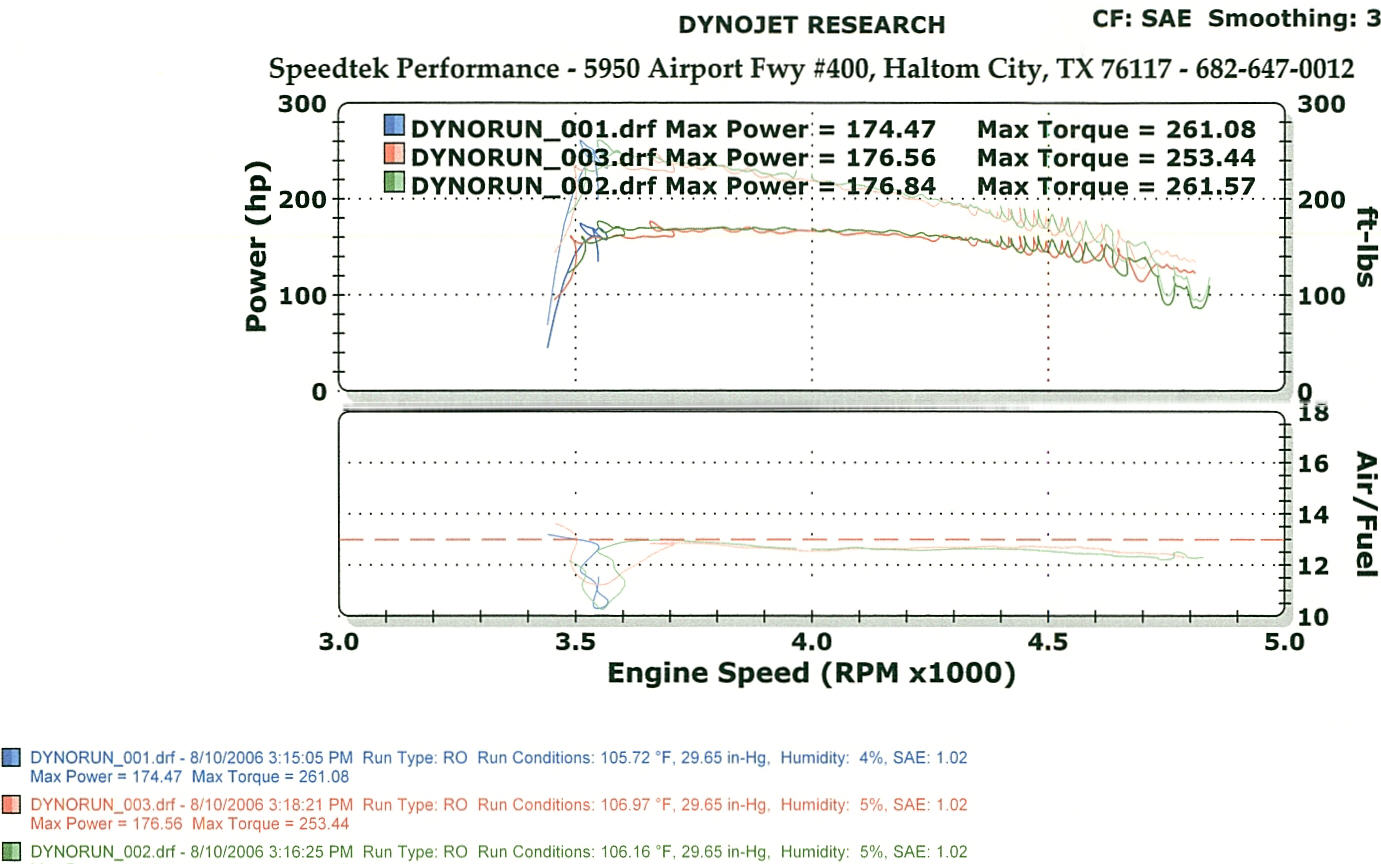
Here is what using asynch did to my stockish 350 at higher RPMs and load, without sufficient DC to begin with.
Moderator
iTrader: (1)
Joined: Mar 2002
Posts: 18,432
Likes: 234
From: Chasing Electrons
Car: check
Engine: check
Transmission: check
Junior Member
Joined: Jan 2006
Posts: 72
Likes: 0
From: Surrey, England
Car: '91 K5 Blazer, '05 Ram Daytona QC
RBob. Now I've got my fuelling pretty good and my PE afr a bit better (still dips into high 11s sometimes but generally mid 12s) I was thinking of messing with spark timing as it seems kind of flat at highway overtake speeds. It used to overtake well from 65-70mph, accelerating well up to over 100mph but now I put my foot down and it seems to take an age to get there.
The main spark table 'seems' to be quite conservative, is that correct?
If so should I start increasing it across the board or just in higher map areas?
Or is there another aspect of the SA tables I should be addressing?
By the way, my road/wheeling trip went really well, the truck running perfectly for 2000 highway miles and crawling over the French Alps at 1500 to 2500 metres altitude at minus 10 to 20c with no issues at all! Very pleased!
Thanks, Mark.
The main spark table 'seems' to be quite conservative, is that correct?
If so should I start increasing it across the board or just in higher map areas?
Or is there another aspect of the SA tables I should be addressing?
By the way, my road/wheeling trip went really well, the truck running perfectly for 2000 highway miles and crawling over the French Alps at 1500 to 2500 metres altitude at minus 10 to 20c with no issues at all! Very pleased!
Thanks, Mark.
Member
iTrader: (2)
Joined: Dec 2006
Posts: 222
Likes: 0
From: Tacoma, WA
Car: '91 Chevy 1500
Engine: 350
Transmission: 700R4
Axle/Gears: 3.73
OK, another dumb question. If the commanded AFR in PE is 12.8 (for instance) the ECM would try to keep it at 12.8, right? The what the heck is the 100map section of the VE table for if the ECM is getting it's direction from the PE commanded AFR table?
Moderator
iTrader: (1)
Joined: Mar 2002
Posts: 18,432
Likes: 234
From: Chasing Electrons
Car: check
Engine: check
Transmission: check
Common misconception, the VE table is used all of the time. Cranking, cruise, decel, PE, hiway mode. . . The basic equation for the PW is along the lines of:
PW = ~AFR * VE * ~T * MAP
The '~' is for the inverse function, AFR increases, the PW decreases. The AFR being the commanded, or desired air fuel ratio. This is changed to suit the conditions, lean when in hiway mode, rich (real rich) when cranking, stoich when in closed loop.
RBob.
PW = ~AFR * VE * ~T * MAP
The '~' is for the inverse function, AFR increases, the PW decreases. The AFR being the commanded, or desired air fuel ratio. This is changed to suit the conditions, lean when in hiway mode, rich (real rich) when cranking, stoich when in closed loop.
RBob.

Supreme Member
iTrader: (2)
Joined: Jan 2002
Posts: 9,962
Likes: 5
From: Moorestown, NJ
Car: 88 Camaro SC
Engine: SFI'd 350
Transmission: TKO 500
Axle/Gears: 9-bolt w/ 3.23's
RBob, have you considered using cranking PW tables instead of the VE? I started using these on my C3 early on and from the factory the P6 has the cranking PW tables as well as variable multipliers based on how many reference pulses have been recieved. The PCM first primes the manifold with a few large shots and then leans out for startup. Really helps get the engine going and gives a lot more control over the startup fueling as well. With teh stock C3 code, I either had to deal with protracted cranking or with flooding. While the C3 cant count individual DRP pulses, you could use a timer based on the DRP period. IIRC, the C3 also has the cranking input if Im not mistaken.
Moderator
iTrader: (1)
Joined: Mar 2002
Posts: 18,432
Likes: 234
From: Chasing Electrons
Car: check
Engine: check
Transmission: check
I've considered using PW based cranking tables. But never did step up to trying them. The code as it is now has a cranking RPM multiplier along with the commanded AFR vs CTS table. Works decent, if the engine starts, its OK. So I was never inclined to go further with it. I should probably try it out.
What I have found is that how quickly the fuel pressure comes up has a lot to do with crank time. The stock TBI regulators (and a lot of aftermarket ones) do not hold pressure when the pump shuts off. This hurts start up.
The C3 ECMs have a status word that shows when a DRP and other actions occur. So doing crank fuel via DRP is feasable.
RBob.
What I have found is that how quickly the fuel pressure comes up has a lot to do with crank time. The stock TBI regulators (and a lot of aftermarket ones) do not hold pressure when the pump shuts off. This hurts start up.
The C3 ECMs have a status word that shows when a DRP and other actions occur. So doing crank fuel via DRP is feasable.
RBob.
Joined: Jan 2005
Posts: 10,450
Likes: 508
From: Hurst, Texas
Car: 1983 G20 Chevy
Engine: 305 TPI
Transmission: 4L60
Axle/Gears: 14 bolt with 3.07 gears
I've considered using PW based cranking tables. But never did step up to trying them. The code as it is now has a cranking RPM multiplier along with the commanded AFR vs CTS table. Works decent, if the engine starts, its OK. So I was never inclined to go further with it. I should probably try it out.
What I have found is that how quickly the fuel pressure comes up has a lot to do with crank time. The stock TBI regulators (and a lot of aftermarket ones) do not hold pressure when the pump shuts off. This hurts start up.
The C3 ECMs have a status word that shows when a DRP and other actions occur. So doing crank fuel via DRP is feasable.
RBob.
What I have found is that how quickly the fuel pressure comes up has a lot to do with crank time. The stock TBI regulators (and a lot of aftermarket ones) do not hold pressure when the pump shuts off. This hurts start up.
The C3 ECMs have a status word that shows when a DRP and other actions occur. So doing crank fuel via DRP is feasable.
RBob.
I have a TPI pump in the tank and plugged the little bypass port in the regulator with JB weld. Its been 6 months and still holds about 20 PSI overnight.
Supreme Member
iTrader: (2)
Joined: Jan 2002
Posts: 9,962
Likes: 5
From: Moorestown, NJ
Car: 88 Camaro SC
Engine: SFI'd 350
Transmission: TKO 500
Axle/Gears: 9-bolt w/ 3.23's
Ive noticed that as well with mine. Once its off, pressure falls like a brick. Another neat thing that they did in the later years was to move control of the fuel pump into the code so it could be run for a desired ammount of time. They set the pump to run for 10 seconds so the pump would be running as soon as you start cranking the motor. In the later years, the cranking input probably wasnt needed as the DRPs generated interrupts in the computer and all the hardware is controlled at the code level.
Probably the biggest single help is the variable fueling based on the DRPs. Really helps get the motor started with a larger manifold. The cranking pulsewidth basically does the same thing as the VE table and modifiers, but it decouples the startup and run fueling, so a change to the VE table wont change the startup. Theres definatly alot of cool stuff in the PCMs that could be a nice addition to the U-TBI code.
Probably the biggest single help is the variable fueling based on the DRPs. Really helps get the motor started with a larger manifold. The cranking pulsewidth basically does the same thing as the VE table and modifiers, but it decouples the startup and run fueling, so a change to the VE table wont change the startup. Theres definatly alot of cool stuff in the PCMs that could be a nice addition to the U-TBI code.
Last edited by dimented24x7; Feb 5, 2007 at 09:55 PM.
Moderator
iTrader: (1)
Joined: Mar 2002
Posts: 18,432
Likes: 234
From: Chasing Electrons
Car: check
Engine: check
Transmission: check
I know it probably sounds crazy, but the C3 crank input is only used by the code for the fuel pump relay malfunction test. For startup: if the engine isn't running and DRP's occur, then it must be cranking.
RBob.
RBob.
Moderator
iTrader: (1)
Joined: Mar 2002
Posts: 18,432
Likes: 234
From: Chasing Electrons
Car: check
Engine: check
Transmission: check
RBob. Now I've got my fuelling pretty good and my PE afr a bit better (still dips into high 11s sometimes but generally mid 12s) I was thinking of messing with spark timing as it seems kind of flat at highway overtake speeds. It used to overtake well from 65-70mph, accelerating well up to over 100mph but now I put my foot down and it seems to take an age to get there.
The main spark table 'seems' to be quite conservative, is that correct?
If so should I start increasing it across the board or just in higher map areas?
Or is there another aspect of the SA tables I should be addressing?
By the way, my road/wheeling trip went really well, the truck running perfectly for 2000 highway miles and crawling over the French Alps at 1500 to 2500 metres altitude at minus 10 to 20c with no issues at all! Very pleased!
Thanks, Mark.
The main spark table 'seems' to be quite conservative, is that correct?
If so should I start increasing it across the board or just in higher map areas?
Or is there another aspect of the SA tables I should be addressing?
By the way, my road/wheeling trip went really well, the truck running perfectly for 2000 highway miles and crawling over the French Alps at 1500 to 2500 metres altitude at minus 10 to 20c with no issues at all! Very pleased!
Thanks, Mark.
What heads and cam are you running? I'll see if I can make a suggestion for the main SA table.
Glad to hear the trip went well. Sounds like a fun time.
RBob.
Junior Member
Joined: Jan 2006
Posts: 72
Likes: 0
From: Surrey, England
Car: '91 K5 Blazer, '05 Ram Daytona QC
Trip was fantastic thanks. A lifetime of memories!!
My motor is an LO5 with a +030 bore, flat tops, stock LO5 heads(although my motor is a '91 these heads are off of an '89 or '90 I believe), Edelbrock performer cam and intake manifold. Ehaust manifolds are stock with a 2:1, 3" system, freeflowing and no cat.I am running IAT in the stock aircleaner (waxstat)
I'm still running the SA tables you originally sent me with the later .bin ( 9 pin OBA high idle ).
Any starting point suggestions appreciated. It will run great throughout the rev range ( I only use idle to around 4500 max) and will run fine at 100mph if you stay out of PE getting there(although a touch lean-explained later), but if you try to accelerate from say 70 mph WOT it struggles to pick up any speed and feels so flat. WB o2 at this point (WOT from 70 mph) is generally in the mid to low 12s.
I've found that to get the WBo2 in that region at 90-100 map I've had to really thin out the VE tables up there. My 80 map tables are higher than my 90-100. If I reduce the 70-80 map areas I get higher BLMs which when going into PE richens it up too much.
My current 70-80 map VE tables give a good 126-128 BLM but the 90-100 region has to be a few points lower to keep the AFR good at high map wot.
Any thoughts appreciated as ever! Mark.
My motor is an LO5 with a +030 bore, flat tops, stock LO5 heads(although my motor is a '91 these heads are off of an '89 or '90 I believe), Edelbrock performer cam and intake manifold. Ehaust manifolds are stock with a 2:1, 3" system, freeflowing and no cat.I am running IAT in the stock aircleaner (waxstat)
I'm still running the SA tables you originally sent me with the later .bin ( 9 pin OBA high idle ).
Any starting point suggestions appreciated. It will run great throughout the rev range ( I only use idle to around 4500 max) and will run fine at 100mph if you stay out of PE getting there(although a touch lean-explained later), but if you try to accelerate from say 70 mph WOT it struggles to pick up any speed and feels so flat. WB o2 at this point (WOT from 70 mph) is generally in the mid to low 12s.
I've found that to get the WBo2 in that region at 90-100 map I've had to really thin out the VE tables up there. My 80 map tables are higher than my 90-100. If I reduce the 70-80 map areas I get higher BLMs which when going into PE richens it up too much.
My current 70-80 map VE tables give a good 126-128 BLM but the 90-100 region has to be a few points lower to keep the AFR good at high map wot.
Any thoughts appreciated as ever! Mark.
Moderator
iTrader: (1)
Joined: Mar 2002
Posts: 18,432
Likes: 234
From: Chasing Electrons
Car: check
Engine: check
Transmission: check
I've found that to get the WBo2 in that region at 90-100 map I've had to really thin out the VE tables up there. My 80 map tables are higher than my 90-100. If I reduce the 70-80 map areas I get higher BLMs which when going into PE richens it up too much.
My current 70-80 map VE tables give a good 126-128 BLM but the 90-100 region has to be a few points lower to keep the AFR good at high map wot.
This is normal for the setup. The heads start to choke a little which reduces the VE. What is important to understand about the VE as used in GM ECMs is that it is based on manifold pressure. Not atmospheric pressure. This is why the MAP value is included in the PW calculation.
if you try to accelerate from say 70 mph WOT it struggles to pick up any speed and feels so flat.
If there is no knock and no roughness, then increase the SA in that area a couple of degrees at a time. If the engine starts to knock or start to get rough then there is too much SA. Otherwise add a few degrees at a time and if possible do some timed runs. The performance graphing should help with this.
RBob.
My current 70-80 map VE tables give a good 126-128 BLM but the 90-100 region has to be a few points lower to keep the AFR good at high map wot.
This is normal for the setup. The heads start to choke a little which reduces the VE. What is important to understand about the VE as used in GM ECMs is that it is based on manifold pressure. Not atmospheric pressure. This is why the MAP value is included in the PW calculation.
if you try to accelerate from say 70 mph WOT it struggles to pick up any speed and feels so flat.
If there is no knock and no roughness, then increase the SA in that area a couple of degrees at a time. If the engine starts to knock or start to get rough then there is too much SA. Otherwise add a few degrees at a time and if possible do some timed runs. The performance graphing should help with this.
RBob.

Junior Member
Joined: Jan 2007
Posts: 63
Likes: 0
RBob,
I'm researching your system right now, but just have a question that I guess i'll throw out.
When your doing the VE Learn and and WB Learn with your EBL, how are these calculations done? Have you used the calculations based on an excel sheet? (I know these are just a compilation of equations). I know some people have experienced numbers jumping after they do their own adjustments that aren't always for the better, but i guess i just want to be assured that the integrated system is "smarter" than us, so should we rely on what the learn features are changing, and "work" around them?
Sorry for the convolution, and I hope you do understand, i don't truly know how to express how much I know, but i'll lend more knowledge here when I do gain more.
There's that fine line between advantages and disadvantages of certain systems (I'm not hinting, really the only option is old school without the features) and whether this investment will yield me the most horsepower out of my engine possible.
Take Care,
- B
EDIT: I have a complete compilation of EBL related information, but i'm sorting it doing the learning process (mostly copy and pastes of your answers to questions), and I completely realize that manuals should only go to people that buy it, but do you have any material related to it that I could take a look at?
I'm researching your system right now, but just have a question that I guess i'll throw out.
When your doing the VE Learn and and WB Learn with your EBL, how are these calculations done? Have you used the calculations based on an excel sheet? (I know these are just a compilation of equations). I know some people have experienced numbers jumping after they do their own adjustments that aren't always for the better, but i guess i just want to be assured that the integrated system is "smarter" than us, so should we rely on what the learn features are changing, and "work" around them?
Sorry for the convolution, and I hope you do understand, i don't truly know how to express how much I know, but i'll lend more knowledge here when I do gain more.
There's that fine line between advantages and disadvantages of certain systems (I'm not hinting, really the only option is old school without the features) and whether this investment will yield me the most horsepower out of my engine possible.
Take Care,
- B
EDIT: I have a complete compilation of EBL related information, but i'm sorting it doing the learning process (mostly copy and pastes of your answers to questions), and I completely realize that manuals should only go to people that buy it, but do you have any material related to it that I could take a look at?
Last edited by 1badz71tahoe; Feb 6, 2007 at 07:08 PM.
Supreme Member
Joined: Dec 2001
Posts: 1,997
Likes: 12
From: Bartlett, IL
Car: 92 ZR-1
Engine: LT-5
Transmission: ZF-6
Axle/Gears: SuperDana 44 4.10
tahoe,
I would recommend fairly long datalogs for the VE Learn function. Doing short
trips will cause a greater volatility from one calibration to the next. You really want the BLMs to settle in. My trips are usually 50+ miles for a Learn. Then you'll find that you get a +- 2-3% each time. That's when I think you can lock it in. Also make sure you have disabled EGR and CCP functions.
I would recommend fairly long datalogs for the VE Learn function. Doing short
trips will cause a greater volatility from one calibration to the next. You really want the BLMs to settle in. My trips are usually 50+ miles for a Learn. Then you'll find that you get a +- 2-3% each time. That's when I think you can lock it in. Also make sure you have disabled EGR and CCP functions.
Junior Member
Joined: Jan 2007
Posts: 63
Likes: 0
tahoe,
I would recommend fairly long datalogs for the VE Learn function. Doing short
trips will cause a greater volatility from one calibration to the next. You really want the BLMs to settle in. My trips are usually 50+ miles for a Learn. Then you'll find that you get a +- 2-3% each time. That's when I think you can lock it in. Also make sure you have disabled EGR and CCP functions.
I would recommend fairly long datalogs for the VE Learn function. Doing short
trips will cause a greater volatility from one calibration to the next. You really want the BLMs to settle in. My trips are usually 50+ miles for a Learn. Then you'll find that you get a +- 2-3% each time. That's when I think you can lock it in. Also make sure you have disabled EGR and CCP functions.
Thanks for chiming in. I've learned a great deal from you also here.

Member
iTrader: (2)
Joined: Dec 2006
Posts: 222
Likes: 0
From: Tacoma, WA
Car: '91 Chevy 1500
Engine: 350
Transmission: 700R4
Axle/Gears: 3.73
I just got my EBL about a month ago, and if I bought another TBI truck, this would be the first mod I did to it. Especially with a wide band O2 sensor.
I drove around about 1500 miles before buying the EBL. About the only thing I touched was the VE tables, and they were still way off. I drove around ONCE when I got the EBL and the VE table was already better than it ever was before. It got even better when I got the WB.
I'm sure Rbob will chime in with the calculation information, but before this, I was using Excel with all kinds of information taken into consideration, and after 1500 miles it still wasn't right.
I've only been tuning about three months, so take my advice for what it's worth. I'm still learning, but I'm getting better thanks to the guys on this forum, and Rbob who doesn't exactly get paid for all of the support he offers.
I drove around about 1500 miles before buying the EBL. About the only thing I touched was the VE tables, and they were still way off. I drove around ONCE when I got the EBL and the VE table was already better than it ever was before. It got even better when I got the WB.
I'm sure Rbob will chime in with the calculation information, but before this, I was using Excel with all kinds of information taken into consideration, and after 1500 miles it still wasn't right.
I've only been tuning about three months, so take my advice for what it's worth. I'm still learning, but I'm getting better thanks to the guys on this forum, and Rbob who doesn't exactly get paid for all of the support he offers.
Moderator
iTrader: (1)
Joined: Mar 2002
Posts: 18,432
Likes: 234
From: Chasing Electrons
Car: check
Engine: check
Transmission: check
RBob,
I'm researching your system right now, but just have a question that I guess i'll throw out.
When your doing the VE Learn and and WB Learn with your EBL, how are these calculations done? Have you used the calculations based on an excel sheet? (I know these are just a compilation of equations). I know some people have experienced numbers jumping after they do their own adjustments that aren't always for the better, but i guess i just want to be assured that the integrated system is "smarter" than us, so should we rely on what the learn features are changing, and "work" around them?
Sorry for the convolution, and I hope you do understand, i don't truly know how to express how much I know, but i'll lend more knowledge here when I do gain more.
There's that fine line between advantages and disadvantages of certain systems (I'm not hinting, really the only option is old school without the features) and whether this investment will yield me the most horsepower out of my engine possible.
Take Care,
- B
EDIT: I have a complete compilation of EBL related information, but i'm sorting it doing the learning process (mostly copy and pastes of your answers to questions), and I completely realize that manuals should only go to people that buy it, but do you have any material related to it that I could take a look at?
I'm researching your system right now, but just have a question that I guess i'll throw out.
When your doing the VE Learn and and WB Learn with your EBL, how are these calculations done? Have you used the calculations based on an excel sheet? (I know these are just a compilation of equations). I know some people have experienced numbers jumping after they do their own adjustments that aren't always for the better, but i guess i just want to be assured that the integrated system is "smarter" than us, so should we rely on what the learn features are changing, and "work" around them?
Sorry for the convolution, and I hope you do understand, i don't truly know how to express how much I know, but i'll lend more knowledge here when I do gain more.
There's that fine line between advantages and disadvantages of certain systems (I'm not hinting, really the only option is old school without the features) and whether this investment will yield me the most horsepower out of my engine possible.
Take Care,
- B
EDIT: I have a complete compilation of EBL related information, but i'm sorting it doing the learning process (mostly copy and pastes of your answers to questions), and I completely realize that manuals should only go to people that buy it, but do you have any material related to it that I could take a look at?
There is some additional material on the web site. Screen shots of the WUD, some wiring diagrams for add-ons, and general information.
RBob.
Junior Member
Joined: Jan 2007
Posts: 63
Likes: 0
The VE Learn is my own design and is based on my experience. Excel is not used, the VE Learn feature is fully integrated with the What's Up Display (WUD). I use the learned in values as is with no need to work around them.
There is some additional material on the web site. Screen shots of the WUD, some wiring diagrams for add-ons, and general information.
RBob.
There is some additional material on the web site. Screen shots of the WUD, some wiring diagrams for add-ons, and general information.
RBob.
Do you have any plans of "upgrades" to the EBL, and if so how do you plan on doing these? Obviously you've planned in a lot of future features, but I don't want to buy the EBL, and have a revised board come out next year and have to pay the $$$ all over again. Upgradeable= good. Do you have an auto-update feature or flashing features for software updates integrated into the WUD?
Just throwing out some stuff, and I do realize some of this has been covered marginally, so I appreciate your time to possibly go a little further in depth. Last questions for now.
- B