


When 330 HP and 380 ft/lbs is not enough. . .


Thread Starter
Member
Joined: Jun 2000
Posts: 350
Likes: 0
From: Madison, WI USA
Car: '89 Camaro Convertible
Engine: LB9 Heads/LT1 Cam Holley 670 Carb
Transmission: T5 Manual
Axle/Gears: 3.73
When 330 HP and 380 ft/lbs is not enough...
I'm researching an engine swap and I think the GMPP 350 HO is a great buy.
I've read a magazine article where a 355 CI roller motor with vortec heads and 9.75:1
compression ratio (similar to the 350 HO with five more C.I. and a slightly higher
compression ratio) made 422 HP with the LT4 Hot Cam kit. This did require machine work
to the L31 heads for larger valve springs to handle the extra lift.
If I install the 350 HO I'd like it to make more than the advertised 330 HP. I'm thinking a cam swap
(any recomendations?) and some 1.6:1 full roller rocker arms.
But I don't want to mess around with machining the heads.
How close to 400 HP do you think I can get with a couple of component swaps?
I'd be using my Holley 670 Street Avenger carb along with my Headman shorty headers
and probably an Edelbrock RPM Air-Gap Manifold. Unless you guys think a single plane
manifold would be a better choice and would not kill too much low end torque.
I like high RPM HP (5500-6000) but I'd like to run my stock torque converter and I
wouldn't want it to be a dog off the line.
Any thoughts?
I've read a magazine article where a 355 CI roller motor with vortec heads and 9.75:1
compression ratio (similar to the 350 HO with five more C.I. and a slightly higher
compression ratio) made 422 HP with the LT4 Hot Cam kit. This did require machine work
to the L31 heads for larger valve springs to handle the extra lift.
If I install the 350 HO I'd like it to make more than the advertised 330 HP. I'm thinking a cam swap
(any recomendations?) and some 1.6:1 full roller rocker arms.
But I don't want to mess around with machining the heads.
How close to 400 HP do you think I can get with a couple of component swaps?
I'd be using my Holley 670 Street Avenger carb along with my Headman shorty headers
and probably an Edelbrock RPM Air-Gap Manifold. Unless you guys think a single plane
manifold would be a better choice and would not kill too much low end torque.
I like high RPM HP (5500-6000) but I'd like to run my stock torque converter and I
wouldn't want it to be a dog off the line.
Any thoughts?
Last edited by Max; Feb 3, 2006 at 07:17 PM.


Joined: Mar 2000
Posts: 43,187
Likes: 46
From: Littleton, CO USA
Car: 82 Berlinetta/57 Bel Air
Engine: L92/LQ4 (both w/4" stroke)
Transmission: 4L80E/4L80E
Axle/Gears: 12B-3.73/9"-3.89
1. You want it all.
2. You don't want to pay the price.
3. Therefore, you can't have it.
2. You don't want to pay the price.
3. Therefore, you can't have it.
Thread Starter
Member
Joined: Jun 2000
Posts: 350
Likes: 0
From: Madison, WI USA
Car: '89 Camaro Convertible
Engine: LB9 Heads/LT1 Cam Holley 670 Carb
Transmission: T5 Manual
Axle/Gears: 3.73
I did some more research and found a series of articles form Car Craft magazine ("Humble Pie" Feb.-April 2004).
They took a 350 HO and installed Comp Cams "Beehive" springs PN 26918 which drop right in the standard spring pockets and easily handle the extreme lift of the LT4 Hot Cam and the 1:6 to 1 rocker arms without having to machine the spring pockets. The only thing they had to do to the heads was drill out the pushrod slots from 5/16" to 3/8". They did this by hand no problem.
With the LT4 hot cam kit (including 1.6:1 full roller rockers), Comp Cams Beehive springs, L31 vortec heads, an Edelbrock RPM Air Gap manifold and a Holley 750 DP their 350 made 401 HP at 5600 RPM and 428 ft./lb. at 4200 RPM!
Over 400 HP from a 350 and no bill from the machine shop.

They took a 350 HO and installed Comp Cams "Beehive" springs PN 26918 which drop right in the standard spring pockets and easily handle the extreme lift of the LT4 Hot Cam and the 1:6 to 1 rocker arms without having to machine the spring pockets. The only thing they had to do to the heads was drill out the pushrod slots from 5/16" to 3/8". They did this by hand no problem.
With the LT4 hot cam kit (including 1.6:1 full roller rockers), Comp Cams Beehive springs, L31 vortec heads, an Edelbrock RPM Air Gap manifold and a Holley 750 DP their 350 made 401 HP at 5600 RPM and 428 ft./lb. at 4200 RPM!
Over 400 HP from a 350 and no bill from the machine shop.
Last edited by Max; Jan 29, 2006 at 12:05 AM.

but a stock converter will make it a dog out of the hole...
If your running a 700r4 it has lockup so on a highway it will really make no difference. If your trying to save money that's not a place to skimp. The converter will make a big difference in the way the motor feels and how the car launches..
If your running a 700r4 it has lockup so on a highway it will really make no difference. If your trying to save money that's not a place to skimp. The converter will make a big difference in the way the motor feels and how the car launches..

Supreme Member

Joined: Jul 2003
Posts: 2,779
Likes: 2
From: any clime or place...
Car: 1987 Camaro SC, 1999 Z28
Engine: GMPP 350HO, LS1
Transmission: Built 700r4/EDGE 3200, T56
Axle/Gears: 3.42 Eaton 7.625, 3.42 Zexel Torsen
very true... better get at least a 3000 stall
i've got one i can get ahold of, come payday....
i've got one i can get ahold of, come payday....
Thread Starter
Member
Joined: Jun 2000
Posts: 350
Likes: 0
From: Madison, WI USA
Car: '89 Camaro Convertible
Engine: LB9 Heads/LT1 Cam Holley 670 Carb
Transmission: T5 Manual
Axle/Gears: 3.73
Thanks for your replies.
The ideal stall speed is something I don't have figured out yet. Since I converted to carb and removed my car's computer, my converter no longer locks up but with the 3.73 gears I cruise at just over 2000 RPM at 55 MPH so i don't think I currently have a problem with slipage on the highway. But, will it cause slipage problems if I increase the stall speed?
Once I have the old motor out, it would be the perfect time to change out the torque converter. I'm thinking that maybee a non-lockup type converter and a trans cooler would give me enough stall speed to take advantage of an engine package like the one I described above without the kind of slipage that would cause too much heat build up in the transmision.
What stall speed do you guys think would be ideal?
Thanks again for participating in the discussion.
The ideal stall speed is something I don't have figured out yet. Since I converted to carb and removed my car's computer, my converter no longer locks up but with the 3.73 gears I cruise at just over 2000 RPM at 55 MPH so i don't think I currently have a problem with slipage on the highway. But, will it cause slipage problems if I increase the stall speed?
Once I have the old motor out, it would be the perfect time to change out the torque converter. I'm thinking that maybee a non-lockup type converter and a trans cooler would give me enough stall speed to take advantage of an engine package like the one I described above without the kind of slipage that would cause too much heat build up in the transmision.
What stall speed do you guys think would be ideal?
Thanks again for participating in the discussion.
Last edited by Max; Jan 28, 2006 at 04:21 PM.
well thats actually slowly killing your tranny. It's building up excessive heat. I fried my 200r4 in my monte that way when I did that same swap in my monte. It was on it's way out so i didn't really care and I had a th350 for it. I suggest getting a b&m kit that you can just set and forget and it will control the lockup for you. Also a tranny cooler with a 700r4 is never a bad thing to add, and route it inline with the stock cooler in the radiator.
-Jim
-Jim
Trending Topics

Member
Joined: Aug 2005
Posts: 366
Likes: 1
From: Evansville, Wisconsin
Car: 91' Pontiac Firebird
Engine: LT1
Transmission: 4L60E
Not that it really helps any, but your "true" stall speed should be about 500 RPM below your motors torque peak. Instead of having us all guestimate what stall would work best with your car, I suggest you call up Edge racing converters. Give them the specs for your car, and they will custom build a converter for you. Remember, with stall converters, you get what you pay for. There is definatly a difference between a $100 converter and a $500 converter and a $700 converter. Personally, I'd go with a 9.5" lockup Street Edge. If nothing else, call them up and see what they recomend, no offense to anyone here, because there are many very knowledgable people on the board, but with something as onportant as a converter, get advise from the people that do them all day, every day(and for the record, I have no affiliation with Edge, I just really like their products and they have a great reputation).
http://www.edgeracingconverters.com/
http://www.edgeracingconverters.com/
Thread Starter
Member
Joined: Jun 2000
Posts: 350
Likes: 0
From: Madison, WI USA
Car: '89 Camaro Convertible
Engine: LB9 Heads/LT1 Cam Holley 670 Carb
Transmission: T5 Manual
Axle/Gears: 3.73
Coach,
I see you live in Evansville. I'm over here in Janesville.
Thanks for the link. When it comes time I'll definately consult with the pros.
I was reading up on the LT4 hot cam and it says that the effective range of the cam is 1,800 to 5,800 RPM. The engine I described above makes 385 ft./lb. at 2600 RPM and reaches it's torque peak of 428 ft./lb.at 4,200 RPM with that cam.
So you're saying I'd be best off with a true stall speed of about 3,800 RPM. That sounds pretty high for a cam that starts making power around 1,800 RPM. But I'm no expert.
Again, thanks for the input.
I see you live in Evansville. I'm over here in Janesville.
Thanks for the link. When it comes time I'll definately consult with the pros.
I was reading up on the LT4 hot cam and it says that the effective range of the cam is 1,800 to 5,800 RPM. The engine I described above makes 385 ft./lb. at 2600 RPM and reaches it's torque peak of 428 ft./lb.at 4,200 RPM with that cam.
So you're saying I'd be best off with a true stall speed of about 3,800 RPM. That sounds pretty high for a cam that starts making power around 1,800 RPM. But I'm no expert.
Again, thanks for the input.
Last edited by Max; Jan 29, 2006 at 02:01 AM.
Where are you getting these numbers from, dyno sheets from people with the same setup as you or from a program? Programs wildly very. Your best bet is to get the converter matched to the cam from a professional shop. But you will definatly need the lockup kit to control it since you pulled the computer. Otherwise your tranny won't live that long specially on a long highway trip.
-Jim
-Jim
Thread Starter
Member
Joined: Jun 2000
Posts: 350
Likes: 0
From: Madison, WI USA
Car: '89 Camaro Convertible
Engine: LB9 Heads/LT1 Cam Holley 670 Carb
Transmission: T5 Manual
Axle/Gears: 3.73
I did some more research and found a series of articles form Car Craft magazine ("Humble Pie" Feb.-April 2004).
Project Humble Pie, Part II
Bigger Cams and 400 hp From the 350 H.O.
By Jeff Smith
Photography: Jeff Smith
Last month, we introduced you to the GM Performance Parts 350 H.O. crate engine. We began testing using the Deluxe model that comes completely outfitted with a water pump, HEI distributor, spark plugs, and a 600-cfm vacuum secondary carburetor. In search of more power, we added Hedman headers, an Edelbrock Performer RPM Air Gap dual-plane intake, and a 750-cfm Holley double-pumper carburetor.
Those simple bolt-on changes pumped the 350 up from its stock power rating of 330 hp and 380 lb-ft of torque to a stout 377 hp and 415 lb-ft of torque. While we were impressed with the small-block's significant gains, we felt that a cam change would be worth even more. That's what we're going to dive into this month.
Listed in the GM Performance Parts catalog is a relatively obscure hydraulic roller cam package originally designed for off-road LT4 fuel-injected engines that offers a mild intake lobe using stock roller lifters tag-teamed with a set of GM Performance Parts 1.6:1 aluminum roller rockers. We've had previous experience with this cam and decided it was a perfect match for the 350 H.O. engine package and the Vortec heads. The beauty of this system is that you can purchase a complete cam, lifter, pushrod, and rocker arm set from GM Performance Parts that will bolt right into the 350 H.O. because it's a one-piece rear main seal engine fully machined to accept a hydraulic roller cam package. GM Performance Parts chose to originally equip the H.O. with a flat-tappet cam to keep the engine affordable. But we wanted more power, so the swap was a natural.
We decided a hydraulic roller might offer some power advantages, so we opted for the GM Performance Parts hydraulic roller Hot cam and kit complete with pushrods, springs, retainers, and a set of GMPP guided roller rockers. The rockers are matched to the cam and offer an improved 1.6:1 ratio.
The Hot hydraulic roller cam actually comes in several different configurations. You can purchase the cam separately or in a kit complete with the springs, retainers, keepers, and rockers. This is the kit we opted for along with the roller lifter kit that included all the retainers and guides, plus a separate retainer plate to locate the cam in the block. All these parts are necessary to install the roller cam in the 350 H.O. block.
We also included a couple of other revisions to this combination by using a set of Comp Cams beehive style valvesprings instead of the LT4-style springs included in the kit. The main reason for this is that the beehive springs will bolt right in place of the stock springs, while the larger 1.32-inch-diameter LT4 springs require significant and expensive machining to the valvespring pockets. However, we did have to remove the heads to elongate the pushrod holes on the inboard side to prevent rubbing the pushrods on the heads while using the 1.6 roller rockers. The high-ratio rockers move the pushrod cup closer to the trunion, which moves the pushrod closer to the end of the pushrod slot in the Vortec heads, necessitating the light drilling with a 3/8-inch drill bit.
While the roller cam kit comes with better LT4-style springs, we decided to use a set of Comp Cams beehive springs since they drop right into place, offer the potential for better valve control, and can accommodate additional lift all without additional machining...
Taylor performed all these basic modifications to the 350 H.O. and then bolted our freshly upgraded small-block back on the dyno to evaluate the results. Roller cams do not require the break-in period that flat tappet cams do, so once Taylor had normalized temperatures, we started beating on the 350 once more. With the timing and jetting experiments accomplished, the combination of the roller cam and its additional rocker ratio revealed that these changes added significant power, making 401 hp at 5,600 rpm. This test illustrates that Vortec heads are certainly capable of a streetable 400 hp as well as excellent low-speed and midrange with 428 lb-ft at 4,200. With 15.5 inches of manifold vacuum at a 950 rpm idle, this is a very streetable package.

In this table under the Test 3 colum you'll see the torque and hp numbers from the combo described in the article.
Interestingly, the Test 1 numbers are for the stock 350 HO equiped with headers, Edelbrock RPM Air-Gap manifold, and a Holley 750 double pumper [although I did the CFM calculation and my 670 CFM carb should provide plenty of flow for this 350 at up to 6,000 RPM]. The truth is that the HO 350 actualy puts out 371 HP at 5,200 RPM in this configuration; quite a bit more than the advertised 330 HP.
With the additional expense of the LT4 Hot cam, Comp Cams Valve Springs, and full roller rocker arms used in the article (roughly $700) they still only gained 24 HP and 19 ft./lb. over the "stock" 350 HO.
Even though 400 HP sounds great and comes with certain bragging rights, I'm thinking I may just skip the additional time and expense it would take to perform the upgrades outlined in this article and just go with the stock 350 HO.
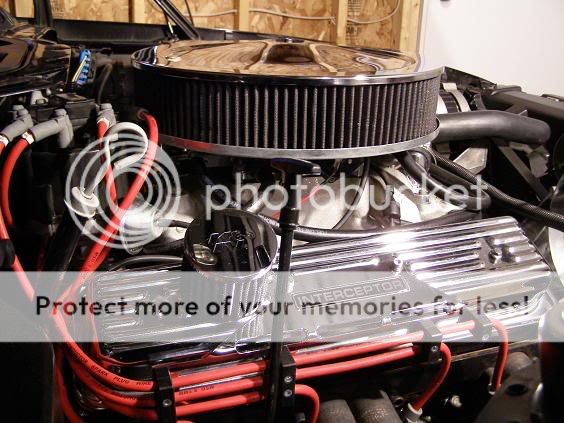
Project Humble Pie, Part II
Bigger Cams and 400 hp From the 350 H.O.
By Jeff Smith
Photography: Jeff Smith
Last month, we introduced you to the GM Performance Parts 350 H.O. crate engine. We began testing using the Deluxe model that comes completely outfitted with a water pump, HEI distributor, spark plugs, and a 600-cfm vacuum secondary carburetor. In search of more power, we added Hedman headers, an Edelbrock Performer RPM Air Gap dual-plane intake, and a 750-cfm Holley double-pumper carburetor.
Those simple bolt-on changes pumped the 350 up from its stock power rating of 330 hp and 380 lb-ft of torque to a stout 377 hp and 415 lb-ft of torque. While we were impressed with the small-block's significant gains, we felt that a cam change would be worth even more. That's what we're going to dive into this month.
Listed in the GM Performance Parts catalog is a relatively obscure hydraulic roller cam package originally designed for off-road LT4 fuel-injected engines that offers a mild intake lobe using stock roller lifters tag-teamed with a set of GM Performance Parts 1.6:1 aluminum roller rockers. We've had previous experience with this cam and decided it was a perfect match for the 350 H.O. engine package and the Vortec heads. The beauty of this system is that you can purchase a complete cam, lifter, pushrod, and rocker arm set from GM Performance Parts that will bolt right into the 350 H.O. because it's a one-piece rear main seal engine fully machined to accept a hydraulic roller cam package. GM Performance Parts chose to originally equip the H.O. with a flat-tappet cam to keep the engine affordable. But we wanted more power, so the swap was a natural.
We decided a hydraulic roller might offer some power advantages, so we opted for the GM Performance Parts hydraulic roller Hot cam and kit complete with pushrods, springs, retainers, and a set of GMPP guided roller rockers. The rockers are matched to the cam and offer an improved 1.6:1 ratio.
The Hot hydraulic roller cam actually comes in several different configurations. You can purchase the cam separately or in a kit complete with the springs, retainers, keepers, and rockers. This is the kit we opted for along with the roller lifter kit that included all the retainers and guides, plus a separate retainer plate to locate the cam in the block. All these parts are necessary to install the roller cam in the 350 H.O. block.
We also included a couple of other revisions to this combination by using a set of Comp Cams beehive style valvesprings instead of the LT4-style springs included in the kit. The main reason for this is that the beehive springs will bolt right in place of the stock springs, while the larger 1.32-inch-diameter LT4 springs require significant and expensive machining to the valvespring pockets. However, we did have to remove the heads to elongate the pushrod holes on the inboard side to prevent rubbing the pushrods on the heads while using the 1.6 roller rockers. The high-ratio rockers move the pushrod cup closer to the trunion, which moves the pushrod closer to the end of the pushrod slot in the Vortec heads, necessitating the light drilling with a 3/8-inch drill bit.
While the roller cam kit comes with better LT4-style springs, we decided to use a set of Comp Cams beehive springs since they drop right into place, offer the potential for better valve control, and can accommodate additional lift all without additional machining...
Taylor performed all these basic modifications to the 350 H.O. and then bolted our freshly upgraded small-block back on the dyno to evaluate the results. Roller cams do not require the break-in period that flat tappet cams do, so once Taylor had normalized temperatures, we started beating on the 350 once more. With the timing and jetting experiments accomplished, the combination of the roller cam and its additional rocker ratio revealed that these changes added significant power, making 401 hp at 5,600 rpm. This test illustrates that Vortec heads are certainly capable of a streetable 400 hp as well as excellent low-speed and midrange with 428 lb-ft at 4,200. With 15.5 inches of manifold vacuum at a 950 rpm idle, this is a very streetable package.
In this table under the Test 3 colum you'll see the torque and hp numbers from the combo described in the article.
Interestingly, the Test 1 numbers are for the stock 350 HO equiped with headers, Edelbrock RPM Air-Gap manifold, and a Holley 750 double pumper [although I did the CFM calculation and my 670 CFM carb should provide plenty of flow for this 350 at up to 6,000 RPM]. The truth is that the HO 350 actualy puts out 371 HP at 5,200 RPM in this configuration; quite a bit more than the advertised 330 HP.
With the additional expense of the LT4 Hot cam, Comp Cams Valve Springs, and full roller rocker arms used in the article (roughly $700) they still only gained 24 HP and 19 ft./lb. over the "stock" 350 HO.
Even though 400 HP sounds great and comes with certain bragging rights, I'm thinking I may just skip the additional time and expense it would take to perform the upgrades outlined in this article and just go with the stock 350 HO.
Last edited by Max; Feb 3, 2006 at 07:26 PM.

Joined: Jul 2005
Posts: 176
Likes: 2
From: In a galaxy far, far away...
Car: 82Z28
Engine: 350
Transmission: 700r4
hey ive got a 350 HO the LT4 hot cam and those upgrades sounds like just what i was looking for, but just a question, is there anything that i could have my machine shop due to my vortec heads to get even more power from that combo? im looking to get over the 400hp mark and any little things that anyone could tell me that i could do to the heads would be much appreciated.

Thread
Thread Starter
Forum
Replies
Last Post
