


got cold air ?


Thread Starter
Junior Member
Joined: May 2006
Posts: 15
Likes: 0

With scoops removed you will see large open area across front of hood, this area is what makes up the cold air duct. Seal the outer edges with sponge trimmed to fit or soft foam. Seal off driver side routing air to passenger side of hood. Air clearer canister is fitted with 90 degree, 3" elbow of PVC. Core support must be trimmed elbow points straight up, air cleaner mounting hold is moved forward 1/4" in canister allowing the assemblly to sit further back away from the core support. When installed a large washer will seal the old hole. Vapor canister front mounting bolt is removed. Canister can be moved over to passenger side slightly allowing room for elbow on air cleaner assembly. Now you can locate where hole in hood bottom will be made, just mark it for now with marker, and a piece of 3" PVC must be fashioned to fit the bottom of the hood and once hole is made passenger side of hood will be sealed off with sponge or foam directing air down through the hole. PVC can be glued with Fuzor EZ100 or equivillant, I reccomend taping it for alignment into elbow on canister when hood is closed. I also reccomend you check your hood allignment before any cutting is done. Flow sensor mounting must be moved to driver side slightly to allow air cleaner canister to sit in desired location, much preperation and time was spent on getting this right. Hope this helps you make your Poncho how it should have been from the factory with scoops that work.
Last edited by gtabob; Jun 25, 2006 at 07:09 AM.

Senior Member
iTrader: (4)
Joined: Feb 2003
Posts: 713
Likes: 1
From: shawnee, ks
Car: 87 Firebird
Engine: 5.3 76mm
Transmission: Rossler TH400, PTC converter
Axle/Gears: Strange 12bolt, 3.08s
Can you tell a diff performance wise? Ive seen those vents used for a fresh air charge before, but wasnt sure how much pressure they actually get at speed.
Thread Starter
Junior Member
Joined: May 2006
Posts: 15
Likes: 0
denser air is always goning to make more power .i also recomend using a hypertec thermomaster prom chip to bring down engine temp for the same reason a k&n air filter to increase flow and a spolier installed in trottle body.to answer your question yes i have much better trottle response when passing at highway speeds over 40 idont know actual air pressure at nose of car but it has blown duct tape off holes i covered.
Senior Member
iTrader: (4)
Joined: Feb 2003
Posts: 713
Likes: 1
From: shawnee, ks
Car: 87 Firebird
Engine: 5.3 76mm
Transmission: Rossler TH400, PTC converter
Axle/Gears: Strange 12bolt, 3.08s
Originally Posted by gtabob
denser air is always goning to make more power .i also recomend using a hypertec thermomaster prom chip to bring down engine temp for the same reason a k&n air filter to increase flow and a spolier installed in trottle body.to answer your question yes i have much better trottle response when passing at highway speeds over 40 idont know actual air pressure at nose of car but it has blown duct tape off holes i covered.

Junior Member
Joined: Dec 2005
Posts: 2
Likes: 0
Car: 1896 trans am
Engine: 77' 350 comp cam, headers, tpi, sucky 882 heads
Transmission: 700r4
hey thats a great intake system you built! i was just wondering though if the hose from the air filter to the throttle body was k@n or something else. i cant wait to this on my car
Trending Topics

Supreme Member
iTrader: (3)
Joined: Feb 2006
Posts: 1,093
Likes: 0
From: western ny
Car: '82 formula clone, 95 saab 900se
Engine: 350 vortec'd tbi, 2.0L turbo
Transmission: 700r4, 5 spd
Axle/Gears: 10 bolt 2.77 open
that is a pretty nifty setup, but i would cutout the original bracing on the hood, block off thepassages that would push air in the wrong directions and fiberglass a new ductway fot the air to pass through

Senior Member
Joined: Aug 2005
Posts: 855
Likes: 0
From: California, Sacrameto
Car: 88 gta
Engine: 350 tpi
Transmission: 700r4
That is the best intake upgrade I have ever seen. I love my gta hood and have been trying to figer out how to do a clean cold air intake, been thinking bout buying the ram air just for that reason but I wanted to keep the stock look. I will be going to start the work today thank you so much for the idea. I am going to use expanding foam to fill the voids, thanks so much it is so simple and clean and only a third gen guy would even notice it.
Supreme Member
iTrader: (3)
Joined: Feb 2006
Posts: 1,093
Likes: 0
From: western ny
Car: '82 formula clone, 95 saab 900se
Engine: 350 vortec'd tbi, 2.0L turbo
Transmission: 700r4, 5 spd
Axle/Gears: 10 bolt 2.77 open
Originally Posted by gtabob
I have thought about expanding foam but was concerned about too much expandsion deforming the hood outer .

Senior Member
Joined: Feb 2004
Posts: 814
Likes: 1
From: Savannah GA
Car: 1982 Trans Am
Engine: 383 chevy
Transmission: T-5
Axle/Gears: 4th gen 10-bolt, posi, 3.42 ratio
excuse my ignorance... but I don't get it. wtf exactly, did he do, besides putting some pipe on his hood, effectively sealing off that pipe? or was sealing that off kinda the point? I don't own a GTA or GTA hood, i have a carbed car with a stock flat hood. is that hole a source of trouble? does it divert air into the engine bay for cooling and reducing engine bay temps? if the idea is to force more air into the stock duct, than it looks good. simple, yet effective. you can always fab some scops and ducting to bring in more fresh air to the engine bay for coling it off. I thin i may do that just because my underhood temps seem to be horrendous since i have a black car (until it's painted. that, and i live in FL. it's friggin hot here.

Supreme Member
Joined: Apr 2006
Posts: 1,206
Likes: 4
From: Morganton, NC
Car: '92 T/A WS6 Vert/1956 Chevy Nomad
Engine: 350 TPI
Transmission: 700r4 w/ Transgo Kit
Axle/Gears: 3.42 LSD
This set-up actually crossed my mind a few weeks ago ... but I just can't justify doing it. With all the twists and bends and constrictions BEFORE you even get to the air filter, my guess is that it loses a lot of its effectiveness
Plus, I would have to cut on my car ... I'm not into cutting on my car
Plus, I would have to cut on my car ... I'm not into cutting on my car

Supreme Member
iTrader: (2)
Joined: Feb 2006
Posts: 1,547
Likes: 0
From: 39.84N 105.11W
Car: '89 Trans Am GTA
Engine: WAS 350 - now L92 (alum. 378/6.2L)
Transmission: WAS 700R4, now a built T56
Axle/Gears: 3.27 9-bolt
That might be too convoluted...
I've also fabbed up a cold-air system on my '89 GTA, & I would guess that it's at least as effective as the one described above.
All I did was
* remove everything from the MAF to the airbox,
* cut the piece of metal that sits beneath the airbox & charcoal canister so that it only supports the charcoal canister,
* then cut a hole in the horizontal piece of metal beneath that (on the other side, it's the piece of metal that supports the battery tray).
With that hole cut, I then used a piece of black PVC tube that exactly fit the elbow that goes to the MAF. On the other side (the bottom), I have a conical K&N filter (that I've secured using a self-tapping screw, as well as being placed on top of the diagonal crosspiece that's right there).
It may look "ghetto" compared to some high-dollar setups, but it has it's advantages. Since the air filter is tucked up in the dead space behind the fender, there's very little danger of it inhaling water, being hit by gravel, etc. It's also completely isolated from the hot under-hood air, & access to it is fairly easy.
If I wanted a "ram-air" effect at speed, I could fabricate a scoop right there, but after doing the research for it (I've been studying aero effects for my Bonneville venture), I found that the benefit wouldn't justify the effort.
Just my 2 cents...
All I did was
* remove everything from the MAF to the airbox,
* cut the piece of metal that sits beneath the airbox & charcoal canister so that it only supports the charcoal canister,
* then cut a hole in the horizontal piece of metal beneath that (on the other side, it's the piece of metal that supports the battery tray).
With that hole cut, I then used a piece of black PVC tube that exactly fit the elbow that goes to the MAF. On the other side (the bottom), I have a conical K&N filter (that I've secured using a self-tapping screw, as well as being placed on top of the diagonal crosspiece that's right there).
It may look "ghetto" compared to some high-dollar setups, but it has it's advantages. Since the air filter is tucked up in the dead space behind the fender, there's very little danger of it inhaling water, being hit by gravel, etc. It's also completely isolated from the hot under-hood air, & access to it is fairly easy.
If I wanted a "ram-air" effect at speed, I could fabricate a scoop right there, but after doing the research for it (I've been studying aero effects for my Bonneville venture), I found that the benefit wouldn't justify the effort.
Just my 2 cents...
Supreme Member
iTrader: (2)
Joined: Feb 2006
Posts: 1,547
Likes: 0
From: 39.84N 105.11W
Car: '89 Trans Am GTA
Engine: WAS 350 - now L92 (alum. 378/6.2L)
Transmission: WAS 700R4, now a built T56
Axle/Gears: 3.27 9-bolt
That might be too convoluted...
I've also fabbed up a cold-air system on my '89 GTA, & I would guess that it's at least as effective as the one described above.
All I did was
* remove everything from the MAF to the airbox,
* cut the piece of metal that sits beneath the airbox & charcoal canister so that it only supports the charcoal canister,
* then cut a hole in the horizontal piece of metal beneath that (on the other side, it's the piece of metal that supports the battery tray).
With that hole cut, I then used a piece of black PVC tube that exactly fit the elbow that goes to the MAF. On the other side (the bottom), I have a conical K&N filter (that I've secured using a self-tapping screw, as well as being placed on top of the diagonal crosspiece that's right there).
It may look "ghetto" compared to some high-dollar setups, but it has it's advantages. Since the air filter is tucked up in the dead space behind the fender, there's very little danger of it inhaling water, being hit by gravel, etc. It's also completely isolated from the hot under-hood air, & access to it is fairly easy.
If I wanted a "ram-air" effect at speed, I could fabricate a scoop right there, but after doing the research for it (I've been studying aero effects for my Bonneville venture), I found that the benefit wouldn't justify the effort.
Just my 2 cents...
All I did was
* remove everything from the MAF to the airbox,
* cut the piece of metal that sits beneath the airbox & charcoal canister so that it only supports the charcoal canister,
* then cut a hole in the horizontal piece of metal beneath that (on the other side, it's the piece of metal that supports the battery tray).
With that hole cut, I then used a piece of black PVC tube that exactly fit the elbow that goes to the MAF. On the other side (the bottom), I have a conical K&N filter (that I've secured using a self-tapping screw, as well as being placed on top of the diagonal crosspiece that's right there).
It may look "ghetto" compared to some high-dollar setups, but it has it's advantages. Since the air filter is tucked up in the dead space behind the fender, there's very little danger of it inhaling water, being hit by gravel, etc. It's also completely isolated from the hot under-hood air, & access to it is fairly easy.
If I wanted a "ram-air" effect at speed, I could fabricate a scoop right there, but after doing the research for it (I've been studying aero effects for my Bonneville venture), I found that the benefit wouldn't justify the effort.
Just my 2 cents...
Last edited by V8Rumble; Sep 22, 2006 at 02:23 PM.
Thread Starter
Junior Member
Joined: May 2006
Posts: 15
Likes: 0
denser air allways makes more power air flow is direct still looks factory i did hate to cut the car saved pieces only people who know the car notice. some think it is oem
Last edited by gtabob; Sep 25, 2006 at 07:48 PM.

Member
Joined: Oct 2003
Posts: 306
Likes: 3
Car: 1991 GTA
Engine: SuperRam 350
Transmission: 700R4
Axle/Gears: 3.73
I have an SLP CAI but that sounds like an interesting idea. Perhaps I can upgrade my SLP box... I'm not to excited about cutting up the box though. I'll give it a thought. A custom box perhaps, so you can take air from both the fender and hood at the same time. Sounds like a project.


Supreme Member
iTrader: (17)
Joined: Jan 2005
Posts: 2,716
Likes: 3
From: Mobile, AL
Car: GTA
Engine: 383 HSR
Transmission: TH-700R4
Axle/Gears: 3.42
 People spend alot of time about cold air yada yada...
If cold air was as great as people made it out to be in the winter time we would all be driving some serious 10 second cars.
It is not about dense air or cold air.
It is about the velocity of the air.

Supreme Member
Joined: Oct 2001
Posts: 8,113
Likes: 6
From: NWOhioToledoArea
Car: 86-FireBird
Engine: -MPFI
Transmission: T5
Axle/Gears: 3:42
The fancy blue filter under the hood with some crapy divider is not true cold air.
True cold air does work. My V6 Bird would get sluggish and lame in stock form when it got hot outside. With a True cold air / ram air setup it runs crisp and responsive all the time. It will rev fast and hard to redline no matter what the conditions are outside. It also lowers my running temps to 185-190 constant with no need for a power suckin fan, unless I sit still for 3-4 mins.
[I also have an aluminum air dam and no AC rad in the way.]
I molded 68 Firebird hood scoops into my stock 86 Firebird hood. Right at the apex of the hood so the scoops face forward to grab mass air.
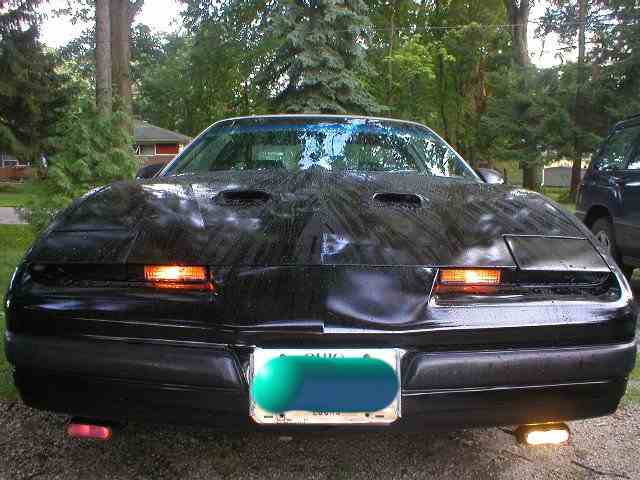
Nother version, right now its only using one side but soon as I stop being lazy one day Ill cut n weld the 2nd snorkle snout on and run both inner headlights for true cold air. car has/had 4 headlight.

Supreme Member
iTrader: (17)
Joined: Jan 2005
Posts: 2,716
Likes: 3
From: Mobile, AL
Car: GTA
Engine: 383 HSR
Transmission: TH-700R4
Axle/Gears: 3.42
Cold air, short ram air, and ram air are three completely different things.
The scoops you fabricated do nothing except keep your engine dirty.
Also, your dryer tubing will problem get even more hot than the stock setup. Then material is thinner and would be easier to heat. It would however dissapate heat better which means.... it would be quicker to cool when the car is off. That means nothing while driving.
Like I said it is about velocity not density.
You would see more gains if your dryer tubing was a mandrel bent tube. The air would be used faster and more efficiently. Rather than a rough surface that disrupts air flow.
The scoops you fabricated do nothing except keep your engine dirty.
Also, your dryer tubing will problem get even more hot than the stock setup. Then material is thinner and would be easier to heat. It would however dissapate heat better which means.... it would be quicker to cool when the car is off. That means nothing while driving.
Like I said it is about velocity not density.
You would see more gains if your dryer tubing was a mandrel bent tube. The air would be used faster and more efficiently. Rather than a rough surface that disrupts air flow.

Supreme Member
iTrader: (1)
Joined: Oct 2004
Posts: 3,361
Likes: 2
From: Worcester, MA
Car: 86 T/A
Engine: HSR 355
Transmission: 700R4
Axle/Gears: 2.77 posi
Cold air, short ram air, and ram air are three completely different things.
The scoops you fabricated do nothing except keep your engine dirty.
Also, your dryer tubing will problem get even more hot than the stock setup. Then material is thinner and would be easier to heat. It would however dissapate heat better which means.... it would be quicker to cool when the car is off. That means nothing while driving.
Like I said it is about velocity not density.
You would see more gains if your dryer tubing was a mandrel bent tube. The air would be used faster and more efficiently. Rather than a rough surface that disrupts air flow.
The scoops you fabricated do nothing except keep your engine dirty.
Also, your dryer tubing will problem get even more hot than the stock setup. Then material is thinner and would be easier to heat. It would however dissapate heat better which means.... it would be quicker to cool when the car is off. That means nothing while driving.
Like I said it is about velocity not density.
You would see more gains if your dryer tubing was a mandrel bent tube. The air would be used faster and more efficiently. Rather than a rough surface that disrupts air flow.
Supreme Member
Joined: Oct 2001
Posts: 8,113
Likes: 6
From: NWOhioToledoArea
Car: 86-FireBird
Engine: -MPFI
Transmission: T5
Axle/Gears: 3:42
With my car sucking hot under hood air on hot summer day it would be running 200+ and be sluggish as a snail. With the cold air, ram air it stays crisp and responsive no matter what the condition are. And even better when its cold.
I don't care if you believe it or not.... Real world experience blows your theory out of the water. Feel free to come over any time and see what I mean. Though wait till its 90F+ outside.
Supreme Member
iTrader: (17)
Joined: Jan 2005
Posts: 2,716
Likes: 3
From: Mobile, AL
Car: GTA
Engine: 383 HSR
Transmission: TH-700R4
Axle/Gears: 3.42
Believe what you want, fact doesn't disappear simply because you do not trust it. Your are falling victim to the belief system. You are wanting to believe your home depot intake works. On a 2.8, the stock intake supplies more than enough air for the engine. By all means it is not the bottle neck of the engine.

Supreme Member
Joined: Oct 2001
Posts: 8,113
Likes: 6
From: NWOhioToledoArea
Car: 86-FireBird
Engine: -MPFI
Transmission: T5
Axle/Gears: 3:42
I don't BS on boards for attention. Anyone who wont take my word for it is welcome to come over. My word is good just ask around. I have owned many hot V8s, but there is nutin like a 60* V6 when it runs how it should. On stock temps and stock hot underhood air, they are a dog when warm. Not so when feed cold air. Though some reason most of this board is just full of haters who have some sort of instant grudge with fellow 3rd gen owners with never anything nice to say. A good 30% of folks never say anything nice, they just post to disagree or hate, never to help or say anything nice.
Kind of a shame but from experience most 3rd gen owners I run into are aholes.
Though the board owners can control that.
Oh wait they own 3rd gens too
Kind of a shame but from experience most 3rd gen owners I run into are aholes.
Though the board owners can control that.
Oh wait they own 3rd gens too
Supreme Member
Joined: Oct 2001
Posts: 8,113
Likes: 6
From: NWOhioToledoArea
Car: 86-FireBird
Engine: -MPFI
Transmission: T5
Axle/Gears: 3:42
Believe what you want, fact doesn't disappear simply because you do not trust it. Your are falling victim to the belief system. You are wanting to believe your home depot intake works. On a 2.8, the stock intake supplies more than enough air for the engine. By all means it is not the bottle neck of the engine.
Were talking about running colder then normal air into your engine for a real postive effect. No one here believes there is some kind of turbo or ram effect.
colder air temps do make a difference. I can prove that. More dirt is lame, and duh, ram air doesn't do anything but feed your car true cold air.
Its nothing more then a term for having scoops on the hood. Like calling NO2 NOS. There is no real ram air effect unless the scoops were near or past the very nose of the car. As the air just goes right over it in reality.
No one is aruging that but you. Were talking about colder air temps.
Don't assume stuff. Colder air into an engine makes a difference.
But duh there is no added flow or bottle neck stuff. Man your just assuming what you want to hate, your looking for something to fuss about for your kicks. No one said there is any air volum gains. Its just colder then normal air, which does make one heck of a difference.
Supreme Member
iTrader: (17)
Joined: Jan 2005
Posts: 2,716
Likes: 3
From: Mobile, AL
Car: GTA
Engine: 383 HSR
Transmission: TH-700R4
Axle/Gears: 3.42
Cold air = Dense air.
Dense air does not mean anything. Especially when it is 90 degrees outside and you think that air is dense just because it is sucked through your bumper.
Fast air = Velocity
Which means more air. Which is why we use CFM as a unit to measure airflow. Dense air does not give you more CFM. Velocity will.
Now, does dense air have more velocity? Yes sure it does. But not when you have a dryer tube taking that dense air and make it turbulent.
Dense air does not mean anything. Especially when it is 90 degrees outside and you think that air is dense just because it is sucked through your bumper.
Fast air = Velocity
Which means more air. Which is why we use CFM as a unit to measure airflow. Dense air does not give you more CFM. Velocity will.
Now, does dense air have more velocity? Yes sure it does. But not when you have a dryer tube taking that dense air and make it turbulent.
Supreme Member
Joined: Oct 2001
Posts: 8,113
Likes: 6
From: NWOhioToledoArea
Car: 86-FireBird
Engine: -MPFI
Transmission: T5
Axle/Gears: 3:42
You do know your looking at two different cars??? Next time read everything instead of making general assumptions.
top pic is a 2.8 Firebird with hood scoops RAM AIR BABY, TURBO EFFECT
2nd pic is a Buick 350X V8 station Wagon with a headlight knocked out
Firebird only have 2 headlights that pop up.
Your assuming again aren't ya?
Im talking about colder then normal air. normal air = hot nasty dirty underhood air. Air around an engine is always hotter then from directly outside the car. That hot air coming through the rad goes somewhere don't it?
Though as you keep bringin it up the thermal properties of that hose does not transfer heat in any direction well, or if it could [ is so minute], it couldn't heat or cool the air enough in any direction to make any difference either way.
your turbalnce thing is mute. weather there is a short section of intake sucking air in or a long one, its all turblant untl it hits the throtle blades.
The stock intake works is just like that hose, but with more bumps n deeper valleys.
top pic is a 2.8 Firebird with hood scoops RAM AIR BABY, TURBO EFFECT
2nd pic is a Buick 350X V8 station Wagon with a headlight knocked out
Firebird only have 2 headlights that pop up.
Your assuming again aren't ya?
Im talking about colder then normal air. normal air = hot nasty dirty underhood air. Air around an engine is always hotter then from directly outside the car. That hot air coming through the rad goes somewhere don't it?
Though as you keep bringin it up the thermal properties of that hose does not transfer heat in any direction well, or if it could [ is so minute], it couldn't heat or cool the air enough in any direction to make any difference either way.
your turbalnce thing is mute. weather there is a short section of intake sucking air in or a long one, its all turblant untl it hits the throtle blades.
The stock intake works is just like that hose, but with more bumps n deeper valleys.
Last edited by Gumby; Oct 29, 2006 at 05:20 PM.
Supreme Member
iTrader: (17)
Joined: Jan 2005
Posts: 2,716
Likes: 3
From: Mobile, AL
Car: GTA
Engine: 383 HSR
Transmission: TH-700R4
Axle/Gears: 3.42
I was going by the 2.8 by the side of your name.

I am done listening to your whining. No one is hating, just you. I have nothing against you. I just disagree with you. You do not merely disagree with me though. Take it personal... I do not mind.
When you want to talk cars like adults, give me a PM and we shall have a good time.
I am done listening to your whining. No one is hating, just you. I have nothing against you. I just disagree with you. You do not merely disagree with me though. Take it personal... I do not mind.
When you want to talk cars like adults, give me a PM and we shall have a good time.

Joined: Aug 2004
Posts: 1,989
Likes: 0
From: Calgary, AB
Car: 1993 Nissan 240sx
Engine: Turbo KA24DE
Transmission: 5 spd
Axle/Gears: 4.08 VLSD
Cold air, short ram air, and ram air are three completely different things.
The scoops you fabricated do nothing except keep your engine dirty.
Also, your dryer tubing will problem get even more hot than the stock setup. Then material is thinner and would be easier to heat. It would however dissapate heat better which means.... it would be quicker to cool when the car is off. That means nothing while driving.
Like I said it is about velocity not density.
You would see more gains if your dryer tubing was a mandrel bent tube. The air would be used faster and more efficiently. Rather than a rough surface that disrupts air flow.
The scoops you fabricated do nothing except keep your engine dirty.
Also, your dryer tubing will problem get even more hot than the stock setup. Then material is thinner and would be easier to heat. It would however dissapate heat better which means.... it would be quicker to cool when the car is off. That means nothing while driving.
Like I said it is about velocity not density.
You would see more gains if your dryer tubing was a mandrel bent tube. The air would be used faster and more efficiently. Rather than a rough surface that disrupts air flow.
Woah, woah. Hold on a sec there, bud. It isnt velocity that counts. It's MASS. There is a conversion. If you're sucking in really hot air at a certain volume flow rate, and then you start suking in colder, denser air at the same volume flow rate, because the density is different, you can get the same ammount of air into the engine at a lower velocity. Ever heard of Bernoulli?
Anyhow, you're right about one thing witht he dryer tubing, though you probably didnt know it. Because of air's specific heat capacity and the fact that it would only be in the (heat insulated) dryer tubing a short time, it wouldnt actually have much of a chance to heat up. BUT, since the dryer tubing is pleated, it's relative roughness is really high, resulting in a really turbulent flow of air, compared to the nice smooth laminar flow you'd get from a smooth mandrel bent exhaust pipe taking its place.
Last edited by 305q_ta86; Nov 4, 2006 at 10:20 PM.
Supreme Member
iTrader: (17)
Joined: Jan 2005
Posts: 2,716
Likes: 3
From: Mobile, AL
Car: GTA
Engine: 383 HSR
Transmission: TH-700R4
Axle/Gears: 3.42
This is pretty much as pointless as the Horse power vs torque arguement. Everyone thinks they know it all but no one really knows anything. You, gumby, and myself are in the same boat.
These are all theories, no one including myself can provide adequate proof. Can we?
These are all theories, no one including myself can provide adequate proof. Can we?
Joined: Aug 2004
Posts: 1,989
Likes: 0
From: Calgary, AB
Car: 1993 Nissan 240sx
Engine: Turbo KA24DE
Transmission: 5 spd
Axle/Gears: 4.08 VLSD
No real proof? Well, the law of conservation of mass states that the mass into a system has to equal the mass leaving a system, and since mass is equal to density times volume, and volume flow rate is equal to the area of the inside of the tube times the velocity. So just having a high velocity of air means ***** if the air has no density.
Imagine you flowed 500 litres of a fluid in one minute. And imagine the density of the fluid was 1.5 kg per liter. So 500 x 1.5 = 750 kg of fluid per minute.
Now imagine you flow twice the volume of a different fluid, whose density is only half that of the above. Then you have 1000 l/min x .75 kg/l = 750 kg per minute.
QED. That's proof enough for me.
Imagine you flowed 500 litres of a fluid in one minute. And imagine the density of the fluid was 1.5 kg per liter. So 500 x 1.5 = 750 kg of fluid per minute.
Now imagine you flow twice the volume of a different fluid, whose density is only half that of the above. Then you have 1000 l/min x .75 kg/l = 750 kg per minute.
QED. That's proof enough for me.

Supreme Member
iTrader: (1)
Joined: Jul 2004
Posts: 10,763
Likes: 4
From: Calgary, AB, Canada
Car: 1982 Trans-Am
Engine: 355 w/ ported 416s
Transmission: T10, hurst shifter
Axle/Gears: 10 bolt, true-trac, 3.73
Q-E-D? Did you just say QED on the INTRAWEB? Huh, I no longer feel nerdy at all....
Just for info's sake - "They" say that a cowl induction hood provides more/better airflow into the motor, then a ram air setup. Assuming in both cases the setup is directly over a carb, and the carb is sealed via a pan to the hood.
The ram air, would have higher velocity, but lower pressure. A cowl, will have much higher pressure, and the velocity is lower. Net gain is on the cowl induction side, see pic in this thread:
https://www.thirdgen.org/forums/tech...light=pressure
However, the ram air, as the air hits flow restrictions (smaller cross section piping) it'll.... increase the pressure? Or will pressure drop and velocity increases more? I remember it was bass-ackwards of logic, Ryan, what is it?
In a nozzle vs a diffuser? I think the diffuser, increases velocity, and drops pressure, and the nozzle increases pressure and drops velocity... Yea, that's it, the opposite of what it "feels" like...
Just for info's sake - "They" say that a cowl induction hood provides more/better airflow into the motor, then a ram air setup. Assuming in both cases the setup is directly over a carb, and the carb is sealed via a pan to the hood.
The ram air, would have higher velocity, but lower pressure. A cowl, will have much higher pressure, and the velocity is lower. Net gain is on the cowl induction side, see pic in this thread:
https://www.thirdgen.org/forums/tech...light=pressure
However, the ram air, as the air hits flow restrictions (smaller cross section piping) it'll.... increase the pressure? Or will pressure drop and velocity increases more? I remember it was bass-ackwards of logic, Ryan, what is it?
In a nozzle vs a diffuser? I think the diffuser, increases velocity, and drops pressure, and the nozzle increases pressure and drops velocity... Yea, that's it, the opposite of what it "feels" like...
Supreme Member
iTrader: (17)
Joined: Jan 2005
Posts: 2,716
Likes: 3
From: Mobile, AL
Car: GTA
Engine: 383 HSR
Transmission: TH-700R4
Axle/Gears: 3.42
Your analogy means nothing, considering you mentioned velocity is not a factor compared to density, which in fact you said velocity is worthless without density, which would mean your precious density would mean nothing without velocity.
You are contradicting yourself. By saying it is all about mass really.
Think of it like an exhaust system... which density has no real factor. The whole reason mandrel bent tubing is used is because it increases velocity of which the air escapes. Put a sharp bend in a straight pipe and the air loses some velocity which in return adds a questionable amount of restriction.
The same principle would work for your intake. 3" straight tube vs 3 1/2" tube with massive amounts of ridges. The velocity of the straight tube would force more air in than the bigger version with more turbulence.
You are contradicting yourself. By saying it is all about mass really.
Think of it like an exhaust system... which density has no real factor. The whole reason mandrel bent tubing is used is because it increases velocity of which the air escapes. Put a sharp bend in a straight pipe and the air loses some velocity which in return adds a questionable amount of restriction.
The same principle would work for your intake. 3" straight tube vs 3 1/2" tube with massive amounts of ridges. The velocity of the straight tube would force more air in than the bigger version with more turbulence.
Joined: Aug 2004
Posts: 1,989
Likes: 0
From: Calgary, AB
Car: 1993 Nissan 240sx
Engine: Turbo KA24DE
Transmission: 5 spd
Axle/Gears: 4.08 VLSD
Q-E-D? Did you just say QED on the INTRAWEB? Huh, I no longer feel nerdy at all....
Just for info's sake - "They" say that a cowl induction hood provides more/better airflow into the motor, then a ram air setup. Assuming in both cases the setup is directly over a carb, and the carb is sealed via a pan to the hood.
The ram air, would have higher velocity, but lower pressure. A cowl, will have much higher pressure, and the velocity is lower. Net gain is on the cowl induction side, see pic in this thread:
https://www.thirdgen.org/forums/tech...light=pressure
However, the ram air, as the air hits flow restrictions (smaller cross section piping) it'll.... increase the pressure? Or will pressure drop and velocity increases more? I remember it was bass-ackwards of logic, Ryan, what is it?
In a nozzle vs a diffuser? I think the diffuser, increases velocity, and drops pressure, and the nozzle increases pressure and drops velocity... Yea, that's it, the opposite of what it "feels" like...
Just for info's sake - "They" say that a cowl induction hood provides more/better airflow into the motor, then a ram air setup. Assuming in both cases the setup is directly over a carb, and the carb is sealed via a pan to the hood.
The ram air, would have higher velocity, but lower pressure. A cowl, will have much higher pressure, and the velocity is lower. Net gain is on the cowl induction side, see pic in this thread:
https://www.thirdgen.org/forums/tech...light=pressure
However, the ram air, as the air hits flow restrictions (smaller cross section piping) it'll.... increase the pressure? Or will pressure drop and velocity increases more? I remember it was bass-ackwards of logic, Ryan, what is it?
In a nozzle vs a diffuser? I think the diffuser, increases velocity, and drops pressure, and the nozzle increases pressure and drops velocity... Yea, that's it, the opposite of what it "feels" like...
Nelapse, I never said you can have one without the other, what I meant was that both are important and those equations show the relationship. I wasnt trying to get much into turbulence of the flow, though you're right that it'll have a major negative impact.
Oh, and Jay, suddenly I feel MORE nerdy.

Supreme Member
iTrader: (17)
Joined: Jan 2005
Posts: 2,716
Likes: 3
From: Mobile, AL
Car: GTA
Engine: 383 HSR
Transmission: TH-700R4
Axle/Gears: 3.42
Yeah, same flow rate going thru a pipe, diameter gets reduced, so does pressure. Very counter-logical if you are thinking ideal gas law.
Nelapse, I never said you can have one without the other, what I meant was that both are important and those equations show the relationship. I wasnt trying to get much into turbulence of the flow, though you're right that it'll have a major negative impact.
Oh, and Jay, suddenly I feel MORE nerdy.
Nelapse, I never said you can have one without the other, what I meant was that both are important and those equations show the relationship. I wasnt trying to get much into turbulence of the flow, though you're right that it'll have a major negative impact.
Oh, and Jay, suddenly I feel MORE nerdy.
I understand your formulas about mass, but it does not pertain to basic air systems. The whole objective is to make an efficient, air system, inwhich the engine could use everything it needs.
You could have an intake system that can flow 2000 cfm, If your engine only uses 1000, then it really wont make a difference to have an over kill intake system. However, by using velocity, using the right size intake tube you can actually force the engine to draw in more volume of air than which is typically required. Density can do the same, but velocity is more constant.
Plus if your system is not set up for velocity, than then restrictions, and turbulence, turn your density into friction which actually heats the air up to a measureable amount.
You are absolutely right, one factor always affects another. In direct proportions.
Joined: Aug 2004
Posts: 1,989
Likes: 0
From: Calgary, AB
Car: 1993 Nissan 240sx
Engine: Turbo KA24DE
Transmission: 5 spd
Axle/Gears: 4.08 VLSD
Yeah, and I guess it's also easier to get cold air (well, ok, maybe not always on a 'Bird) than it is to actually engineer the ducting required to make sure your cold air efforts are all for naught. Another thing to consider is that even though mandrel bends are way better than crush bends, bends are still bends and they still contribute to minor losses. The screen in the MAF would help smooth out the flow of air to some degree too, but at the expense of some kinetic energy. I guess the best thing to do would probably be to just cut a bigass hole in the front of your hood, run a smooth 3" pipe out of it to a cut cut funnel or something and call it a day. :P
Supreme Member
iTrader: (17)
Joined: Jan 2005
Posts: 2,716
Likes: 3
From: Mobile, AL
Car: GTA
Engine: 383 HSR
Transmission: TH-700R4
Axle/Gears: 3.42
a bend no matter what degree is a restriction. The best intake is forced induction  at that point it really doesnt matter.
at that point it really doesnt matter. 
Member
iTrader: (1)
Joined: Nov 2005
Posts: 196
Likes: 0
From: rochester,in.
Car: Forrest 91 t/a
Engine: 5.0 tpi w/underdrive/accel,full 3"
Transmission: 700r4
Axle/Gears: 3.73 pos
GTABOB,
I think its a pretty good Idea. Just wondering can you hear the engine sucking the air thru the grills?
I won't bother with the conversation going on about cold air.
I think its a pretty good Idea. Just wondering can you hear the engine sucking the air thru the grills?
I won't bother with the
conversation going on about cold air. 
Supreme Member
Joined: May 2005
Posts: 1,701
Likes: 0
From: San Diego, CA
Car: 1991 Camaro RS
Engine: LO3
Transmission: 700R4
Axle/Gears: 3.42 LS1
hmmm well all this confirms my idea as to how to use the "ram air" slots in the '83 Z28 hoods
I'll use the K&N filter I got at the junkyard, something like 11.5x6.5 or whatever (supposedly came from a SAAB 9000 Turbo), use the bottom of a SAAB air cleaner, and then funnel it through PVC or ABS or whatever kind of tubing
I'll use the K&N filter I got at the junkyard, something like 11.5x6.5 or whatever (supposedly came from a SAAB 9000 Turbo), use the bottom of a SAAB air cleaner, and then funnel it through PVC or ABS or whatever kind of tubing

Supreme Member

Joined: Mar 2001
Posts: 5,144
Likes: 2
From: CC, TX
Car: 1999 Yamaha Banshee
Engine: 379cc twin cyl 2-stroke stroker
Transmission: 6 spd manual
Axle/Gears: 14/41 tooth

Thread
Thread Starter
Forum
Replies
Last Post
IROCZDAVE (88-L98)
Engine/Drivetrain/Suspension Parts for Sale
0
Sep 2, 2015 08:43 AM
kyle5647
Tech / General Engine
1
Aug 15, 2015 11:56 PM
