


Why is my check engine light on?


Thread Starter
Junior Member
Joined: Jan 2001
Posts: 38
Likes: 0
From: Stillwater, OK.
Why is my check engine light on?
Well I decided to do some maintenance on my '83 Z with crossfire injection. This included changing the leaky drivers valve cover gasket, the spark plugs, the O2 sensor, and put new injectors in. I started my engine and the check engine light came on. The car is definitely running a lot better, but I still want to get the light taken care of. I'm pretty sure it has to do with the Bosch O2 sensor, but I already verified it's the correct part # on the sensor. Anyone have any ideas? thanks,
Tim
Tim

Member
Joined: Apr 2001
Posts: 171
Likes: 0
From: albany area. NY
heh,
I have no idea about the crossfire ignition, so I can't tell you that you forgot to hook up a particular wire or something. If I were you though, I would start by disconnecting the pos. lead on the battery for a min. or two, that should reset the computer's ses light mem. reconnect it and see if the light still comes on. Does you're 83 have a diagnostic port to plug in a computer? (not sure if 83's have this feature>?) It should be under the steering wheel on the bottom of the dash. it is a half inch by three inch rectangle that with a cover on it. the cover pops right off with a flathead. There's a tech article for reading your ses light codes. You just take a paper clip and jump two connections in the diagnostic port, and the ses light will flash diffrent codes for each reason. The ignition has to be on without the car running. You should be able to find that article pretty easily, if you can't, I'm sure someone can provide you with a link. (i would but I haven't a clue how!)
------------------
87 IROC 305 TPI VIN F
Guttted cat- Flowmaster Catback
I have no idea about the crossfire ignition, so I can't tell you that you forgot to hook up a particular wire or something. If I were you though, I would start by disconnecting the pos. lead on the battery for a min. or two, that should reset the computer's ses light mem. reconnect it and see if the light still comes on. Does you're 83 have a diagnostic port to plug in a computer? (not sure if 83's have this feature>?) It should be under the steering wheel on the bottom of the dash. it is a half inch by three inch rectangle that with a cover on it. the cover pops right off with a flathead. There's a tech article for reading your ses light codes. You just take a paper clip and jump two connections in the diagnostic port, and the ses light will flash diffrent codes for each reason. The ignition has to be on without the car running. You should be able to find that article pretty easily, if you can't, I'm sure someone can provide you with a link. (i would but I haven't a clue how!)
------------------
87 IROC 305 TPI VIN F
Guttted cat- Flowmaster Catback

Moderator


Joined: Jan 2000
Posts: 19,680
Likes: 316
Dowtyt,
To find out what's up with your system, ket the ECM tell you. It's really pretty easy and takes about five minutes.
First, you'll need to acquire a GM OBD I ECM Diagnostic Trouble Code Retrieval Tool (commonly known as a paper clip to TGO members).
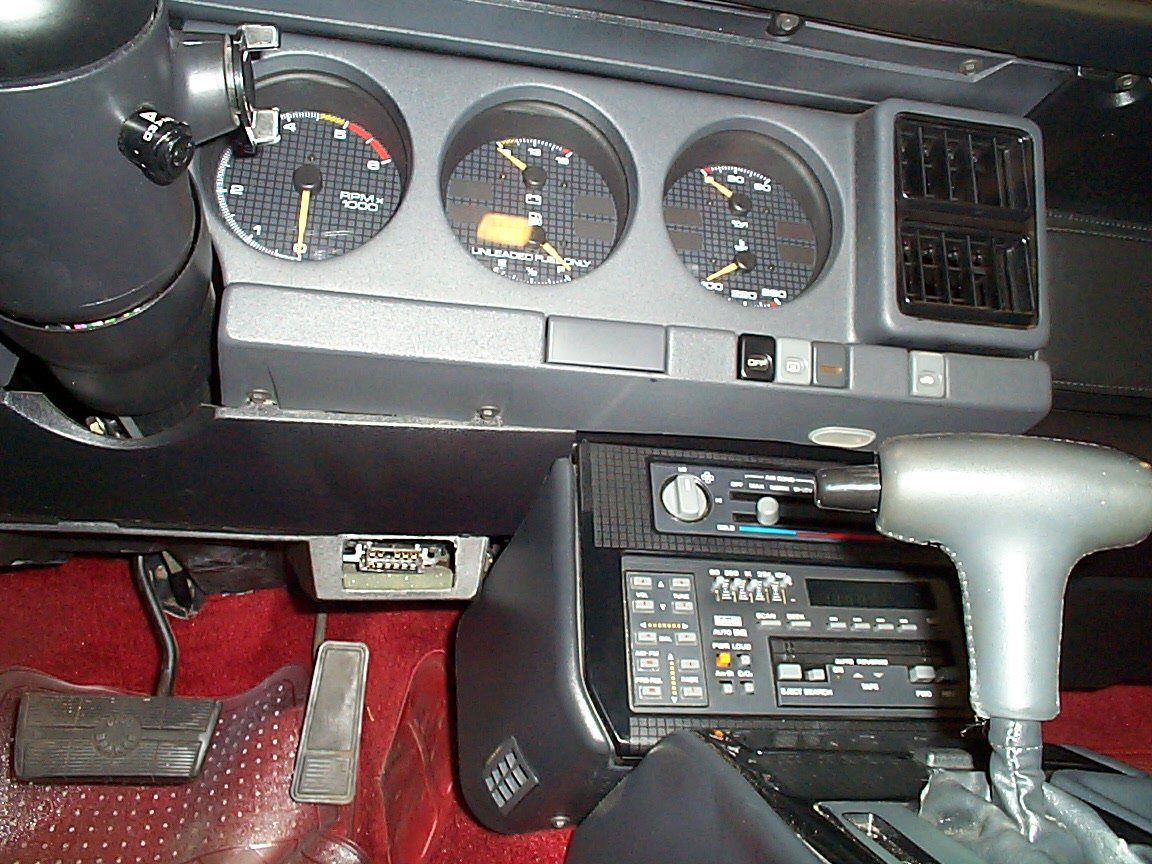
With the engine and ignition turned off, locate the ALDL connector under the dash, just to the right of the steering wheel in the driver's foot well area. There should be a small rectangular cover over the access hole in the lower dash trim.
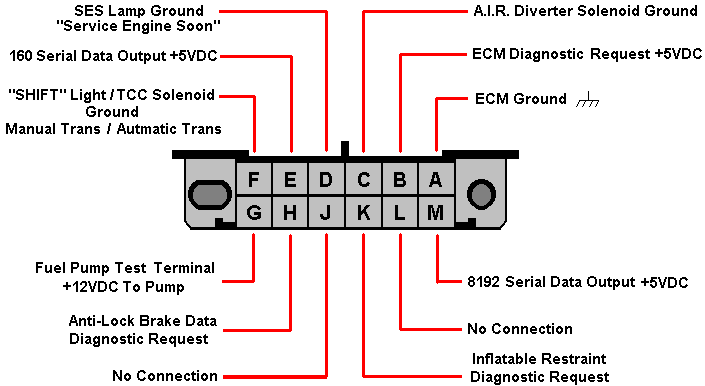
Insert a tool as described above (paper clip) into the 'A' and 'B' terminals on the ALDL connector:
WITHOUT STARTING the engine, turn the ignition to the "RUN" position. Watch the Malfunction Indicator Lamp (MIL) and it will begin to flash. This is also commonly called the "Service Engine Soon" or "SES" lamp. The first code will flash three times, and will usually be a code '12'. This is encoded by one flash of the lamp, a brief pause, then two successive flashes of the lamp. Each code will repeat three times, so you should see a "Code 12" flash three times. Any other error codes will follow in numerical order, and each code should flash three times. After all codes have been displayed three times, the "Code 12" will again flash three times, then all other codes will follow as described earlier. This cycle will continue until the jumper is removed or the ignition is turned off.
After you have made a note of all error codes, turn off the ignition and remove the jumper immediately. If you forget to remove the jumper and attempt to start the engine with it in place, you could damage the ECM. For this reason you should remove it immediately.
Once you have a note of all error codes, check this file for the decoding:
GM Error Codes.pdf.
You'll need Adobe Acrobat Reader to open/print the file. (See below)
------------------
Later,
Vader
------------------
"Let the bodies hit the floor!"
Adobe Acrobat Reader
To find out what's up with your system, ket the ECM tell you. It's really pretty easy and takes about five minutes.
First, you'll need to acquire a GM OBD I ECM Diagnostic Trouble Code Retrieval Tool (commonly known as a paper clip to TGO members).
With the engine and ignition turned off, locate the ALDL connector under the dash, just to the right of the steering wheel in the driver's foot well area. There should be a small rectangular cover over the access hole in the lower dash trim.
Insert a tool as described above (paper clip) into the 'A' and 'B' terminals on the ALDL connector:
WITHOUT STARTING the engine, turn the ignition to the "RUN" position. Watch the Malfunction Indicator Lamp (MIL) and it will begin to flash. This is also commonly called the "Service Engine Soon" or "SES" lamp. The first code will flash three times, and will usually be a code '12'. This is encoded by one flash of the lamp, a brief pause, then two successive flashes of the lamp. Each code will repeat three times, so you should see a "Code 12" flash three times. Any other error codes will follow in numerical order, and each code should flash three times. After all codes have been displayed three times, the "Code 12" will again flash three times, then all other codes will follow as described earlier. This cycle will continue until the jumper is removed or the ignition is turned off.
After you have made a note of all error codes, turn off the ignition and remove the jumper immediately. If you forget to remove the jumper and attempt to start the engine with it in place, you could damage the ECM. For this reason you should remove it immediately.
Once you have a note of all error codes, check this file for the decoding:
GM Error Codes.pdf.
You'll need Adobe Acrobat Reader to open/print the file. (See below)
------------------
Later,
Vader
------------------
"Let the bodies hit the floor!"
Adobe Acrobat Reader
Last edited by Vader; Mar 31, 2018 at 10:21 AM. Reason: Updated links
Thread Starter
Junior Member
Joined: Jan 2001
Posts: 38
Likes: 0
From: Stillwater, OK.
Alright, I've done what you said to do, and it gave me the readout, I think! It did the, "flash pause flash, flash" three times, which I guess means 12? Then it did a, "flash, flash pause flash, flash" 3 times. I'm guessing that is 22, is this correct? If it isn't will someone tell me? If it is, then 22 signifies that my TPS voltage is low. How do you fix low voltage to your throttle position sensor? Thanks for the help so far, but I'm not out of this yet. thanks again,
Tim
Tim


Supreme Member
Joined: Jul 1999
Posts: 18,457
Likes: 16
From: Loveland, OH, US
Car: 4
Engine: 6
Transmission: 5
Another thought... if it was OK before you worked on the car, but it (TPS) shows to be screwed up now, you might want to just do a visual and see if you accidentally bumped it loose or disconnected it for some reason and left it unplugged.... things that are OK until somebody works on a car and then suddenly are hosed are usually the result of a simple mechanical failure, where the mechanic failed to remeber or notice some little detail.
"The simplest explanation that fits all the facts is usually the right one"
— Occam, c. 2600 years ago, before carbs not to mention FI
------------------
"So many Mustangs, so little time..."
ICON Motorsports
"The simplest explanation that fits all the facts is usually the right one"
— Occam, c. 2600 years ago, before carbs not to mention FI
------------------
"So many Mustangs, so little time..."
ICON Motorsports
Trending Topics
Thread Starter
Junior Member
Joined: Jan 2001
Posts: 38
Likes: 0
From: Stillwater, OK.
I'll make sure I didn't bump it, but I don't think that's the problem. I didn't know I could adjust a sensor, but yes please show me that article. I don't need to be buying anything else unless I have to, at this point. thanks,
Tim
Tim
Moderator
Joined: Jan 2000
Posts: 19,680
Likes: 316
Dowtyt,
Dowtyt,
You have a CFI system, so the procedure for setting the TPS sensor base position is almost as much fun as watching someone hack off your gonads with the dull edge of a butter knife - well, maybe not quite THAT bad.
The throttle positions must be synchronized, and the TPS voltage setting is a tricky one. The throttle positions can be set with a manometer or less accurately with two vacuum gauges.
The TPS setting is a real treat, since the signal is conditioned at the ECM for an average value and a presumed throttle opening.
You'll be lucky if only the sensor is unplugged or poorly connected.
Presuming the throttle positions haven't been altered, you can set the TPS just like you would any other TBI. Monitor voltage on the center lead, and if necessary loosen the mounting screws and move the TPS to achieve 0.53VDC at the idle position. Typically, anything below 0.40VDC will cause the error message, so you either have a lot of adjustment or the TPS to perform.
------------------
Later,
Vader
------------------
"Let the bodies hit the floor!"
Adobe Acrobat Reader
[This message has been edited by Vader (edited August 14, 2001).]
Dowtyt,
You have a CFI system, so the procedure for setting the TPS sensor base position is almost as much fun as watching someone hack off your gonads with the dull edge of a butter knife - well, maybe not quite THAT bad.
The throttle positions must be synchronized, and the TPS voltage setting is a tricky one. The throttle positions can be set with a manometer or less accurately with two vacuum gauges.
The TPS setting is a real treat, since the signal is conditioned at the ECM for an average value and a presumed throttle opening.
You'll be lucky if only the sensor is unplugged or poorly connected.
Presuming the throttle positions haven't been altered, you can set the TPS just like you would any other TBI. Monitor voltage on the center lead, and if necessary loosen the mounting screws and move the TPS to achieve 0.53VDC at the idle position. Typically, anything below 0.40VDC will cause the error message, so you either have a lot of adjustment or the TPS to perform.
------------------
Later,
Vader
------------------
"Let the bodies hit the floor!"
Adobe Acrobat Reader
[This message has been edited by Vader (edited August 14, 2001).]

Thread
Thread Starter
Forum
Replies
Last Post