When you click on links to various merchants on this site and make a purchase, this can result in this site earning a commission. Affiliate programs and affiliations include, but are not limited to, the eBay Partner Network.
I am using a GM serpentine belt system and will be upgrading the R4 pancake AC compressor. The GM factory serpentine belt system is a great system and there is no reason to reinvent the wheel here. The folks over at Old air products make brackets that allows a Sanden 508 compressor to be used in place of the R4 with no serpentine belt alignment problems. You will have to get custom AC lines fabricated for the 508 compressor install. The R4 worked better on the drawing board then it ever did in the real world. Any forum members make the switch yet?
If you think the R4 compressor is bad, you clearly have no experience with its predecessor, the A6. Now THAT was a steaming pile. The R4, when it came out 45 years ago, was LIGHT YEARS ahead of the old late 50s POS. Much the same way newer ones from the last 20 years or so are better than the R4. Funny thing: as a species, humans are fairly good at taking what's been done before, and improving on it; subject to one's definition of "improvement".
A compressor is just a pump. It doesn't care what it's pumping through, and the other things don't care what's doing the pumping. Kinda like, your water heater and your faucets don't have to be the same brand, or otherwise be "compatible". They just ARE, by definition.
So there's no issue of "compatibility" in that sense. As long as the pump pumps enough stuff, and does so at the right pressure, it's transparent to the rest of the system. And vice-versa. Which, since all of those things are dictated by the properties of the refrigerant, they all are.
All that's left then, is mechanical fitment. Lines, and what we used to call "mount & drive" back when I worked at a distributor & installer of automotive AC systems. Obviously there can be constraints there: if for example the compressor is shallow front-to-rear, and has to go in front of some motor part such as a block or head, then any other compressor you want to put there, has to be no larger than the other. Beyond that it's pretty straightforward. The electrical part is even simpler; virtually all compressor clutches are either 2-wire (separate wires for battery & ground) or 1-wire (1 side of the coil is grounded, the wire supplies battery). All you have to do is put the right matching connector on the wire in your car and if necessary ground the other compressor terminal.
. Lines, and what we used to call "mount & drive" back when I worked at a distributor & installer of automotive AC systems. Obviously there can be constraints there: if for example the compressor is shallow front-to-rear, and has to go in front of some motor part such as a block or head, then any other compressor you want to put there, has to be no larger than the other.
The Sanden 508 is a efficient unit and with the rest of the stock AC pieces you should get close to 18 to 20K BTU. The Sanden 508/R4 conversion has been around a while now. The main draw back was the valve cover clearance issue with the back of the unit. These brackets will lift the 508 AC compressor high enough to solve that problem while maintaining the proper serpentine belt position. IIRC the next longer in length serpentine belt will be needed to complete the upgrade. I want to keep the GM serpentine belt system and improve on the 40 year old IROC's AC system at the same time.
We have three new additions to our line of easy-to-install A/C Upgrade Kits for Camaros to make your vintage ride’s A/C system work better and look better under the hood. 1989 – 92 Camaro owners can now enjoy the benefits of Classic Auto Air’s custom upgrade kits for compressors and engine compartments.
Why Upgrade?
The factory R4 compressor in third-generation Camaros has proven to be unreliable and is the most common cause of A/C component failure in these models. Upgrading to a rotary compressor will not only solve this problem but reduce horsepower draw and allow for operation at up to 6,000 RPMs.
Additionally, the OEM condenser design and R12 refrigerant are significantly out-of-date. Upgrading to Classic Auto Air’s high-performance parallel-flow direct fit condenser not only makes converting to 134a easy but drastically improves system performance.
Classic Auto Air’s 3 Stages
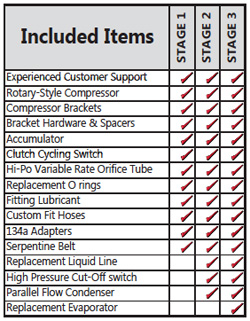
STAGE 1: Compressor upgrade that replaces the unreliable and poorly performing R4 compressor with the dependability and efficiency of the modern rotary-style compressor
STAGE 2: Engine compartment upgrade that combines the Stage 1 kit with a high-performance direct-fit parallel-flow condenser
STAGE 3: Deluxe engine compartment upgrade combines Stage 2 with a new evaporator, replacing all components that contain refrigerant and lubrication, and eliminating any chance of system contamination
A/C Upgrade Kits for Camaros Features
All A/C Upgrade kits feature model-specific hoses, compressor adapter brackets, a new accumulator, a new hi-po variable-rate orifice tube, a new serpentine belt, step-by-step installation instructions, all necessary hardware, and a new pressure switch.
Can I Install This Myself?
Yes, if you typically do your own repair work, then this can be installed with tools found in most enthusiasts’ garages. However, evacuating and charging the system should be performed by a licensed professional.
Contact us today for more information about the 89-92 Camaro Upgrade Kits. We also offer stock replacement parts and factory restoration and rebuilding services for your factory-installed A/C and heater parts.
If you think the R4 compressor is bad, you clearly have no experience with its predecessor, the A6. Now THAT was a steaming pile. The R4, when it came out 45 years ago, was LIGHT YEARS ahead of the old late 50s POS. Much the same way newer ones from the last 20 years or so are better than the R4. Funny thing: as a species, humans are fairly good at taking what's been done before, and improving on it; subject to one's definition of "improvement".
A compressor is just a pump. It doesn't care what it's pumping through, and the other things don't care what's doing the pumping. Kinda like, your water heater and your faucets don't have to be the same brand, or otherwise be "compatible". They just ARE, by definition.
So there's no issue of "compatibility" in that sense. As long as the pump pumps enough stuff, and does so at the right pressure, it's transparent to the rest of the system. And vice-versa. Which, since all of those things are dictated by the properties of the refrigerant, they all are.
All that's left then, is mechanical fitment. Lines, and what we used to call "mount & drive" back when I worked at a distributor & installer of automotive AC systems. Obviously there can be constraints there: if for example the compressor is shallow front-to-rear, and has to go in front of some motor part such as a block or head, then any other compressor you want to put there, has to be no larger than the other. Beyond that it's pretty straightforward. The electrical part is even simpler; virtually all compressor clutches are either 2-wire (separate wires for battery & ground) or 1-wire (1 side of the coil is grounded, the wire supplies battery). All you have to do is put the right matching connector on the wire in your car and if necessary ground the other compressor terminal.
I have a lot of experience with the A6. It is 10x the unit of anything that has come since. More BTUs, better longevity and held up much better with R134a than the R4 ever dreamed about. I am actully building brackets to install a serpentine clutch equipped A6 on my 97 Express because nothing beats an A6 in a dual evaporator application.
From: Franklin, KY near Beech Bend Raceway, Corvette Plant and Museum.
Car: 1992 Pontiac Firebird
Engine: 5.0L L03 TBI
Transmission: 700R4
Axle/Gears: 2.73
Re: Getting rid of the pancake R4 AC compressor
Originally Posted by Fast355
I have a lot of experience with the A6. It is 10x the unit of anything that has come since. More BTUs, better longevity and held up much better with R134a than the R4 ever dreamed about. I am actually building brackets to install a serpentine clutch equipped A6 on my 97 Express because nothing beats an A6 in a dual evaporator application.
I too think the GM A6 is a excellent AC compressor.
I'll raise you the Chrysler Air Temp dual front and rear heat and air in my 1967 Chrysler that's as big as a whale and seats about 20. It has enough R12 Freon to refill about 3.5 3rd gens and you can hang meat in it on a 105 degree day parked on fresh new black as the Ace of spades blacktop with it sitting there idling. On that same day it was blowing high 20s out the vent and when turned off water condensed across the metal dash and vents and dripped all over the place.
When you turn the AC on the compressor clutch engages and it never cycles until you turn the AC off and it disengages. It's a non-cycling system.
When you turn on the AC it's like you engaged an air brake going down the road as the massive heavy AF V-twin compressor sucks the life out of a 440 TNT engine rated at 375 HP & 480 FT-LBS or torque. My Chrysler still has the factory R12 charge in it that it left the factory with in 1967.
I have removed the engine and trans multiple times for upgrades from the bottom of the car and installed it from the bottom of the car just so as to not disturb the original AC system. I built brackets to hold it all in place while the engine and trans came out on the K member from the bottom.
I remember years ago I was doing a custom ac system on a customers car, it had a R4 stock but the guy did billet pulley kit, can’t remember which brand but it came with an sd7, anyway this was the first time I had ever installed one and I remember being concerned that it wouldn’t perform as well, I remember looking up all the specs and if my memory serves me the R4 actually had more displacement and more cfm than the sd7 sanden, now don’t get me wrong the wobble plate design is way more efficient when it come to power consumption.
I have the FLX7. It'll freeze you out of the car even at idle.
I’m not knocking it, I actually have an sd7 in my GTA and it blows ice but I completely customize the system, the only reason I switch from the R4 was for space, too many things going on in my engine bay. But both the SD5 and the SD7 Sanden compressors don’t have the same flow as the R4 @ low rpm.
It's sad you can't copy and paste a web site with info that is very relevant to this post!!!
Classic auto air and search for Camaro retrofit
I sure appreciate the information you provided about Classic Airs kit, but when I wandered over to their website I missed it. I also appreciate all of the other posters input here on other options available for the GM serpentine setup. I got a very good chuckle out of Airwolfe's description of the Mopar industrial AC compressor of days past, that is still working today. A true snapshot in time when well made pieces were put into American made cars. Fast forward 50+ years and you now have Red colored plastic pieces, that contain some LEDs and 2 sensors that are used taillight assemblies for newer Ford F 150, 250 and 350 trucks, that cost 7.5K a piece to replace. Headlights are only 5K a piece. GM pieces aren't much cheaper.
I will be running a 9:1 steering box that was setup by the folks in SC and is mated with a PS pump that has an additional port to use with the hydroboost system. With GM's serpentine system I can use the PS pump that was modified for the hydroboost. The GM serpentine system might not be as pretty as some other options out there, but for most applications it works very well.
Calling and talking to the great folks @ Classic I was informed the 89 to 92 Camaro AC compressor upgrade kits are no longer available. Their Fla plant was closed and Classic is redesigning some of their AC kits for future sales. The train has already left the station on this option.
Talking to Rick @ Old Air Products they do have a parallel flow condenser that will fit into the 3rd Gen Camaros. At 16 x 23" inches it is very close in size to the OEM piece and you will have to do some bracket work to mount it in. At that size that will provide plenty of cooling area for the 134 freon, which is needed for the 134 to work efficiently. Rick suggested using the Blue orifice tube in the setup. OAP also makes a hose kit that will allow you to make up your own hoses for the Sanden 508 conversion, hi/lo pressure switch and the dryer for 1 stop shopping.
I have the FLX7. It'll freeze you out of the car even at idle.
What does it cool like in 110F and 50% RH kind of heat load? Fairly common summer heat load here where I am. In those conditions, freezing out a vehicle at idle has never been something I have experienced with a Sanden. My regular cab 2500 Ram V10 had a factory Sanden SD7H15 on it and it was mediocre at best around town on a hot day.
Talking to Rick @ Old Air Products they do have a parallel flow condenser that will fit into the 3rd Gen Camaros. At 16 x 23" inches it is very close in size to the OEM piece and you will have to do some bracket work to mount it in. At that size that will provide plenty of cooling area for the 134 freon, which is needed for the 134 to work efficiently. Rick suggested using the Blue orifice tube in the setup. OAP also makes a hose kit that will allow you to make up your own hoses for the Sanden 508 conversion, hi/lo pressure switch and the dryer for 1 stop shopping.
I suggest the Red 0.062" orifice tube myself. Has worked the best for me in both conversions and factory R134a GM systems. The Blue will not allow the low side pressure to pull down low enough to get the air truly cold. R134a has a substantially better Latent Heat of Evaporation than R12. Some rough math on percentages and area percentages of the various orifice tube sizes reinforce why the 0.062" works the best out of the sizes I have tested from 0.047-0.072. In purely low-speed around town driving 0.057" actually works better than the 0.062" but the compressor will cycle much more often at highway speeds resulting in less cooling. The GM van based shuttle buses that were part of a fleet I worked on at a shop years ago that merely idled around DFW Airport cooled a lot better with the 0.057" than the 0.071" and those were factory R134a systems. We always added a pair of 11" pusher fans for a ~1999 Tahoe application to those condensers as well. For what those shuttle buses were doing it was far better performing than the factory systems.
Boiling R12 removes 72 BTU per lb. R134a removes 93.4 BTU per lb for a 25.9% increase. 0.071" has an area of 0.003959 in². 0.062" has an area of 0.003019 in² a difference of 26.94%. 0.062" thus keeps the evaporator working very closely to the designed BTU capacity. It is as close to optimized as possible with off the shelf components. Increasing the orifice tube diameter increases the BTU capacity but increases the low side pressure making the refrigerant in the evaporator boil at a higher temperature and the inverse is also true. Reducing the size decreases the flow amd lowers the pressure. The smaller orifice tube actually reduces the high side pressure as well because the refrigerant has more time to cool in the condenser before it makes its journey to the evaporator and compressor again.
From: Franklin, KY near Beech Bend Raceway, Corvette Plant and Museum.
Car: 1992 Pontiac Firebird
Engine: 5.0L L03 TBI
Transmission: 700R4
Axle/Gears: 2.73
Re: Getting rid of the pancake R4 AC compressor
Originally Posted by Aaron R.
Hate to sidetrack this thread, but how do you KNOW this car still has the factory a/c charge 58 years later? I am genuinely intrigued by this.
My uncle lived in Wheaton, Ill and worked at Guardian Electric. He was the head engineer there. This 1967 Chrysler was the first car he ever bought brand new. He got to go watch the car being built and took delivery of the car at the factory. It has a brass plaque on the lower dash stating that the car was custom built by the Chrysler Corporation for W. Warren Wright.
I have his personalized front and rear Illinois W W W license plates and his Kentucky ones too. Now the car wears my initials.
He was a very organized and particular type of guy, a very matter of fact, put together man. All the i's dotted and the t's crossed.
He had every single piece of paperwork and documentation concerning the car, his purchase of the car, and maintenance of the car since day one. Which I have all of now.
The dealer order forms, the receipt showing the car he traded in and the amount they allowed him on trade and the total bill. The canceled check he wrote for the purchase of the car. The Vehicle Certicard showing the VIN, options, his name and address, and build & delivery date of the car. The broadcast sheet I retrieved from the back seat between the springs and cushion. The original shop manual he purchased with the car, owner's manual, warranty info. Personal notes about the car he kept in a notebook, all the receipts for any parts purchased and maintenance done to the car.
Well worn and battle tested. My uncle had a thing about putting his name and address on all of his stuff. He even did it on the inside front and back covers too. My uncle had incredible artistic skills but horrible handwriting. He took Calligraphy classes to improve his penmanship and it appears he missed dotting an i in his last name.
There are no receipts or notes in his notebook concerning servicing of the AC system and I also asked him if he had ever had the AC system serviced and he said No. Since I bought the car from him in the early 1990's I have never had to service it either. Until the day comes that I absolutely have to break the seal on the AC system I'm not going to. If it ain't broke don't fix it until it is. I'll be happy watching the nice clear R12 Freon flowing through the sight glass until the day it isn't.
I'm probably a nut. If I ever remove the engine again it will come out the bottom still attached to the stub frame.
It is possible he didn't note it in his notebook, or save the receipt, or forgot about it. He was of sound mind & body when I asked him.
It's my story and I'm sticking to it though.
Last edited by Airwolfe; Apr 11, 2025 at 05:36 AM.
From: Franklin, KY near Beech Bend Raceway, Corvette Plant and Museum.
Car: 1992 Pontiac Firebird
Engine: 5.0L L03 TBI
Transmission: 700R4
Axle/Gears: 2.73
Re: Getting rid of the pancake R4 AC compressor
Originally Posted by Aaron R.
That is amazing. Thanks for the detailed reply. Very convincing.
Since you shown some interest thought I post this to give you some kind of an idea of what kind of "Guy" my uncle was. Not what kind of person he was. He was a great person though.
I am using a GM serpentine belt system and will be upgrading the R4 pancake AC compressor. The GM factory serpentine belt system is a great system and there is no reason to reinvent the wheel here. The folks over at Old air products make brackets that allows a Sanden 508 compressor to be used in place of the R4 with no serpentine belt alignment problems. You will have to get custom AC lines fabricated for the 508 compressor install. The R4 worked better on the drawing board then it ever did in the real world. Any forum members make the switch yet?
The one thing that amazes me is your variable orifice worked. They have never lasted long at all for me. Most of the time they worked well initially and then stick closed after a short period of time.
I am not sure why, probably Chinesium to blame but I have now had 2 different brands of cycling switches fail in the same manner. This one was brand new out of the box. This was after ~10 miles of driving in 90F weather the other day with the cycling switch not allowing the compressor to cycle. High fan speed and recirculate. It froze the evaporator core up after about 20 minutes and I had to switch to vent to the ice melt.
The 134 Freon will preform a lot better if you use a parallel flow condenser. The R12 condenser is a serpentine type and doesn't offer the cooling area for the Freon that the parallel flow unit does. The 1994 Camaro was the first Camaro with 134 Freon but I never looked into whether that condenser was a parallel flow type condenser and would fit into a 3rd gen box.
The 134 Freon will preform a lot better if you use a parallel flow condenser. The R12 condenser is a serpentine type and doesn't offer the cooling area for the Freon that the parallel flow unit does. The 1994 Camaro was the first Camaro with 134 Freon but I never looked into whether that condenser was a parallel flow type condenser and would fit into a 3rd gen box.
I'm sure it would, but its moot. I only drive with T-Tops off for occasional joy ride and the fan isn't strong enough to over come the wind anyway. And I like retaining what came from the factory or at least what was available for nostalgia. Fast355 has experimented with some different fans, which is intriguing - I wouldn't have a problem putting a strong fan in, can't tell its there anyway. I was able to retro fit a 4th Gen F-body charcoal canister, so there probably other parts that are nearly a direct swap.
The Monte carlo link mentions that thu used a GM style hose connection and if I recall they used the thirdgen serp hose assembly... I wonder if that would fit on a thirdgen? Or does the Sanden compressor place it at a bad angle?
The Monte carlo link mentions that thu used a GM style hose connection and if I recall they used the thirdgen serp hose assembly... I wonder if that would fit on a thirdgen? Or does the Sanden compressor place it at a bad angle?
Personally I would adapt a V5 or V7 as David did on his Nova before I chose a Sanden having first hand experience with the SD7H15s lack of displacement and idle cooling. David was a member of the old GMEFI email group back in the day.
Sandens are overated IMO. Then again this is how difficult it is to cool things in Texas though. One of the GMT400 guys was in a struggle to get even 60F cruising down the highway out of his TBI era Suburban he had swapped a Sanden SD7H15 on. After messing around with it and spinning his wheels he built a bracket and swapped on a V7. Got it down below 40F at highway speeds with a single V7 but still not as cool as he wanted idling around in traffic. He ended up adding a 2nd condenser and a 2nd V7 to run the front and rear evaporators off completely seperate systems. Just to give you an idea of how well a V7 performs, his AC blows mid 30s from the vents at IDLE on a 115F day now. The V7 compressor also basically never have to cycle so the AC stays blowing ice cold vs warming up 10F or so every minute or so when the compressor cycles.
Great fabrication work on what once was the TX national vehicle, the TBI Suburban fast355. The Lizard Skin heat barrier works pretty good and helps to keep the temps down inside the vehicle. PITA to strip the interior down and spray it, but it does help. The Rat Rod folks do have some fabrication skills and there are some interesting rides in their mix. The propane powered V12 mid engine cat 6 truck took a while to build. As did a lot of the rides in the video. A Plymouth Savoy @ 10:55 of the video?
Great fabrication work on what once was the TX national vehicle, the TBI Suburban fast355. The Lizard Skin heat barrier works pretty good and helps to keep the temps down inside the vehicle. PITA to strip the interior down and spray it, but it does help. The Rat Rod folks do have some fabrication skills and there are some interesting rides in their mix. The propane powered V12 mid engine cat 6 truck took a while to build. As did a lot of the rides in the video. A Plymouth Savoy @ 10:55 of the video?
I did not fabricate that one myself. Just offered information and followed along for the ride as he went through various setups. I agree WildBlue19s fabrication is top notch though. Very cool video, I enjoyed watching it.
Sanden FLX-7 is a 508 with an interchangeable head. The GV pad works with the factory hose manifold. I used the 4860 for my v-belt setup. 4872 with 125mm pulley looks right for serpentine. R134 blows cold in 95 degree heat even with my smaller crank pulley, but I replaced the drier, evaporator, and condenser with a parallel flow when I did the swap. Also dual LS fans wired to both run at half-speed flow a lot more air over the condenser which helps at idle.
I've always considered swapping away from the R4 but with tall valve covers to clear rocker arm girdle it would be a mess trying to fit something in there.
Supposedly this compressor is a R4 form factor but scroll compressor internals. Not much for reviews out there on the interwebs as of the last time I did any reading on it. It very likely has a lower output vs the R4.
I'm probably going to give the R4 one more go now that my airflow is about as good as it gets using a brushless cooling fan that moves a ton of air.


Rob