


Odd detonation problem


Thread Starter
Supreme Member
iTrader: (2)
Joined: Jan 2002
Posts: 9,962
Likes: 5
From: Moorestown, NJ
Car: 88 Camaro SC
Engine: SFI'd 350
Transmission: TKO 500
Axle/Gears: 9-bolt w/ 3.23's
Odd detonation problem
Ive been getting detonation (or perceved knock) in a narrow band across my timing curve. It goes from around 2000 - 2400 rpm and exists at all map values. Ive had this problem ever since I put the 350 in. Now that the rest of the timing is where it needs to be. I was messing with the car and in third gear with the pedal near the floor itll actually start slowing down when it gets to 60 mph and just hang there untill it either gets past it or I lift. If i lift and jab the pedal down the TC will stall past that point and itll take back off again and go to around 120 when it hits the end of the powerband w/o breaking a sweat. What could cause this? It seems to get worse with temperature so I would assume its knock but it could also maybe be noise on the valve train thats aggrivated by thinning oil or a bum module (the one I have is used but appears to still work). Everywhere below and above it wont pick up lots of knock counts with too much timing, just begin to run somewhat rough with a peppering of counts in the areas with too much timing. Whats everyones opionion on this? Is it possibly a mechanical problem thats causing false knock?
Last edited by dimented24x7; Apr 20, 2004 at 02:08 AM.
Thread Starter
Supreme Member
iTrader: (2)
Joined: Jan 2002
Posts: 9,962
Likes: 5
From: Moorestown, NJ
Car: 88 Camaro SC
Engine: SFI'd 350
Transmission: TKO 500
Axle/Gears: 9-bolt w/ 3.23's
Heres my timing curve. Pretty much everything between the lines is succeptible to detonation. Its probably also the cause of the vicious bog on sudden tip in that I sometimes have. Is it possible that maybe some part of the engines operation is to blame? I have, well, i *think* I have a used 350 module but maybe ill replace it with a new A/C delco unit jsut to be safe.

Senior Member
Joined: Oct 1999
Posts: 6,621
Likes: 2
Car: 91 Red Sled
Axle/Gears: 10bolt Richmond 3.73 Torsen
E-mail me your bin so I can take a look at the rest of your tune. If I were you I'd disable the PE adder spark and work your Coolant SA vs map table since you said you're knocking as the engine heats up. Also might look at your AE to make sure you aren't running too lean at those speeds when you smash the pedal down. There's a lot to try so get lockers and stop guessing  .
.
. 
Moderator
iTrader: (1)
Joined: Mar 2002
Posts: 18,432
Likes: 234
From: Chasing Electrons
Car: check
Engine: check
Transmission: check
Originally posted by dimented24x7
Heres my timing curve. Pretty much everything between the lines is succeptible to detonation. Its probably also the cause of the vicious bog on sudden tip in that I sometimes have. Is it possible that maybe some part of the engines operation is to blame? I have, well, i *think* I have a used 350 module but maybe ill replace it with a new A/C delco unit just to be safe.
Heres my timing curve. Pretty much everything between the lines is succeptible to detonation. Its probably also the cause of the vicious bog on sudden tip in that I sometimes have. Is it possible that maybe some part of the engines operation is to blame? I have, well, i *think* I have a used 350 module but maybe ill replace it with a new A/C delco unit just to be safe.
For a module get an early CCC one labeled BLH.
RBob.
Thread Starter
Supreme Member
iTrader: (2)
Joined: Jan 2002
Posts: 9,962
Likes: 5
From: Moorestown, NJ
Car: 88 Camaro SC
Engine: SFI'd 350
Transmission: TKO 500
Axle/Gears: 9-bolt w/ 3.23's
Originally posted by JPrevost
E-mail me your bin so I can take a look at the rest of your tune. If I were you I'd disable the PE adder spark and work your Coolant SA vs map table since you said you're knocking as the engine heats up. Also might look at your AE to make sure you aren't running too lean at those speeds when you smash the pedal down. There's a lot to try so get lockers and stop guessing .
E-mail me your bin so I can take a look at the rest of your tune. If I were you I'd disable the PE adder spark and work your Coolant SA vs map table since you said you're knocking as the engine heats up. Also might look at your AE to make sure you aren't running too lean at those speeds when you smash the pedal down. There's a lot to try so get lockers and stop guessing
. The cool compensation as well as the PE adder are both zeroed out. Ill email you the bin later when I get to my computer.
RBob, I wasnt aware that the earlier modules worked with the later EFI ecms. Ill have to give that a try.
Thread Starter
Supreme Member
iTrader: (2)
Joined: Jan 2002
Posts: 9,962
Likes: 5
From: Moorestown, NJ
Car: 88 Camaro SC
Engine: SFI'd 350
Transmission: TKO 500
Axle/Gears: 9-bolt w/ 3.23's
Well... It seems it was just too much timing. Worked fine in the winter but the problem came back now that its getting hot out again. Ive been pulling timing out as it got warmer but today I decided to bite the bullet and pull around 1-3 degrees out across the whole timing curve and it seemed to smooth the motor out, although its become flat in some spots from not enough timing. What is odd though is why it only really has detonation around 2000-2400 rpm and jsut runs rough in other spots instead  Kinda wierd. At WOT I flattened out the curve arouynd the trouble spot and it seemed to get rid of the detonation. At least it doesnt pick up knock counts and bog real bad. Have to do some driving so ill see tommorow how it works. I also have to redo the VE's runs on the rich side now that it has less timing.
Kinda wierd. At WOT I flattened out the curve arouynd the trouble spot and it seemed to get rid of the detonation. At least it doesnt pick up knock counts and bog real bad. Have to do some driving so ill see tommorow how it works. I also have to redo the VE's runs on the rich side now that it has less timing. Last edited by dimented24x7; Apr 20, 2004 at 08:06 PM.

Trending Topics
Thread Starter
Supreme Member
iTrader: (2)
Joined: Jan 2002
Posts: 9,962
Likes: 5
From: Moorestown, NJ
Car: 88 Camaro SC
Engine: SFI'd 350
Transmission: TKO 500
Axle/Gears: 9-bolt w/ 3.23's
It was sort of rich before, and now that I took timing out its pretty rich. Odd, though. In first it really doesnt feel all that responsive anymore w/o the timing. It does go in the higher gears, though. It actually gets underway quite nicely in third at highway speeds (50-90) now. It actually presses me back in the seat when im accelerating at those speeds, which is surprising. It used to just only go in 1st and 2nd. Guess the extra timing was causing detonation under prolonged load. Doesnt feel good in first, though, guess its just the butt dyno being inaccurate.

Junior Member
Joined: Oct 2002
Posts: 82
Likes: 0
From: Houston, TX
Car: 89 S10 Blazer
Engine: Built 4.3L V6 TBI
Transmission: Built 700R4
Axle/Gears: 7.65/Zexel/3.73
Interesting. Maybe this is a TBI issue, as I now have this exact problem, only the band is much narrower. It's only about 200-300 rpm wide. I'll have to try cutting a trough through my timing table at 2400 and see if that fixes it. 
I'm just getting started hashing out the timing table, so it's pretty rudimentary at this point.
I'm just getting started hashing out the timing table, so it's pretty rudimentary at this point.
Senior Member
Joined: Oct 1999
Posts: 6,621
Likes: 2
Car: 91 Red Sled
Axle/Gears: 10bolt Richmond 3.73 Torsen
Here's my only hint and I don't want any more questions asked until it's been tried. Remove a lot of timing in the 70-100kpa below 2400rpm. When you open the throttle even just a little bit you can hit 100kpa at low engine speeds. Don't worry about not having tire smoking torque, it'll be there, trust me . I've had this problem and tackled it through trial and error. It's not detonation, it's pre-ignition with too much timing in the high load low RPM areas.
. I've had this problem and tackled it through trial and error. It's not detonation, it's pre-ignition with too much timing in the high load low RPM areas. Junior Member
Joined: Oct 2002
Posts: 82
Likes: 0
From: Houston, TX
Car: 89 S10 Blazer
Engine: Built 4.3L V6 TBI
Transmission: Built 700R4
Axle/Gears: 7.65/Zexel/3.73
But it trips the knock sensor when I'm cruising, not dipping in the throttle. I'll have to give both a shot I guess. 
Teeleton
Teeleton
Thread Starter
Supreme Member
iTrader: (2)
Joined: Jan 2002
Posts: 9,962
Likes: 5
From: Moorestown, NJ
Car: 88 Camaro SC
Engine: SFI'd 350
Transmission: TKO 500
Axle/Gears: 9-bolt w/ 3.23's
I found the cause of my 'detonation' problems last summer. I had a set of these in the car (see pic). The ones with the screw-off terminals. Took them out and threw them in the trash and magically all my problems dissapeared.
Thread Starter
Supreme Member
iTrader: (2)
Joined: Jan 2002
Posts: 9,962
Likes: 5
From: Moorestown, NJ
Car: 88 Camaro SC
Engine: SFI'd 350
Transmission: TKO 500
Axle/Gears: 9-bolt w/ 3.23's
Originally posted by JPrevost
Here's my only hint and I don't want any more questions asked until it's been tried. Remove a lot of timing in the 70-100kpa below 2400rpm. When you open the throttle even just a little bit you can hit 100kpa at low engine speeds. Don't worry about not having tire smoking torque, it'll be there, trust me . I've had this problem and tackled it through trial and error. It's not detonation, it's pre-ignition with too much timing in the high load low RPM areas.
Here's my only hint and I don't want any more questions asked until it's been tried. Remove a lot of timing in the 70-100kpa below 2400rpm. When you open the throttle even just a little bit you can hit 100kpa at low engine speeds. Don't worry about not having tire smoking torque, it'll be there, trust me
. I've had this problem and tackled it through trial and error. It's not detonation, it's pre-ignition with too much timing in the high load low RPM areas. Junior Member
Joined: Oct 2002
Posts: 82
Likes: 0
From: Houston, TX
Car: 89 S10 Blazer
Engine: Built 4.3L V6 TBI
Transmission: Built 700R4
Axle/Gears: 7.65/Zexel/3.73
Hmm.. no such luck here. I'm running the standard delco R42LTS plugs for vortec heads. I don't have very many miles on these plugs, but the tune has been through some big changes, so maybe a fresh set of plugs is in order.
Teeleton
Teeleton
Thread Starter
Supreme Member
iTrader: (2)
Joined: Jan 2002
Posts: 9,962
Likes: 5
From: Moorestown, NJ
Car: 88 Camaro SC
Engine: SFI'd 350
Transmission: TKO 500
Axle/Gears: 9-bolt w/ 3.23's
I doubt its your problem, but thats what was causing mine. The difference between those and the standard delcos was night and day.
One of the wires carbon tracked because of those plugs. After a while, it burned all the way back to the dist. and started arcing and it burned the module and coil out.
One of the wires carbon tracked because of those plugs. After a while, it burned all the way back to the dist. and started arcing and it burned the module and coil out.

Supreme Member
Joined: Jun 2002
Posts: 1,787
Likes: 0
From: great lakes
Originally posted by dimented24x7
I doubt its your problem, but thats what was causing mine. The difference between those and the standard delcos was night and day.
One of the wires carbon tracked because of those plugs. After a while, it burned all the way back to the dist. and started arcing and it burned the module and coil out.
I doubt its your problem, but thats what was causing mine. The difference between those and the standard delcos was night and day.
One of the wires carbon tracked because of those plugs. After a while, it burned all the way back to the dist. and started arcing and it burned the module and coil out.
Senior Member
Joined: Oct 1999
Posts: 6,621
Likes: 2
Car: 91 Red Sled
Axle/Gears: 10bolt Richmond 3.73 Torsen
Originally posted by dimented24x7
But wouldnt pre-ignition cause serious engine damage from excessive heat instead? To me, it doesnt seem like the ks would be able to see the mixture lighting up real early just after the intake cycle.
But wouldnt pre-ignition cause serious engine damage from excessive heat instead? To me, it doesnt seem like the ks would be able to see the mixture lighting up real early just after the intake cycle.
The tuffest part about GM EFI is getting all the tables in your head. Just because the main SA table says 15 degrees doesn't mean that's even close to what the engine is seeing. The 3 bias's, the 3 tables, dizzy, and initial... it's very confusing to a new guy.
Dim, you should look at the TCC SA table. That sucker's bit me more times than I can count. First it was the bias that was zero but the table was nearly all 20 degrees. That did NOT work, lol. Then the table eventually reared it's ugly head where I had the timing all dialed in then all of a sudden tcc locked up and the car got SLOW. I had to zero out the TCC locked SA table, 2 degrees was fine but stock it was pulling nearly 5 degrees out
.I'm sticking to my guns here with the timing at high load low RPM. When you just add 4 degrees to the whole table you REALLY shouldn't. In other words, be extra conservative there or it'll drive you nutz. It doesn't help that the knock sensor is ignored below 1000rpm and 10mph.
Last edited by JPrevost; Mar 1, 2005 at 08:57 PM.
Thread Starter
Supreme Member
iTrader: (2)
Joined: Jan 2002
Posts: 9,962
Likes: 5
From: Moorestown, NJ
Car: 88 Camaro SC
Engine: SFI'd 350
Transmission: TKO 500
Axle/Gears: 9-bolt w/ 3.23's
Ive always been under the impression that preignition is the mixture lighting up very early in or just before the compression stroke, leading to massive ammounts of heat being developed in the CC during the compression stroke, which in turn torches holes in the pistons. No?
Luckily, so far the only engine Ive had confirmed pre/auto-ignition in was a weed wacker. I ran out of gas so I got lazy and threw some solvent in there. Ran like crap at first but it really started making some serious power after awhile. After a short period of use it got so hot I couldnt be near it anymore. At that point, I took my headphones off and the thing sounded like a little miniature diesel. It was like: 'pingpingpingping..." Best part was it just kept right on truckin' when I cut the spark. Had to choke it and mash the cutting head into the dirt to get it to shut off. Luckly when I took the cyl. head off it was still ok inside. That solvent mustve had an octane rating of like -10, lol...
Ive consolidated most of my tables so its definatly easier to tune now. As for the TCC table, I have the table zero'd out (all entries equal to the bias). Still ironing out the main SA so I havnt had the need to use it yet. I still have the bias', but in tunercats, it automatically takes it out for me so I havnt removed them (sheer lazyness more then anything else).
Luckily, so far the only engine Ive had confirmed pre/auto-ignition in was a weed wacker. I ran out of gas so I got lazy and threw some solvent in there. Ran like crap at first but it really started making some serious power after awhile. After a short period of use it got so hot I couldnt be near it anymore. At that point, I took my headphones off and the thing sounded like a little miniature diesel. It was like: 'pingpingpingping..." Best part was it just kept right on truckin' when I cut the spark. Had to choke it and mash the cutting head into the dirt to get it to shut off. Luckly when I took the cyl. head off it was still ok inside. That solvent mustve had an octane rating of like -10, lol...
Ive consolidated most of my tables so its definatly easier to tune now. As for the TCC table, I have the table zero'd out (all entries equal to the bias). Still ironing out the main SA so I havnt had the need to use it yet. I still have the bias', but in tunercats, it automatically takes it out for me so I havnt removed them (sheer lazyness more then anything else).


Joined: Jun 2001
Posts: 8,028
Likes: 93
From: DC Metro Area
Car: 87TA 87Form 71Mach1 93FleetWB 04Cum
Preignition is when the A/F charge is lit too early and pushes down on the piston before it has reached TDC. Detonation is usually when you get a second, spontaneous flame front (usually caused by the pressure spike after the ignition delay from the intended ignition) that collides into the first which rocks the piston in the bore and results in all sorts of unpleasantness (and could actually be preignition also, if the burn completes too soon because of the detonation).
As far as the rest of this conversation goes, my dead stock, LG5 truck (350 TBI) does exactly the same deal with the stock chip. I actually found some 2732’s just to tinker with it to see if I can get rid of it but haven’t tried yet.
As far as the rest of this conversation goes, my dead stock, LG5 truck (350 TBI) does exactly the same deal with the stock chip. I actually found some 2732’s just to tinker with it to see if I can get rid of it but haven’t tried yet.

Supreme Member
Joined: Nov 2003
Posts: 1,399
Likes: 0
From: STL area
Originally posted by funstick
something to think about advancing timming makes the engine look rich retarding it makes it look lean.
something to think about advancing timming makes the engine look rich retarding it makes it look lean.
Last edited by 11sORbust; Mar 2, 2005 at 09:27 AM.

Joined: Mar 2000
Posts: 1,692
Likes: 1
From: Corona
Car: 92 Form, 91 Z28, 89 GTA, 86 Z28
Engine: BP383 vortech, BP383, 5.7 TPI, LG4
Transmission: 4L60e, 700R4, 700R4..
Axle/Gears: 3.27, 2.73
I work on a dyno all day and with a wideband, and tomorrow I should have some free time. I'll test that theory on ignition advance and wideband reading for you all. By tomorrow I mean your evening tonight (I'm in China).
How does WOT at MBT vs WOT at MBT - 5 degrees sound?
This motor is also not knock limited, so I'll go the other direction too. MBT was found on an engine dyno and is within .5 degrees and .2 kW at steady state, easily. This test will be done on a chassis dyno, so I won't even bother with torque comparison.
What A/F would you like this done at? 12, 12.5, 13, 13.5? Doesn't matter to me, or that engine.
How does WOT at MBT vs WOT at MBT - 5 degrees sound?
This motor is also not knock limited, so I'll go the other direction too. MBT was found on an engine dyno and is within .5 degrees and .2 kW at steady state, easily. This test will be done on a chassis dyno, so I won't even bother with torque comparison.
What A/F would you like this done at? 12, 12.5, 13, 13.5? Doesn't matter to me, or that engine.
Supreme Member
Joined: Nov 2003
Posts: 1,399
Likes: 0
From: STL area
I'm sure of the results. But if want something to do....
1)Lean it out to aprox 13.8:1.
2)Then max the timing, as much as it can handle w/o detonation. (At 13.8, there will be less fuel left unburned in the chamber, so when you max the timing A/F will not change much)
3)confirm a/f ratio, should be 13.8 or a hair leaner.
4)Reduce the total timing 15*
On a sidenote, I bet you'll see more hp at 13.8 than 12.5
1)Lean it out to aprox 13.8:1.
2)Then max the timing, as much as it can handle w/o detonation. (At 13.8, there will be less fuel left unburned in the chamber, so when you max the timing A/F will not change much)
3)confirm a/f ratio, should be 13.8 or a hair leaner.
4)Reduce the total timing 15*
On a sidenote, I bet you'll see more hp at 13.8 than 12.5
Thread Starter
Supreme Member
iTrader: (2)
Joined: Jan 2002
Posts: 9,962
Likes: 5
From: Moorestown, NJ
Car: 88 Camaro SC
Engine: SFI'd 350
Transmission: TKO 500
Axle/Gears: 9-bolt w/ 3.23's
If you have speed density youll see the AFR go richer with less timing and slightly leaner with more, to a point. The timing effects the engines true VE and whenever the timing is changed, youll have to change the VE tables. If you have MAF, the mixture should remain pretty much the same since itll see the changes in airflow.
Thread Starter
Supreme Member
iTrader: (2)
Joined: Jan 2002
Posts: 9,962
Likes: 5
From: Moorestown, NJ
Car: 88 Camaro SC
Engine: SFI'd 350
Transmission: TKO 500
Axle/Gears: 9-bolt w/ 3.23's
Ive field tested this already. My blms are still ~122-125 no matter what my timing is. With SD, timing changes, then the VE table must be changed as well.
Supreme Member
Joined: Nov 2003
Posts: 1,399
Likes: 0
From: STL area
Originally posted by dimented24x7
Ive field tested this already. My blms are still ~122-125 no matter what my timing is. With SD, timing changes, then the VE table must be changed as well.
Ive field tested this already. My blms are still ~122-125 no matter what my timing is. With SD, timing changes, then the VE table must be changed as well.

Thread Starter
Supreme Member
iTrader: (2)
Joined: Jan 2002
Posts: 9,962
Likes: 5
From: Moorestown, NJ
Car: 88 Camaro SC
Engine: SFI'd 350
Transmission: TKO 500
Axle/Gears: 9-bolt w/ 3.23's
Small changes in timing shouldnt have much effect with a system that can directly calculate the actual airflow. Obviously if you pull ALOT then thats a different story. That will adversly effect the motor and probably cause incomplete combustion.
Im going to play devils advocate and say that the sole effect of a modest change in timing wont be the engine richening up/leaning out.
The implications of the statement that timing can cause the apparent AFR at the exaust side to substantially vary with a constant AFR on the intake side are profound. That would mean that one would never be able to know ones true AFR from a WB-O2 because it would be, at least in part, a function of timing.
I certainly hope this isnt true It would be impossible to calibrate a flow based system like mine. If it is true, then Im going to go get one of them new fangled electric cars.
What does happen is that the engines volumetric efficiency is coupled together with the ammount of timing it recieves. Too little or too much timing will cause the volumetric efficiency to decline with respect to the volumetric efficiency of the engine with the idealized ammount of timing. With a SD system, this will cause the apparent AFR to change since the engines VE has changed with respect to whats in the tables.
Im going to play devils advocate and say that the sole effect of a modest change in timing wont be the engine richening up/leaning out.
The implications of the statement that timing can cause the apparent AFR at the exaust side to substantially vary with a constant AFR on the intake side are profound. That would mean that one would never be able to know ones true AFR from a WB-O2 because it would be, at least in part, a function of timing.
I certainly hope this isnt true
It would be impossible to calibrate a flow based system like mine. If it is true, then Im going to go get one of them new fangled electric cars. What does happen is that the engines volumetric efficiency is coupled together with the ammount of timing it recieves. Too little or too much timing will cause the volumetric efficiency to decline with respect to the volumetric efficiency of the engine with the idealized ammount of timing. With a SD system, this will cause the apparent AFR to change since the engines VE has changed with respect to whats in the tables.
Last edited by dimented24x7; Mar 2, 2005 at 09:42 PM.
Joined: Mar 2000
Posts: 1,692
Likes: 1
From: Corona
Car: 92 Form, 91 Z28, 89 GTA, 86 Z28
Engine: BP383 vortech, BP383, 5.7 TPI, LG4
Transmission: 4L60e, 700R4, 700R4..
Axle/Gears: 3.27, 2.73
I'm about to go out there now. I'll try the things you want, but this engine's MBT at WOT is low below 10 at low RPMS to low 20's at mid. Pulling 15 out is rediculous.
I'll test that A/F theory for you also, and even play with timing at different A/F, but this engine is <1L with a 5k redline so results may not be universal.
I'll test that A/F theory for you also, and even play with timing at different A/F, but this engine is <1L with a 5k redline so results may not be universal.
Senior Member
Joined: Oct 1999
Posts: 6,621
Likes: 2
Car: 91 Red Sled
Axle/Gears: 10bolt Richmond 3.73 Torsen
Want to get really scientific about the change in volumetric efficiency? Well here goes; Retard the timing and the exhaust gets hotter, this changes the velocity and mass flow rate. It ALSO changes the resonance frequency since that depends on the speed of sound which just so happens to depend on temperature . It's why if you look at the REALLY new stuff you'll notice the Vol Eff shift depending on intake manifold temperature and assumed cat temp. It doesn't move much at all but it does move  . When I say much at all I'm talking less than 300rpm but for some reason (probably OBD-III aka CAN) it's important enough to include.
Also, not that this will make a huge difference but BLMs use the narrow band o2 sensor. This sensor design is flawed because it has a temperature offset. Retard the timing, o2 sensor gets really hot, the voltage vs lamda changes resulting in slightly shifted BLMs. Run a wideband and you won't notice a change in the AFR, maybe 0.1-0.2 difference, the major differences will be misfire and detonation influenced "bad burns."
. It's why if you look at the REALLY new stuff you'll notice the Vol Eff shift depending on intake manifold temperature and assumed cat temp. It doesn't move much at all but it does move . When I say much at all I'm talking less than 300rpm but for some reason (probably OBD-III aka CAN) it's important enough to include.Also, not that this will make a huge difference but BLMs use the narrow band o2 sensor. This sensor design is flawed because it has a temperature offset. Retard the timing, o2 sensor gets really hot, the voltage vs lamda changes resulting in slightly shifted BLMs. Run a wideband and you won't notice a change in the AFR, maybe 0.1-0.2 difference, the major differences will be misfire and detonation influenced "bad burns."
Joined: Mar 2000
Posts: 1,692
Likes: 1
From: Corona
Car: 92 Form, 91 Z28, 89 GTA, 86 Z28
Engine: BP383 vortech, BP383, 5.7 TPI, LG4
Transmission: 4L60e, 700R4, 700R4..
Axle/Gears: 3.27, 2.73
Well, I couldn't see any difference on A/F caused by timing (-6 to +4 degrees from MBT (stoich MBT) and at different WOT A/F's from 12.0-13.6). So, I just went ahead and measured power and torque differences based on A/F.
To my surprise: It made a little more TORQUE at 13.0 then all other A/F's (at 3250 RPM), and small spark changes had little effect. Hp didn't care whether it was 12.0 or 13.0 at 4750 RPM. Spark tuning made the most difference there. Power dropped at leaner than 13:1.
I've seen some big cammed straight sixes, and even flathead V8's make way more torque below 12:1, and more Hp near 12.5:1, so don't take this as gospel or universal.
The MBT was calibrated on a high resolution engine dyno, but was calibrated at 14.7:1 and not at WOT, just at about 98% of available MAP and not at 5000. Our new software doesn't have PE spark adder (yet, that would only take an hour to add, seriously), but in the testing today, I saw more power and torque with more timing once richened with PE fuel. Cat temps will be our enemy though with this engine, because it's so small, it needs WOT on the Euro drive cycle, so we may be delaying PE fuel for, oh, 20 minutes (should have the cat dripping hot by then, just begging for a rich mixture). All testing so far is catless on this engine until we finish debugging. Don't worry, I'll post cat temp testing results later.
Maybe I'll go out and verify MBT at WOT and 14.7 then see what spark is needed when richer.
To my surprise: It made a little more TORQUE at 13.0 then all other A/F's (at 3250 RPM), and small spark changes had little effect. Hp didn't care whether it was 12.0 or 13.0 at 4750 RPM. Spark tuning made the most difference there. Power dropped at leaner than 13:1.
I've seen some big cammed straight sixes, and even flathead V8's make way more torque below 12:1, and more Hp near 12.5:1, so don't take this as gospel or universal.
The MBT was calibrated on a high resolution engine dyno, but was calibrated at 14.7:1 and not at WOT, just at about 98% of available MAP and not at 5000. Our new software doesn't have PE spark adder (yet, that would only take an hour to add, seriously), but in the testing today, I saw more power and torque with more timing once richened with PE fuel. Cat temps will be our enemy though with this engine, because it's so small, it needs WOT on the Euro drive cycle, so we may be delaying PE fuel for, oh, 20 minutes (should have the cat dripping hot by then, just begging for a rich mixture). All testing so far is catless on this engine until we finish debugging. Don't worry, I'll post cat temp testing results later.
Maybe I'll go out and verify MBT at WOT and 14.7 then see what spark is needed when richer.
Senior Member
Joined: Oct 1999
Posts: 6,621
Likes: 2
Car: 91 Red Sled
Axle/Gears: 10bolt Richmond 3.73 Torsen
RednGold, from my limited experience I've noticed that an engine's ideal AFR has a lot to do with combustion chamber design and spefic output more than anything else. The more efficient fast burn chambers, high compression, and small squish require a leaner AFR while the power adders, large combustion chamber, poor squish engines tend to need rich. Some examples of lean: high tech 4+ valves per cylinder, fastburn vortec/lt4, LSX series motors, and numerous euro and jap motors. Examples of needing rich: Old detroit iron, power adders like the GN and GTP, anything with low compression "in the hole" designs. The thing about needing a richer AFR at peak torque and leaner for horsepower was talked about a couple months ago, seems to be pretty universal. I don't know about the CART and F1 engines but from what I've seen it's been the case. It's another reason why open loop is SO nice (when you don't have a cat  ).
).
). Joined: Jun 2001
Posts: 8,028
Likes: 93
From: DC Metro Area
Car: 87TA 87Form 71Mach1 93FleetWB 04Cum
You just partially contradicted yourself. Most of the 4valve designs out here have an awful chamber, little if any quench/squish, slow combustion… their only redeeming quality is a large surface area which allows them to do some heavy breathing with small lifts and durations allowing for a wider useful powerband. The other side of this, a lot of old Detroit iron has some very good chambers. The early ‘80’s 305 heads, most small block mopars, old caddies… all had chambers that are virtually identical to the current vortech/fastburn designs. The biggest issue that a lot of these engines had were that they were either saddled from the factory with pistons way too far in the hole (what the hell was mopar thinking???) or small ports and valves because the engine was never intended to see any real rpm (look at the big caddy head, a 500ci caddy has the same size exhaust port cross section as a 305 chevy).
Senior Member
Joined: Oct 1999
Posts: 6,621
Likes: 2
Car: 91 Red Sled
Axle/Gears: 10bolt Richmond 3.73 Torsen
You're right, I should have explained it better but I didn't think anybody really cared for the fine print.
Here's the squish of a clover leaf chamber.
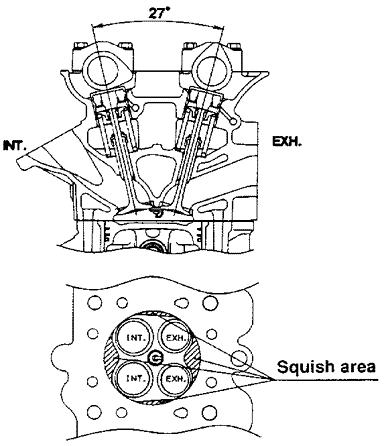
It still has plenty of squish and the tumble (not swirl so much) is also far superior to any 2 valve designs making for a very homogenious mixture (head efficiency). Sure a Hemispherical chamber can put in big valves but the squish then comes from a complex piston dome, not exactly the ideal way of keeping the piston from "rocking" in the bore .
I should also note that a lot of the 4 valve chambers have suprior spark plug location but that's another story for another time.
Question, do you have pictures of the older heads that had fastburn chambers? I've yet to see an older chamber design that was similar to the fastburn.
One thing that seems to be of much depate is the effectiveness of preventing hot-spots in the combustion chamber. From a few tests I've seen aluminum heads making more power than similar iron heads but none of the tests show thermocouple readings of various parts of the head. I also see conflicting information regarding thermocoatings. Some can't find any more power, some find it, others just do it to keep the heat out of the oil and cooling system. From a simplicitic engineering point of view I'd say the coatings are only moving the heat energy that would otherwise be wasted into the cooling system (oil included), into the exhaust whilst the mechanical energy is equal. Who knows, probably Ferrari and a few others but even then I bet 90% of their engineers don't know the answers either . Anybody for hire? I need somebody to get some secret GM research and I don't care how they do it  .
.
Here's the squish of a clover leaf chamber.
It still has plenty of squish and the tumble (not swirl so much) is also far superior to any 2 valve designs making for a very homogenious mixture (head efficiency). Sure a Hemispherical chamber can put in big valves but the squish then comes from a complex piston dome, not exactly the ideal way of keeping the piston from "rocking" in the bore
.I should also note that a lot of the 4 valve chambers have suprior spark plug location but that's another story for another time.
Question, do you have pictures of the older heads that had fastburn chambers? I've yet to see an older chamber design that was similar to the fastburn.
One thing that seems to be of much depate is the effectiveness of preventing hot-spots in the combustion chamber. From a few tests I've seen aluminum heads making more power than similar iron heads but none of the tests show thermocouple readings of various parts of the head. I also see conflicting information regarding thermocoatings. Some can't find any more power, some find it, others just do it to keep the heat out of the oil and cooling system. From a simplicitic engineering point of view I'd say the coatings are only moving the heat energy that would otherwise be wasted into the cooling system (oil included), into the exhaust whilst the mechanical energy is equal. Who knows, probably Ferrari and a few others but even then I bet 90% of their engineers don't know the answers either
. Anybody for hire? I need somebody to get some secret GM research and I don't care how they do it . 
Thread
Thread Starter
Forum
Replies
Last Post
