When you click on links to various merchants on this site and make a purchase, this can result in this site earning a commission. Affiliate programs and affiliations include, but are not limited to, the eBay Partner Network.
I'd really like to get in the 350 - 400 hp whp range. We'll see, seems like a few guys were able to get there reading through the Power Adders forum.
If I can be of any assistance just say the word. Was tuning boost pressure these last few nights out on the highway because I recently resurrected my GTA, and you need to take your time with it. Don't listen to anyone who tells you otherwise. Will give you an example, tonight I was planning additional tuning for a 10-psi spring in the wastegate... until I came across this. As you can see, you want to tune the VE with as little boost pressure as possible, you do not want to make a mistake at over 10-psi. At a mere 3-psi, depending on where you are in the VE during cruise, and when you floor the throttle, you will want to see the INT/BLM lock at 128/127 (on the rich side, never the lean side), but in my case, it is a tad too rich at 128/123. So I need to go back in and adjust the VE a tad in the area (RPM/kPa) I was in just before I floored it because my PE is already set to 12.2. I mean you can of course compensate in the BST fueling, but I am stickler for seeing the right numbers ahead of time before boost becomes a factor Once that is corrected, double check with another datalog, and when you see that it was corrected, move on to more boost pressure...
I do not have my wideband connected to the EBL at the moment...
besides disabling the canister purge and egr are there any other things that can be altered in the bin to get good broader range of VE learns with a NB im noticing that im out of closed loop with just a slight throttle opening
would it be beneficial to hold the car through the rev range in 2nd or 3rd gear (its auto) rather than cruizin in 4th with the lock up on?
Disable the lean cruise hiway mode. Can disable the open loop decel, but it is possible to run into surging as the VE Learn can lean out decel too much. If that occurs re-enable open loop decel and manually add fuel back in to eliminate any surging.
Note that in closed loop decel, proportional gains can also cause surging.
Disable the lean cruise hiway mode. Can disable the open loop decel, but it is possible to run into surging as the VE Learn can lean out decel too much. If that occurs re-enable open loop decel and manually add fuel back in to eliminate any surging.
Note that in closed loop decel, proportional gains can also cause surging.
RBob.
thanks
what are your thoughts of slowly holding it in a low gear through the rev range rather than cruising with the car in OD
also does BLM - RPM Learn Threshold have effect of the VE NB learns?, the bin that i started off with max is 3600 should i set this to 6k?
also does BLM - RPM Learn Threshold have effect of the VE NB learns?, the bin that i started off with max is 3600 should i set this to 6k?
Yes, increase the BLM Learn threshold up to 6000-RPM, and max out the PE trigger points to avoid Open Loop just until those areas are Learned, then set the PE back to where it was once completed...
Yes, increase the BLM Learn threshold up to 6000-RPM, and max out the PE trigger points to avoid Open Loop just until those areas are Learned, then set the PE back to where it was once completed...
- Rob
thanks but i dont know what you mean PE trigger points i have in Tuner pro things that start with PE
PE- tps% hyst
PE map hyst
PE CTS thres for richer
PE cold afr richer
PEmin rpm thres
PE afr attack enrich
PE afr decay enrich
PE afr enrich over time
PE- tps% enable threshold
PE map enable threshold
PE afr commanded
These. You'll want to max out the PE trigger/enable points, so peg all MAP entries to 100-kPa, and peg all TPS entries to 100%. This will keep you in Closed Loop so the VE Learns can correct a larger portions of the VE table. Remember to put it back to the original settings once completed.
Hi guys, jumping in here with a somewhat related topic. I was told the ECM doesn't look at the O2 sensor when TPS is over ~80%. Is this just with the original ECM like a 7747 or does the EBL do the same? Does this apply only to a NBO2 sensor? Does the EBL calculate AFR, based on BLM stoich 128, when in PE or does it use feedback from the WBO2?
When in PE mode the O2 sensor value is ignored. The INT is locked to 128, and the BLM is used if at 128 or higher. If it is lower then 128, then 128 is used.
When in PE mode the O2 sensor value is ignored. The INT is locked to 128, and the BLM is used if at 128 or higher. If it is lower then 128, then 128 is used.
RBob.
I guess that's even with a WBO2? Is there some place to adjust the calculation? In my logs I have CAFR set to 12.0 but my WBO2 shows low 11s, or am I not getting enough air flow since my MAP shows only 90KPa?
I guess that's even with a WBO2? Is there some place to adjust the calculation? In my logs I have CAFR set to 12.0 but my WBO2 shows low 11s, or am I not getting enough air flow since my MAP shows only 90KPa?
VE is too high at 5225 RPM and 90 KPa. Lower it some in that area and likely the surrounding area. Look at the data log to see if it is rich or lean elsewhere.
The 90 KPa can for for various reasons. Elevation above sea level, air cleaner restriction or TB restriction.
And to add regarding the 90 KPa, check that the go-pedal fully opens the TB. A stretched cable or even a floor mat can prevent it from fully opening.
RBob.
Thanks, it is a bored out 46mm TB with "Ultimate Mods" including shaved horns and throttle bar on a 5.7L TBI with the Edelbrock 3704 intake bored to 48mm. I know the blades don't go completely vertical at WOT, maybe could go another 5*? I'll see if I can bend or adjust the cable mount to get full pedal. I know I do get 95 - 100% MAP at lower revs, I was hoping with it being bored out it wouldn't be restricted to the point I'm not getting enough flow.
On your previous post, I'll try lowering my VE table based on my logs after I get the throttle thing fixed. I didn't think about it being too high but, that makes sense now.
trying to diagnosis a 4000-4400 rpm ping at WOT thought it was the TC locking up under WOT cause i had it set to force lock at 75mph but still get it on the ebl even after turning off the force lock up and can hear it
i looked at the data log and at the rpm 4000 and 4400 the little bar graph in the WUD showed SA at 37* now i dont know how this all works b/c in the tune at that rpm i have it 33* so is it 33 plus the initial 6*? or is my physical initial timing set higher than 6 giving me 37?
believe engine is set to 6 physically (this maybe problem and its not at 6)
in tune initial is at 6
in main table 100kpa the highest i the SA is 33* from 2800 to 6000
in the WUD SA blue bar graph its showing 37* in this kpa and rpm range
would rather tweak the physical base timing in engine rather than the graph in the tune just trying to figure how the SA works does the advance include the 6* from the initial? the blue bar graph in the WUD does this display total spark timing?
hmm after re watching the log over again and reading the calibration help pages to see what else would add SA to the main table i found out that the car goes into PE i have the gear selector in manual 3 its a 700r4 i noticed in the tune there is a SA PE adder vs gear and rpm and in that range its adds and additional 3* this would explain my blue advance bar graph reading 37 instead of 33 meaning the blue bar displays spark advance not total timing?
would it be ok to put the values to 0? in the SA PE adder?
hmm after re watching the log over again and reading the calibration help pages to see what else would add SA to the main table i found out that the car goes into PE i have the gear selector in manual 3 its a 700r4 i noticed in the tune there is a SA PE adder vs gear and rpm and in that range its adds and additional 3* this would explain my blue advance bar graph reading 37 instead of 33 meaning the blue bar displays spark advance not total timing?
would it be ok to put the values to 0? in the SA PE adder?
Yes, you can zero out the PE SA adder table.
would rather tweak the physical base timing in engine rather than the graph in the tune just trying to figure how the SA works does the advance include the 6* from the initial? the blue bar graph in the WUD does this display total spark timing?
The SA value on the WUD and in the data log is the actual at-crank spark timing. The ECM handles the base spark timing is such a way that the SA timing in the main tables is what the engine actually gets. The ECM subtracts out the base SA prior to programming the SA into the ECM hardware.
With the physical position of the distributor adding it back in. So if the WUD is showing 33° BTDC, so should a timing light at the crank/damper. This is why the physical base timing and the SA - Initial SA in the calibration should always match.
The SA value on the WUD and in the data log is the actual at-crank spark timing. The ECM handles the base spark timing is such a way that the SA timing in the main tables is what the engine actually gets. The ECM subtracts out the base SA prior to programming the SA into the ECM hardware.
With the physical position of the distributor adding it back in. So if the WUD is showing 33° BTDC, so should a timing light at the crank/damper. This is why the physical base timing and the SA - Initial SA in the calibration should always match.
RBob.
thanks that helps out alot is this how the stock ecu also handled the SA? the part about subtracting the base timing
for example a stock aujp has 26 SA at 4800rmp plus additional 4 from PE making its total 30
still tinkering with it getting denotation at 4000 to 4400 at WOT can hear it aswell turned the SA down to 30 for the 4k value and 32 for the 4400 value 4k seems fine now with no retard pick ups in the ebl but the 44 picked up 2 points im thinking this is fuel related b/c the engine is gen 2 LT based reverse flow aluminum heads there factory SA was 33-34 for this area also gonna check and change the plugs it has 3 year old ngk v groove tr555 gonna put some regular acdelo copper r44lts
just did a VE learn with the settings street lethal suggested above to keep it in CL longer and came up with this, now i dont know what this all means but i originally had graphed in LT1 VE tables b/c the long block is a stock heads stock cam lt1 with a holley stealthram on top of it running a dizzy
what does this all mean the learn is lowering the VE values does that mean it was to rich or lean?
should i keep doing the learns and graph in the areas it doesnt learn
injectors are the stock lt1 based 24lbs with part number 7095004 only thing was changed in the tune was the two INJ rate values 24 up form 22
is there any values that i have to put in for the
INJ injector correction offset
INJ small PW correction
INJ single fire mode PW
Lower VE values and corrections are removing fuel. Remember that the VE learn is using feed back from the O2 sensor (NB or WB).
Be sure to hold the go-pedal steady during learns. And as in the doc's, disable EGR and CCP for the time learns are being done. Then re-enable them.
RBob.
yes car doesnt have egr it is always disabled ccp was disabled and plugged
with these injectors should these values be altered from the supplied started bins
INJ injector correction offset
INJ small PW correction
INJ single fire mode PW
not sure how this works in the ebl
is this correct?
for KR attack rate in ebl a lower numeric number will pull less timing out? so in this pic at the lower 800-2400 rpm its attacking less?
for KR Recovery Rate will a higher numeric number will put back timing quicker so in this pic 800-1600 rpm its putting retarded timing back in faster than at 4k?
changed the plugs and even switched the filter out in the ebl, lt4 knock module to a stock aujp memcal thinking there could be a compatibility issue since i have a 92 350 tpi KS in the block it didnt seem to make any difference in knock counts in the ebl at least at WOT. 4k and 4.4k rpm used 33 degrees in these areas ebl and even audible would pick up 2-3 peak degrees have to put it to 30-31, no knock in the rpm below or above 4k and 4.4k even though those areas its set to 33 so i just evened out the wot table to go from a gradual 29-33 degrees from 2.8k to 4.8k no knock detected, and im WOT testing on a up hill freeway incline i noticed that i can keep the 33 degrees at 4k and 4.4k and not get knock in the ebl if the road is flat though
but i do get knock in the ebl although i cant hear it in the 1k to 2k range at low kpa levels 20-50 with slight throttle or even w/o pressing throttle coming to a stop, or i can stomp on the throttle while the car is in neutral either parked or driving and set off many knocks. going back and lowering the peak amount from the table and re driving even got to a point where timing was less than the stock supplied iron head bin still picks up in ebl. car has no cat and headers along with crane roller rockers built 700r4 and poly engine mounts none of these can be helping i plan on uploading a data log for further analysis on the air fuel maybe even putting a new KS in the block also
not sure how this works in the ebl
is this correct?
For KR attack rate in ebl a lower numeric number will pull less timing out? so in this pic at the lower 800-2400 rpm its attacking less?
For KR Recovery Rate will a higher numeric number will put back timing quicker so in this pic 800-1600 rpm its putting retarded timing back in faster than at 4k?
after I got my VE tables an closed loop issues (almost) fixed I started getting more into the SA tables. The stock table totally cut the power above 4800rpm. With SA increased at upper rpm the engine feels totally different now.
My problem is how to work out a good working SA table as the knock sensor does not do its job properly. I always get knock counts at around 4000-4400rpm even with the stock table (EBL_F_3000.BIN) reduced in this area. So the knock sensor seems more or less useless Now I do not know how to approach a good spark table... I have no drag strip or any place to make measurable performance runs after and after again. I know there is more power and I want to find it
Would someone be willing to share his spark tables for a mildy modified 355 L31 vortec? I run a Lunati 20080660 (213/219@0.05 and 0.447/0.471 lift) and 3.08 rears on a ~5400lbs Chevy G20 Van. (Other specs: bored TB, big block injectors, increased fuel pressure, headers, dual exhaust... but I guess that wont matter for the spark tables?)
IMPORTANT: I am running 95 octane European gas which should be comparable to 91 octane US gas (the octane ratings are calculated in a different way).
In addition to my SA question above:
Here is my current BIN. I have done lots of VE learns NB and WB and also did a lot of work on the parameters that are related to closed loop operation. So far I am quite happy, except for the SA tables mentioned above.
As this is my first time working with a programmable ECU I would be very grateful if someone a bit more experienced could take some time to have a quick look at the "important" tables... just to check if the whole picture looks good or if there is some major stupidness implemented in my BIN
Any help is appreciated
By the way:
Since I got new tires and brake shoes I cannot to burnouts any more... is it possible that the 3.08 rear is just too long for the engine and weight combinatin in my van? Or is there any tricks to get more power around the stall speed area (~2100-2200rpm in my case). Sometimes it feels to have more power with ~70-80% throttle than with 100% throttle => I guess that might be SA related again
anyone know what is going on here? when starting car from cold start happens every time, idle rpm wants to drop fast even below the commanded P/N settings then when putting car in D it stalls here is a DL
Tony, how old is your coolant temp sensor? The CTS and IAT should be close when cold, but your datalog is showing the IAT reading higher during a cold start. When the engine allows you to idle in gear, is the CTS caught up with the IAT, or does it fix itself during the second start regardless...?
- Rob
Edit: Speaking with Tony via text, the engine gets started immediately after and holds the idle just fine when placed into gear. So this eliminates the above CTS & IAT deviance as being a possible culprit. I've had something similar happen to me from a cold start, first attempt was start and stall, second attempt it was fine. Coolant temps did not increase, nor did the IAT temp, but the second attempt was fine. Turned out to be the IAC valve itself, not the setting in the bin, just the pintle from sitting overnight. Replaced IAC fixed it in my case...
However in this case it sounds like it is in the IAC settings down low (Coolant Temp wise)...
- Rob
Last edited by Street Lethal; Oct 5, 2020 at 02:17 PM.
still does it the first DL had a warm start from day before the 2nd start is where the problem occurs so you have to fast forward a little, threw the car in D after the idle comes down in P idle drops cars dies the 2nd DL is about 2min after no problem gonna try the stock ecu with aujp tomorrow to see what happens have to DL with a phone on the tach though this will narrow down if it s the ecu or something physically like the iac
from what i can see from the 2nd DL is when i throw the car in D the idle goes down to 750 before going to the commanded 950 that i have set in the ebl for the temp
in the first DL on a cold start even while in P the idle goes down to 920 before settling at commanded 1050 that is set in the ebl im noticing it in the car even w/o a DL the rpm go down to a point where its to low to idle for that temp before settling at the commanded rpm
when looking at the 2nd DL that is mins after the the rpm in P does not shoot down to 900 after cranking there is no correction down and then up
this drop is what i will look for with the stock aujp ecu tomorrow
Tony, in my opinion, try to keep the IAC - P/N and Drive commanded RPM's no greater than 50-RPM from one another. So if your targeted RPM say at 50* F in Park is 1050-RPM, set the Drive side to 1000-RPM. I would try that for every entry. Also, the; IAC - Park to Drive Steps, in that area, the starter bin you're using is set for just a 1 step increase (most of them do in the calibrations), but increase it. I have mine at a 50 step bump when going from Park to Drive, it gives the engine a chance to breath with the sudden load increase. Haven't looked at $8D in God knows how long, but I am almost positive that $6E has a 50 step increase from Park to Drive as well...
Tony, in my opinion, try to keep the IAC - P/N and Drive commanded RPM's no greater than 50-RPM from one another. So if your targeted RPM say at 50* F in Park is 1050-RPM, set the Drive side to 1000-RPM. I would try that for every entry. Also, the; IAC - Park to Drive Steps, in that area, the starter bin you're using is set for just a 1 step increase (most of them do in the calibrations), but increase it. I have mine at a 50 step bump when going from Park to Drive, it gives the engine a chance to breath with the sudden load increase. Haven't looked at $8D in God knows how long, but I am almost positive that $6E has a 50 step increase from Park to Drive as well...
- Rob
was just about to post about that the P to D steps im in 6D now what does 6D call there IAC - Park to Drive Steps in that mask?
My goodness... I have only been using the EBL's XDF for practically the last decade, and it was written extremely well. I am looking at ARAP and AUJP as I write this and they are so damn ancient from what I remember. I think I was referring to that "Idle Speed Adder Park/Neutral" with the 50 RPM increase, and not an actual step adder when transitioning from Park to Drive as found in the EBL's. Either way, I would add in small increments just to see if it fixes the issue, but again, if a restart fixes the issue with the temperature being essentially the same, something is telling me that the pintle in the IAC may be sticky from sitting overnight like mine was...
Also Tony, if you look at the data just before you stall when placing it into Drive during the second part of the datalog when cold, and compare it to the first part of the datalog when the transition from Park to Drive is fine when its warm, you'll see the differences as far as the commands. See pics below of your datalog for reference, first is warm, second is cold. When it stalls, your timing is a lot higher (it's 38* because the Coolant Compensation table is adding 7* to the Main Table value). Perhaps try going into the SA - Coolant Compensation Spark Advance table, and bring the average down a little closer to 9.84 (which is zero) during the colder 20 to 44* C values when your stalling...
Note that these two pics are exactly when you place it into Drive in both instances...
hmm how does that table actually work in regards to the values that are below 9.84? 5.63 and 7.38 ect.
and the 2 pics above are at around the same kpa and rpm but timing is actually 13* higher
my table is from the 3005 bin
couple of questions im assuming the 9.84 comes from the value that is also 9.84 set in the SA - Coolant Comp Bias SA
so at 30 and 40 kpa between 32C and 68 its taking out 2-4 degrees?
in the pics above it shows a 13* difference im assuming this is b/c im using the lt1 timing main table that has much higher timing in the 30-40kpa at 700-800 rpm its around 28-30* but
"When it stalls, your timing is a lot higher (it's 38* because the Coolant Compensation table is adding 7* to the Main Table value"
did you mean to say adding 4*? (14.08 minus 9.8) or is there another formula to how you got additional 7*
Of course, I'll explain. 65* F is 18* C, if you look at your SA - Coolant Compensation, the EBL is commanding 16.52 on top of 9.84, with 9.84 representing 0 degrees. I rounded off the difference of 6.68 between the two to 7* being added at that specific temperature. So your SA was at 38* at 65* F when it stalled in Gear, meaning your LT1's SA Main Table already has roughly 31* at 750-RPM and 40-kPa. I would consider zeroing out the SA - Coolant Compensation by bringing the values in that temperature range down to 9.84, and just let the SA Main Table command your timing. The 3005 bin is only at 23* at that RPM and kPa in its' SA Main Table (see pic below), and with the SA Coolant Compensation adding 7*, the 3005 bin would be totaling 30*. Your LT1 is already at 31* without the SA Coolant Compensation of the 3005 bin, so you don't need the added timing from that table. Zero it out by entering 9.84 in the SA Coolant Comp table. I would also increase the steps using the IAC - Park to Drive, start with 5 steps, and add if needed...
that all makes sense except idk why you are using 16.52 dont you mean 14.06 since the two pics from the DL are both at 30-40kpa?
are the values below 9.84 in the coolant comp table subtracting timing?
then there is startup choke parameter and its numerous delays that take place
just trying to understand how this works as a whole and not just for my current issue
so let say with a untouched 3005 bin at 32 C on a start up the ebl is commanding a additional 5.27 degrees that will decay out after about 27 sec from the start choke, aswell as a additional -4 degrees at 40kpa, -3* at 30kpa, 0* at 20kpa, 5* at 20kpa, 6* at 0kpa from the comp coolant bias
so for a untouched 3005 bin at 40kpa at 32 C after the SA startup choke decays out it will still have around 20* and at 30 kpa it will have 16* is this correct?
i did get a DL from this morning with no stalling although a tad bit warmer today than the other days the only thing i changed from yesterday was the IAC - Idle Down Rate i made it a tad slower (lower numerical number) in the 8-32 celsius areas this also resulted in a much steadier IAC as the idles came down but yes it does look like i need more than 1 IAC step for P to D
that all makes sense except idk why you are using 16.52 dont you mean 14.06 since the two pics from the DL are both at 30-40kpa?
The top row of the SA - Coolant Compensation table is vacuum, not kPa, so you should be looking towards the right in the 20, 10 & 0 columns and average them out. It's safer just to use the two from 10 & 0 in your case, as my vacuum is close to 10" at idle, so my focus is only between those two columns (10" & 0) because that is what I seen before zeroing it all out (9.84) myself...
Originally Posted by BHR
are the values below 9.84 in the coolant comp table subtracting timing?
Yes.
Originally Posted by BHR
so let say with a untouched 3005 bin at 32 C on a start up the ebl is commanding a additional 5.27 degrees...
From the SA - Startup Choke perspective, yes....
Originally Posted by BHR
that will decay out after about 27 sec from the start choke, aswell as a additional -4 degrees at 40kpa, -3* at 30kpa, 0* at 20kpa, 5* at 20kpa, 6* at 0kpa from the comp coolant bias...
The decaying is correct, but your SA values from the SA - Coolant Compensation Bias I believe you have wrong, because you're looking at the top row as kPa, and not Hg. The graph emulates the Open Loop table in Hg graph with 0 to the right. Kpa has 0 to the left..
Originally Posted by BHR
so for a untouched 3005 bin at 40kpa at 32 C after the SA startup choke decays out it will still have around 20* and at 30 kpa it will have 16* is this correct?
No. Think SA - Idle State as well, if you're commanding 20.04* at idle state, the idea is not to go under that when the engine is running, otherwise you'll have a tug of war (surge). After the choke decays in 3005, the SA is commanded as follows;
* SA Idle State = 20.04
* SA (Main) and IAC - Drive RPM commanded @ 20-kPa and 625-RPM = 20.04*
* SA Coolant Compensation commanded at 32* C = 12.48 (12.48 is the average between 9.84 @ 20" Hg & 15.12" @ 10" Hg), you do this because the stock vacuum of an L98 is somewhere between 20" and 10", maybe slightly higher than 20" in some instances, but I digress. But a few degrees will not make a difference with this. You then take 12.48 and minus that by 9.84, and you get 2.68, so it is adding about 3* (rounded off) of timing at 32* C....
perfect makes sense now, just one more thing on this topic how do you know that you and i are at 10- 20" vac at idle? is this something shown in the WUD or only in the dump log
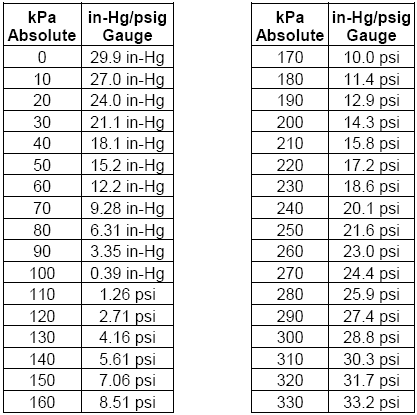
Just use a kPa to Hg conversion chart (see below)...
Also, if you want to keep the SA adder during colder temps, I would recommend zeroing out the SA Coolant Compensation bias and make all of the values 9.84, and just use the one right underneath it, as it is more of a "fixed" adder using an IAT compensation. This one is already zeroed out, but it takes a second to add spark advance during warm up if need be...
You're more in the 15" Hg range though, I am cammed up at 11"....
SA - IAT/CTS or IAT Compensation
Last edited by Street Lethal; Oct 7, 2020 at 04:08 PM.
These. You'll want to max out the PE trigger/enable points, so peg all MAP entries to 100-kPa, and peg all TPS entries to 100%. This will keep you in Closed Loop so the VE Learns can correct a larger portions of the VE table. Remember to put it back to the original settings once completed.
- Rob
Will setting only this at 100 not kill PE ? PE- tps% enable threshold
And disabling DFCO I've just set the temp enable to max.
Just use a kPa to Hg conversion chart (see below)...
Also, if you want to keep the SA adder during colder temps, I would recommend zeroing out the SA Coolant Compensation bias and make all of the values 9.84, and just use the one right underneath it, as it is more of a "fixed" adder using an IAT compensation. This one is already zeroed out, but it takes a second to add spark advance during warm up if need be...
You're more in the 15" Hg range though, I am cammed up at 11"....
SA - IAT/CTS or IAT Compensation
i dont see it, using this data log from this morning or the others i have from a warm start the kpa is 28-30 in P on start up then goes to 37 when putting in gear using the graph above that shows me 18-20 in-HG
50-40 kPa is what I was seeing when I was driving with you a few weeks back during the tuning. Your car is pulling high 11's naturally aspirated, If you really are at 18" Hg in Gear at idle, then you have some set of heads on there to be trapping that high...


 . I didn't think about it being too high but, that makes sense now.